


The minutes of the Reserve Bank of Australia's November meeting revealed the risk of rising inflation, rare policy differences may have raised the threshold for further tightening
The Zhitong Finance App learned that the minutes of the November monetary policy meeting released by the Reserve Bank of Australia on Tuesday showed that most members of the nine-member monetary policy committee voted to raise interest rates two weeks ago because they are concerned that the risks facing the inflation outlook are still biased upward, and consumer prices have been at too high levels for too long.
At the November meeting, the Reserve Bank of Australia's monetary policy committee voted 6-3 to support the interest rate hike, raising the cash interest rate to 4.85%, the highest in 18 years. The minutes of the meeting showed that most members believed that “forward inflationary pressure has increased.” The members assessed that the risks posed by “inadvertently making monetary policy less restrictive” outweigh the risks associated with “inadvertently setting monetary policy too tight.”
Most members also pointed out that the economy continues to show resilience, consumer spending remains stable, and employment is expected to continue to grow. Furthermore, some members expressed concern about rising neutral interest rates, as it meant that monetary policy might not be as restrictive as initially anticipated.
Since this year, the Reserve Bank of Australia has raised interest rates five times in an attempt to cope with the price pressure brought about by domestic production capacity constraints and the global energy shock caused by the US-Iran conflict. The central bank is counting on a slowing economy and a loose labor market to help curb inflation.
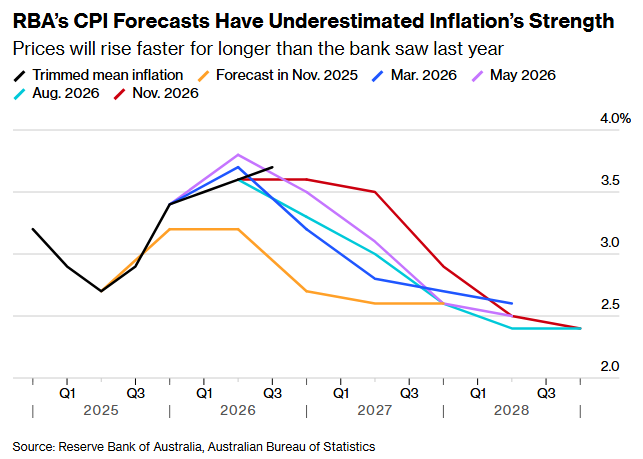
The Reserve Bank of Australia's CPI forecast underestimates how strong inflation is
The minutes of the meeting once again emphasized that all members believe that the current monetary policy is “in an advantageous position” to cope with various developments, and that members will continue to pay close attention to economic data. The minutes of this meeting did not mention the possibility of further tightening monetary policy.
The minutes of the meeting showed that the three members who opposed interest rate hikes paid “slightly less attention” to the risk of upward inflation, while they paid “slightly higher” importance to the downside risk of economic growth. The Reserve Bank of Australia said: “These members have expressed concern that the economy may be close to a tipping point of entering a significantly more severe downturn, and pointed out that this could have costs in terms of unemployment.”
Earlier, it was reported that some committee members had criticized remarks made by Vice President Andrew Hauser last month. At the time, Hauser said, “The outlook for inflation seems to have deteriorated markedly,” and this statement fueled a sharp rise in market bets on interest rate hikes.
The report quoted an anonymous source close to the Reserve Bank of Australia as saying that members of the committee were dissatisfied with Hauser's hawkish remarks because these remarks might force them to raise interest rates, or left the impression that the committee only accepted the full evaluation of the RBA's senior officials and staff.
Hauser later that week refuted claims that his remarks might force the Interest Rate Decision Committee to tighten policy, and denied trying to “interfere with market expectations” through “public statements,” that is, to influence market expectations through tough statements.
Open disagreements within central bank decision-making committees are extremely unusual, reflecting the pressure faced by decision makers. This also shows that the threshold for further tightening monetary policy is high. Most economists and traders expect that the Reserve Bank of Australia will currently suspend interest rate adjustments for a period of time.
Since this year, before the US and Israel launched attacks on Iran and drove oil prices to soar, the Reserve Bank of Australia has been trying to bring the inflation rate back to the target range of 2% to 3%. Even so, the central bank implemented the most aggressive austerity policy in advanced economies this year.
In the latest economic forecast released at the same time two weeks ago, RBA staff expect the overall inflation rate to rise to 4.5% this quarter. This forecast is based on the assumption that the Brent crude oil price will be 109.50 US dollars. Currently, oil prices have fallen below $100, so the Reserve Bank of Australia may be able to prevent inflation from exceeding expectations again, but only if the risk factor of the global situation is still extremely volatile and needs to be taken into account. In fact, the Commission pointed out that its oil price hypothesis included the expectation that oil prices would drop sharply in the next few quarters, and this has not happened since the war broke out at the end of February.