


Why Intel Rose Even Though Profit Fell
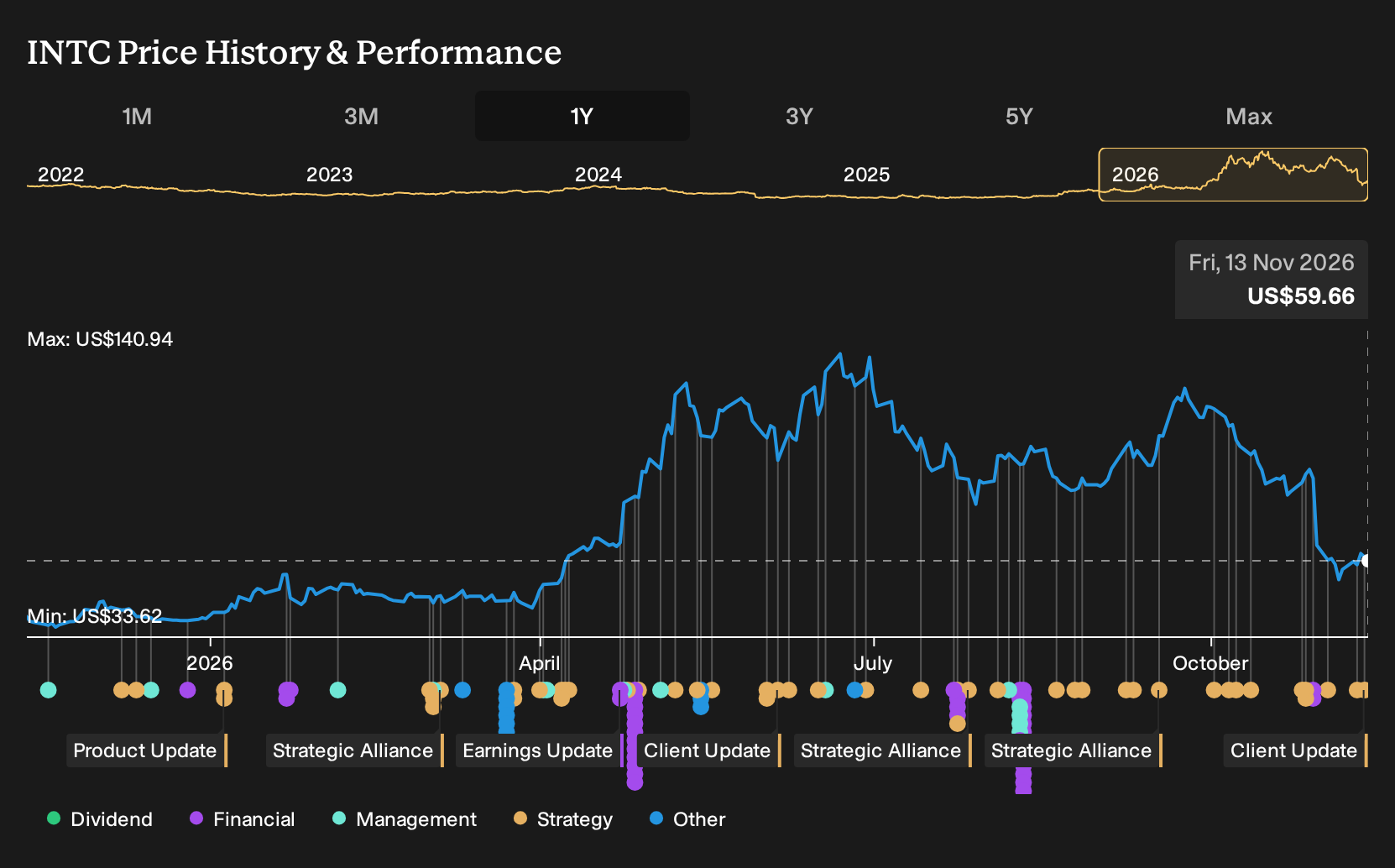
If you only glanced at Intel’s headlines this year, the rollercoaster of AI wins, heavy capex and a sector-wide sell off might not suggest a “quietly rewarding investment.” Investors who held Intel over the past year are up 68.0%, including dividends. If you had bought on 13 November 2025, with analysts split between ambitious EPS recovery and much lower fair values, what exactly were you betting this business could fix, and how fast?
Intel is not the only name tied to this theme. Zero in on 53 AI infrastructure stocks and compare how each one is priced.
What You Would Have Been Weighing Up On Intel
The shares cost US$35.91 at the start of the period. Anyone looking at Intel then had to decide whether recent missteps were a temporary stumble or a lasting drag on the business.
On the bullish side, one argument saw an aggressive product roadmap and a PC rebound driving earnings, with a fair value of US$79 as the price those assumptions implied. That view leaned on revenue growth of 10.0% and a net margin of 22.0% within five years.
The more cautious script pointed to restructuring and AI partnerships helping, but not transforming, Intel’s position, and implied a fair value of US$25.18. In this case the key bet was that revenue grew about 3.5% a year while profit margins recovered only to 7.8%.
What The Evidence Did To The Intel Argument
Intel’s Q2 2026 update, with AI driven data center demand lifting revenue to US$16.1b, gave the optimistic case real support on growth and product traction. The Q3 2026 figures then complicated that story. Revenue moved from US$13,653m in Q3 2025 to US$16,513m in Q3 2026, while net income slipped and net margin fell from 29.8% to 20.1%. The evidence cut both ways.
The useful takeaway is simple. When a thesis leans on margin recovery, as Intel’s bull case did, it is most important to track net margin and profit per share. Only after that should investors focus on top line momentum at the next set of results.
What Intel’s Current Price Already Assumes
Intel now trades at US$59.66 after a 68.0% gain over the past year, while this Narrative’s Fair Value sits below the current price based on its own framework.
According to julio, a Simply Wall St Community investor who wrote the Narrative, the key question is whether Intel can deliver its ambitious manufacturing roadmap without slipping again.
"Intel encountered significant manufacturing delays in years past, and there is no guarantee that it can execute well in its aggressive aspirations to develop five process nodes in four years."
That disagreement has a full argument behind it. → Uncover the lower Fair Value this Narrative argues for
Find Your Own Contrarian Opportunity
The story behind this run has already been told. The next one could be taking shape somewhere else. Where could you start looking before it becomes the headline?
- Company 1 - 38% below our estimate - uses AI enabled freight tools and stricter carrier vetting to tighten safety and claims control.
- Company 2 - 28% below our estimate - expands manufacturing and installation capacity to push higher margin protective films through OEM and dealer channels.
- Company 3 - 33% below our estimate - converts large AI infrastructure contracts and multicloud database deals into subscription based software and services revenue.
Three companies from the same screener. Open the full list of 34 companies trading below our fair value estimates →
Have feedback on this article? Concerned about the content? Get in touch with us directly. Alternatively, email editorial-team@simplywallst.com