


Does Three Segment Reorganization Change The Bull Case For General Mills (GIS)?
- General Mills has outlined a new operating model that takes effect in January 2027, consolidating its businesses into three segments, creating a combined Commercial function, and reshaping senior leadership responsibilities across cereal, snacks, meals, baking, international and pet.
- The reorganization tightens how General Mills links marketing, sales and consumer insights, which could influence how effectively it allocates resources behind brands and channels as it pursues its enterprise transformation plans.
- We will now look at how General Mills’ new three segment structure could reshape the existing investment narrative built around productivity.
Scan how General Mills’ reset compares by lining it up against our curated 29 resilient stocks with low risk scores, which prioritizes balance sheet resilience alongside disciplined capital allocation.
General Mills Investment Narrative Recap
To own General Mills, you need to be comfortable with a slow, productivity led consumer business that is working through earnings pressure while aiming for sizeable cost savings by fiscal 2030. The analyst consensus narrative on Simply Wall St leans on that thesis. The new three segment model and combined commercial function mostly reinforce this story rather than rewrite it.
The near term swing factor is whether management can stabilize volumes after organic net sales and adjusted profit both declined in fiscal 2026, while protecting margins during the US$750 million fiscal 2027 savings push. The biggest risk stays the same. Prolonged weak volumes or further execution missteps could keep earnings and cash flow under strain.
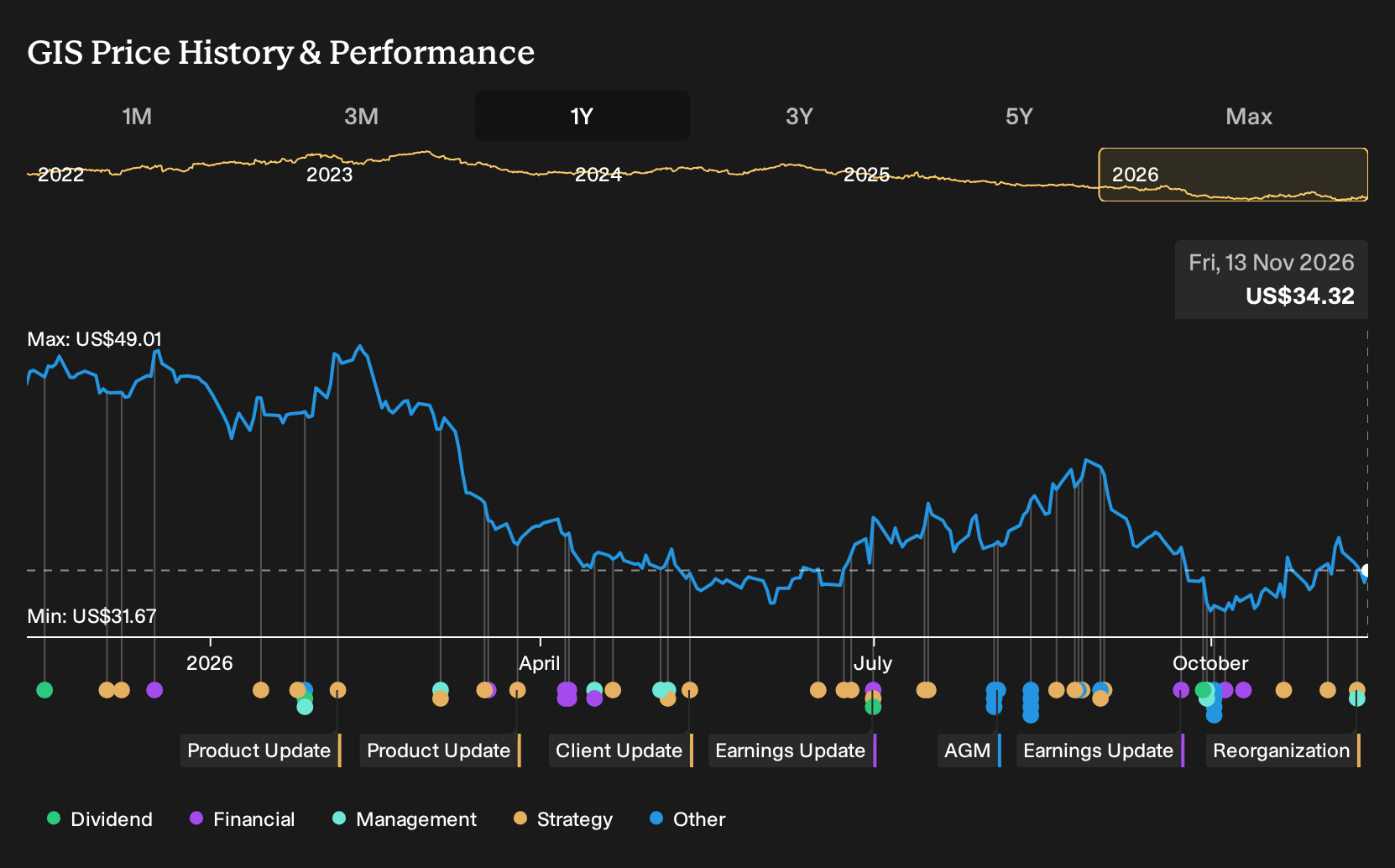
The reorganization lands alongside General Mills’ decision to keep its quarterly dividend at US$0.61 a share while prioritizing debt reduction. That choice goes straight to the risk flagged earlier. Debt is not well covered by operating cash flow and the dividend is not well covered by current earnings.
For you as a shareholder, that unchanged payout framed against a roughly 7% yield and ongoing deleveraging becomes a key watchpoint. It ties directly to the catalyst analysts are focused on: the plan to extract US$3b of savings through fiscal 2030 and return to profitability while revenue expectations are flat. Execution against both the new structure and the balance sheet plan will likely matter more than the org chart headlines themselves.
General Mills’ narrative projects US$17.9b revenue and US$1.8b earnings by 2029. Analysts assume revenue stays broadly flat over the period and expect earnings to move from a loss of US$894.8m today to a profit of US$1.8b, which is an earnings swing of roughly US$2.7b.
Uncover why General Mills' fair value indicates a 7% potential upside to its current price, which could narrow quickly.
Exploring Other Perspectives
Some of the most optimistic analysts frame the new operating model as a potential catalyst, not just a cost story. Before this reset was announced, the bullish camp was already penciling in about US$18.4b of revenue and US$2.1b of earnings by 2029 for General Mills. You can treat those pre news projections as one end of the spectrum and weigh how this leadership and segment shuffle might push expectations in either direction.
Explore 7 other General Mills fair value estimates, including one that suggests as much as 154% upside from the current price.
The Verdict Is Yours
Don't just follow the ticker, dig into the data and build a conviction that's truly your own.
- A great starting point for your General Mills research is our analysis highlighting 2 key rewards and 2 important warning signs that could impact your investment decision.
- See our latest analysis for General Mills. The report includes a comprehensive fundamental analysis summarized in a single visual, the Snowflake, making it easy to evaluate General Mills' overall financial health at a glance.
Looking For More Investment Ideas Beyond General Mills?
If General Mills helps you frame what a mature, productivity focused consumer business looks like, the next step is to compare it with other listed companies that fit different risk and return profiles. The Simply Wall St Screener lets you move from a single stock story to a watchlist of ideas that match your own rules on quality, balance sheets and income.
- If you care most about financial resilience, start with businesses that pair sturdy balance sheets with disciplined fundamentals through the list of solid balance sheet and fundamentals (24 results).
- If value is your priority, broaden your watchlist with opportunities that combine quality fundamentals and what may be undemanding valuations using the 34 high quality undervalued stocks.
- If income is central to your plan, focus on companies that offer higher yields while still aiming to keep payouts supported by their finances by reviewing the 6 dividend fortresses.
Have feedback on this article? Concerned about the content? Get in touch with us directly. Alternatively, email editorial-team@simplywallst.com