


Should Raised 2026 Guidance Require Action From Quest Diagnostics Stock Investors?
- Quest Diagnostics reported third quarter 2026 sales of US$3.097b and net income of US$312 million, along with higher basic and diluted EPS versus the prior year, and also lifted full year 2026 revenue and earnings guidance.
- The earnings update highlighted continued progress on net income and per share profitability. The guidance raise also indicated management confidence in Quest Diagnostics' ability to sustain operational momentum through the rest of 2026.
- We will now look at how Quest Diagnostics' raised full year 2026 earnings guidance could influence the broader investment narrative around the business.
Quest Diagnostics Investment Narrative Recap
To own Quest Diagnostics, you need to be comfortable with a fairly steady testing business that leans on advanced diagnostics, consumer channels, and cost efficiency. The raised 2026 revenue and EPS guidance indicates that management currently sees enough demand and productivity to support higher full year expectations. For near term sentiment, that stronger earnings run rate is the key catalyst.
The biggest near term risk remains pricing and cost pressure. Potential reimbursement cuts and ongoing wage inflation can squeeze margins even when volumes hold up. The latest quarter does not remove that risk. It provides fresher evidence on how well Quest Diagnostics is handling it for now.
The most relevant update is the higher full year 2026 outlook. Net revenue guidance now stands at US$12.065b to US$12.105b and reported diluted EPS at US$10.21 to US$10.31. Those numbers matter because they reset the bar for how efficiently Quest Diagnostics turns its testing footprint and automation efforts into earnings.
For investors, that guidance range is a live reference point against the existing risks around reimbursement, Medicaid and ACA related volume pressure, and higher operating costs. Execution against the new targets, rather than the act of raising them, becomes the catalyst that either reinforces or challenges the current Quest Diagnostics narrative.
What The Long Range Forecast Implies For Quest Diagnostics
Quest Diagnostics' longer term story now ties the near term guidance upgrade to a much bigger set of analyst expectations for the next several years. Instead of just focusing on the next couple of quarters, the consensus tries to map the testing specialist's footprint, margin structure, and capital returns into a 2029 snapshot that investors can measure against today's price.
Analysts are working off a revenue trajectory that assumes 4.8% annual top line growth over the next 3 years. That puts a clear hurdle in place for Quest Diagnostics. The company needs to keep volumes flowing across advanced diagnostics and consumer channels while holding its hospital and physician relationships tight enough that pricing and mix do not erode the projected expansion in profit margins from 9.2% today to 11.0% in 3 years.
The current profit pool matters as the anchor. Consensus points to earnings today of about US$1.1b, with a path to US$1.5b and earnings per share of US$12.95 by around October 2029. That implies an earnings step up of roughly US$400m. For readers, that is a simple way to frame it. The Quest Diagnostics investment case on these numbers assumes the business can add roughly one third more net profit over the next few years while absorbing reimbursement pressure and higher wages.
Analysts do not just stretch the income statement. They factor in a modest decline in the share count, with an expected reduction of 0.78% per year for the next 3 years. Fewer shares, if achieved, would spread that US$1.5b earnings pool over a smaller base, which is why the projected EPS sits meaningfully above current levels. For investors, the question is less about financial engineering and more about whether core operations and automation programs can support that higher earnings output.
On valuation, the consensus view connects these operating assumptions to what investors might be willing to pay for those future profits. The Simply Wall St report notes that analysts are working with a required P/E of 23.1x on the 2029 earnings estimate, down from about 25.4x today. That multiple is described as lower than the current P/E for the broader US Healthcare group at 25.6x, which suggests the scenario does not require a richer rating than peers. Instead, the framework leans on execution within Quest Diagnostics and a discount rate of roughly 7.2% to 7.24% to bring those 2029 cash flows back to present value.
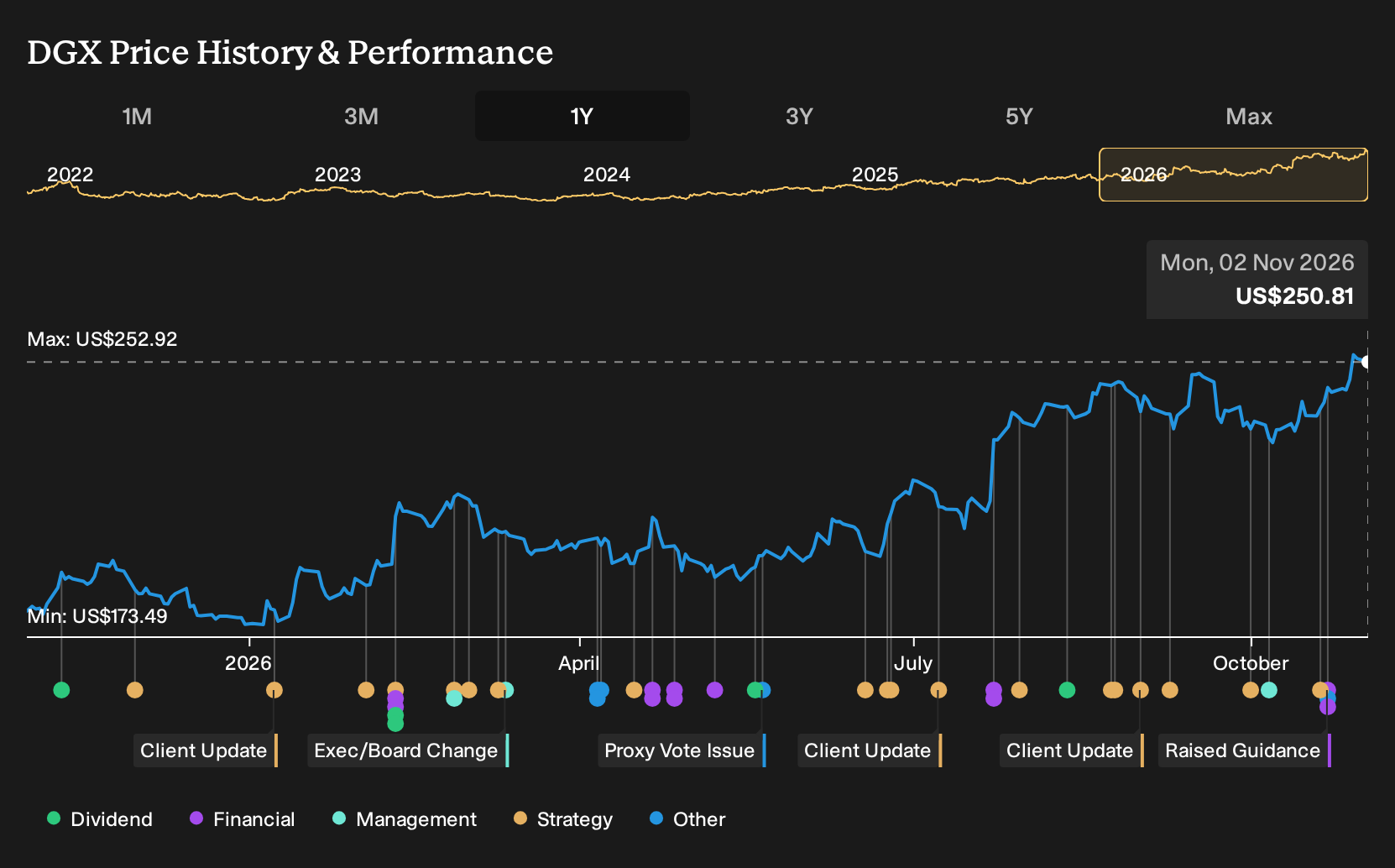
The result of that exercise is a consensus price target of US$253.73. With the shares recently trading around US$243.28, the gap sits at 4.1%. That modest spread signals that, on average, analysts see the stock as roughly in line with their expectations. For you, that framing can be helpful. The current price already reflects a good chunk of the projected revenue growth, margin gains, and earnings expansion that the Quest Diagnostics story depends on.
Quest Diagnostics' narrative projects US$13.3b revenue and US$1.5b earnings by 2029. This setup assumes 4.8% yearly revenue growth and an earnings increase of about US$400m from US$1.1b today.
Behind the price target there is also an explicit revenue anchor. Consensus expects Quest Diagnostics to reach about US$13.3b in annual revenue by 2029 alongside that US$1.5b earnings figure. That pairing is what needs to line up with your own view. If you think reimbursement cuts, ACA and Medicaid related volume pressure, or higher operating costs will bite harder than the analysts expect, then the current fair value estimates may look optimistic. If you see more durable demand for advanced diagnostics, consumer wellness, and Co Lab partnerships than the market is currently discounting, the same numbers may look conservative.
All of these projections hinge on the same core tension already visible in 2026. Quest Diagnostics is investing in automation, AI tools, and lab productivity projects that are intended to unlock roughly 3% annual cost savings. The consensus assumes those programs continue to offset wage inflation and project spending such as Nova. If that balance tilts the wrong way, operating margin could struggle to reach the anticipated 11.0% level and the forecast earnings profile would need to be revisited.
The discount rate assumption of around 7.2% to 7.24% also carries weight in the background. It sets the hurdle for how investors compare Quest Diagnostics to other healthcare stocks and to lower risk assets. A higher perceived risk profile would lift that rate and reduce the present value of the 2029 cash flows. A lower perceived risk would do the opposite. While you do not need to model this formally, it is worth keeping in mind when you compare the consensus fair value to your own sense of acceptable return.
As with any forecast stretching several years ahead, the key for readers is not to treat the US$13.3b revenue and US$1.5b earnings targets as fixed. Treat them as a scenario that spells out what needs to go right on pricing, test volumes, consumer health traction, and cost control. Then decide whether the current Quest Diagnostics share price leaves enough room between that scenario and your preferred margin of safety.
Uncover why Quest Diagnostics' fair value indicates Quest Diagnostics is roughly in line with its current price.
Exploring Other Perspectives
Simply Wall St Community members have only two fair value estimates here, from US$253.73 up to a much richer US$377.13, so you are dealing with a wide spread of opinions on Quest Diagnostics. Factor that in alongside reimbursement and wage pressures on one side, and consumer testing and automation catalysts on the other, then judge which narrative you trust.
Explore another Quest Diagnostics fair value estimate, including one that suggests it could be worth just $253.73.
Decide For Yourself
Don't just follow the ticker. Dig into the data and build a conviction that's truly your own.
- A great starting point for your Quest Diagnostics research is our analysis highlighting 4 key rewards and 1 important warning sign that could impact your investment decision.
- See our latest analysis for Quest Diagnostics. The report includes a comprehensive fundamental analysis summarized in a single visual, the Snowflake, making it easy to evaluate Quest Diagnostics' overall financial health at a glance.
Looking For More Investment Ideas Beyond Quest Diagnostics?
Once you have a view on Quest Diagnostics, it can help to widen the lens and compare it with other businesses that match your risk profile and return goals. The Simply Wall St Screener lets you scan the market quickly using fundamentals that matter to you, then narrow that down to a focused watchlist.
- If capital preservation and balance sheet resilience are high on your list, start with a 29 resilient stocks with low risk scores that score well on financial strength and lower risk profiles.
- If you want potential mispricings backed by solid fundamentals, filter for companies trading below estimated value using a 34 high quality undervalued stocks that combines quality with attractive pricing.
- If income is a priority, check out a 4 dividend fortresses that aim to pair higher yields with supporting cash flows and coverage metrics.
Have feedback on this article? Concerned about the content? Get in touch with us directly. Alternatively, email editorial-team@simplywallst.com