


12 stock options on the Hong Kong Stock Exchange were listed on November 9, and weekly and monthly rights were sold on the same day
The Zhitong Finance App learned that the Hong Kong Stock Exchange will add 12 new stock option categories on November 9. The first batch of listings will simultaneously provide both weekly and monthly contracts. In addition to this batch, the number of weekly stock options on the Hong Kong Stock Exchange increased to 66 listed companies and ETFs.
In the first nine months of this year, the average daily turnover of Hong Kong stock options was 899,056, 1.4% more than the same period last year, reaching a record high for the same period. Zhou Quan, which was only launched in November 2024, has sold more than 51 million copies, accounting for about 20% of related product transactions. Chen Yiting, CEO of the Hong Kong Stock Exchange Group, said in the CEO blog on October 12 that 38 weekly stock options have been added from the beginning of the year until now, and 12 more short-term products and themed futures options will be introduced later.
All 12 are new categories, and there were no options before
These 12 original shares had no options on the Hong Kong Stock Exchange before, so this is a new option category. It's not about adding a week's interest to anyone's monthly options. The Hong Kong Stock Exchange issued two new market codes specifically for them. 143 tubes expire monthly and 145 tubes expire weekly.
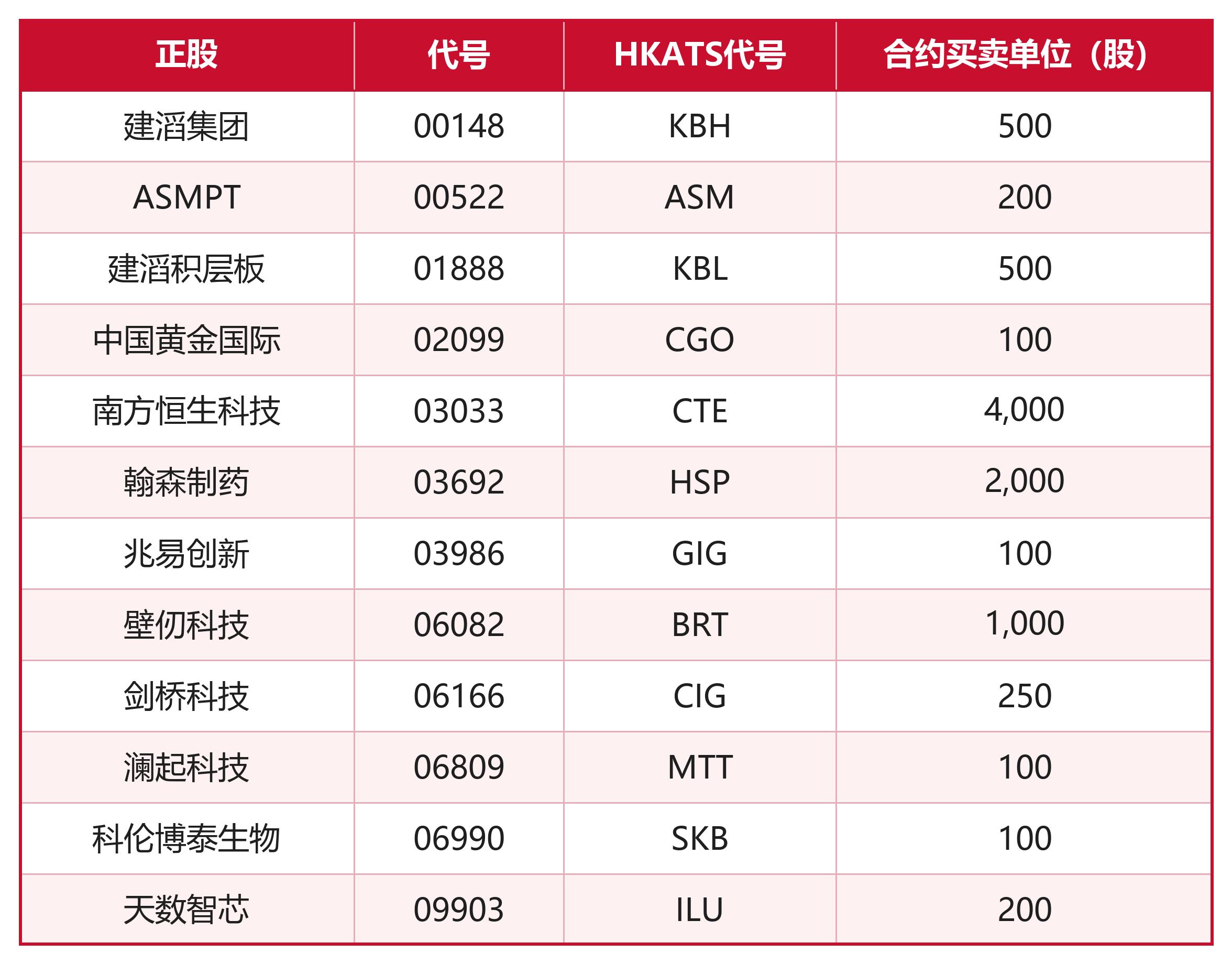
According to the original shares, chips and technology hardware account for half: ASMPT (00522), Zhaoyi Innovation (03986), Bijiao Technology (06082), Cambridge Technology (06166), Lanqi Technology (06809), and Tianshu Zhixin (09903). Two innovative drugs, Hanson Pharmaceuticals (03692) and Collumbotai Biotech (06990). Materials and three pieces of gold: Jiantao Group (00148), Jiantao Laminate (01888), and China Gold International (02099). Another ETF is Southern Hang Seng Technology (03033).
The contract unit is quite similar. Southern Hang Seng Technology has 4,000 shares, Hanson Pharmaceuticals 2000 shares, Bizao Technology 1,000 shares, ASMPT and Tianshu Zhixin 200 shares each, Cambridge Technology 250 shares, and the rest is between 100 and 500 shares:
The Hong Kong Stock Exchange is not looking at who has a large market capitalization. In November 2024, the first batch of ten stocks were given to big blue chips such as Tencent, Ali, Meituan, and HSBC. The goal was liquidity. From this year to now, 38 have been added, which is clearly biased towards themed stocks.
Of these 12, only 6 are on the AI computing power chain. 2 are only the main characters authorized to go overseas for innovative drugs this year, and 3 are following the price of gold. The reason for picking them is actually simple: the underlying stock fluctuates enough. Options are a bilateral quotation business. The original stock is a ticket that doesn't move much from day to night, and no one wants to quote it even when using options.
Zhou Quan is not only able to live for a week
Zhou Quan is most likely to be misunderstood as a short-term product that “expires after one week.” In fact, “weekly” refers to the frequency of expiration, not the life span of a product.
A new weekly contract is usually due out this Monday and expires next Friday, and the current week and next week at the same time. What you can buy on the first day of November 9 is the two expiration dates November 13 and November 20. When the one on the 13th expires, the one on the 20th will rise and become the current week. On the same day, a new contract for next week will be placed, and it will roll down week by week. As long as this stock is still on the list, this product can always be traded.
On the monthly contract side, the expiration months are scheduled to be November and December 2026 and January, February, March, June, and September 2027. It's not every month; it's the most recent month plus the quarter month. The furthest you can see is September next year.
One detail is easy to miss: if the expiration date of a week's weekly rights collides with the monthly subscription, that week's share won't matter. The two contracts don't expire on the same day.
Division of labor between the two contracts
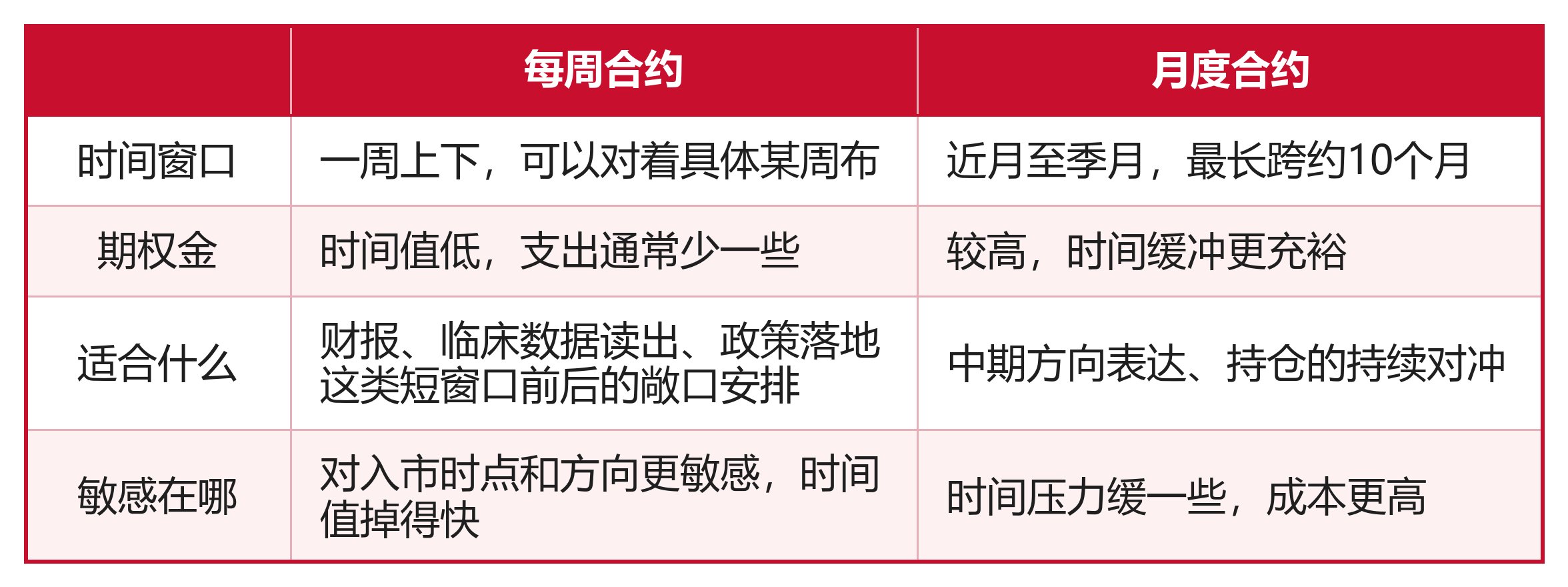
According to the Hong Kong Stock Exchange, weekly power “does not replace monthly options, but rather provides investors with more flexible options when deployment timing is particularly important”.
In actual use, there are only two differences: how long it takes to cover and how much it costs. I just want to cover one incident. For example, the clinical data of an innovative drug will be released next Wednesday. The right to buy is appropriate. Once the incident is over, it will naturally end, so there is no need to worry about a monthly subscription with three weeks remaining. Conversely, if you want to protect a stock position ready to be obtained in the first quarter of next year, you will have to move your position every week if you use weekly shares. Adding up to a dozen options is not necessarily cheaper than a quarterly contract.