


The Bank of England's interest rate hike on Thursday is a foregone conclusion. How many more increases will follow? The differences between the market and economists are clear
The Zhitong Finance App learned that as the UK's inflation rate approaches 4% and the war in Iran still shows no sign of ending, the Bank of England's interest rate hike on Thursday has almost been seen as a foregone conclusion. However, there are clear differences between economists and investors as to how many times the Bank of England will raise interest rates in the future.
Under the first scenario, after completing the first rate hike since 2023 this week, the Bank of England will raise interest rates three more times before the end of next summer. The UK economy remains resilient, the labor market stabilized, and the energy shock worsened in recent weeks, forcing the Monetary Policy Committee to raise bank interest rates to at least 4.75% — a result that has been priced in the money market since early September.
Another scenario — and economists' consensus — points to a 4% rate hike this week, followed by a 50% chance of raising interest rates again in the first quarter of 2027. Underpinning this judgment is that there are signs that consumers are starting to tighten spending, and there is currently little evidence that energy shocks are triggering a price feedback cycle.
If policymakers oppose long-term austerity policies, UK government bonds are likely to rise, particularly short-term varieties with yields that have hit a three-year high. Another possibility is that the Bank of England is making investors wait for more clear signals about future interest rates, as current market pricing is helping households and businesses fight inflation by driving up borrowing costs.
There is a clear discrepancy between market pricing and economists' predictions
“People have always anticipated a fall in energy prices and made inflation and bank interest rate forecasts based on this,” said Paul Dales, chief British economist at KITU Macro. “That's why economists generally don't think there will be too many rate hikes and expect interest rates to fall back. But we're in an environment where if energy prices stay at current levels for another six months or so, interest rates are likely to be higher.”
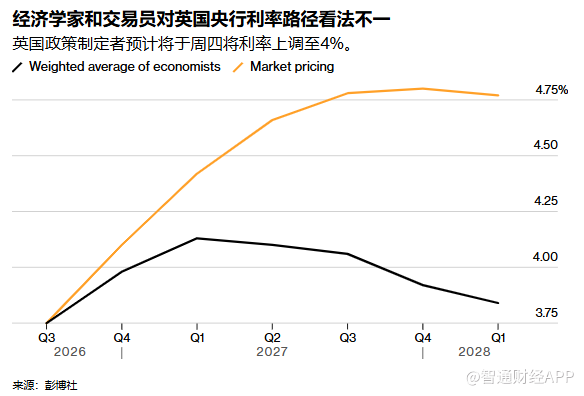
Bank of America strategists pointed out that there is a 0.55 percentage point gap between market pricing and the bank's economists' predictions of bank interest rates, which is one of the biggest gaps among major economies.
The Bank of England has said that investors are demanding compensation due to rising risk in interest rate prospects, which partly explains the intensity of the market curve. But even Hugh Peel, one of the Bank of England's most hawkish policymakers and chief economist, warned that he was “skeptical” about the need for four hikes.
Interest rate strategists at Bank of America and Citigroup attribute this gap to the following risks: energy prices continue to rise, the Iran war shows no sign of ending, and the UK economy continues to be stronger than expected. GDP unexpectedly grew for the third month in a row in August, indicating that the third-quarter expansion far exceeded the Bank of England's forecast of 0.1% in July.
Elias Haddad, head of global market strategy at Brown Brothers Harriman, said that this made the Bank of England's communication on market pricing and its corresponding forecasts for inflation and the UK economy “the key to evaluating the room for interest rate hikes after this week.”
Bank of America strategist Mark Capleton and others said that if “excessive” market pricing is fought back, the British curve may “steepen the bull market”, that is, short-term bond yields will drop more compared to the long term.
A “no surprise” decision
After British Chancellor of the Exchequer John Healy's first budget was largely digested by the market last week, the Bank of England probably hopes that this decision will not come as a surprise. As the market anticipated that the Bank of England would raise interest rates several times, financial conditions tend to be tight, allowing the Bank of England to stand still and lag behind the Federal Reserve and the European Central Bank in policy action.
However, policymakers are aware that expectations will ultimately require action to support or recalibrate. Bank of England Governor Andrew Bailey once threw cold water on the market in spring, when traders raised interest rates as many as four times.
Both Bailey and Vice President Sarah Briden pointed out that there are signs that companies are cutting costs to deal with energy shocks rather than passing price increases on to consumers. And this happened even before the Bank of England last week announced an unexpected dovish investigation into private companies.
In the context of consumer pressure, many companies have found it difficult to raise prices, and so far, few of the executives surveyed plan to raise wages next year to cope with the impact of inflation, which indicates that the second-round effect is still limited.
“The Monetary Policy Committee is likely to strike back at market pricing moderately,” said Dani Stoilova, an economist at BNP Paribas. Policymakers “may use the tightening of UK financial conditions and limited evidence of second-round effects to justify taking a less aggressive path.”