


What PepsiCo (PEP)'s Taco Bell Renewal Means For Shareholders
- In October 2026, PepsiCo and Taco Bell renewed their long running U.S. beverage partnership for 11 years and extended global collaboration across Canada, the U.K., Ireland and Thailand, keeping exclusives like Mountain Dew Baja Blast and Baja Midnight on Taco Bell menus.
- This extended deal, combined with PepsiCo’s push into crafted, functional and energy drinks, deepens its reach into foodservice channels while targeting Gen Z and new morning and afternoon beverage occasions.
- The focus now turns to how PepsiCo's Taco Bell renewal, particularly its functional and energy drink push, could influence the investment narrative.
Scan how PepsiCo’s foodservice push compares with other defensives by reviewing the hand picked 29 resilient stocks with low risk scores that may offer similar resilience with different risk profiles.
PepsiCo Investment Narrative Recap
To own PepsiCo, you need to be comfortable with a slow and steady story built on everyday brands, strong international exposure and a big commitment to productivity. The Taco Bell renewal fits that picture but does not change the near term swing factor, which is whether PepsiCo can keep margins steady as input costs stay elevated into early 2027.
The sharper risk remains on costs and capacity. PepsiCo is closing plants and pushing hard on efficiencies at the same time that it leans on pricing in chips, sodas and dips. If cost cuts bite too deeply into future service levels, North America beverages could struggle to recover and earnings could disappoint.
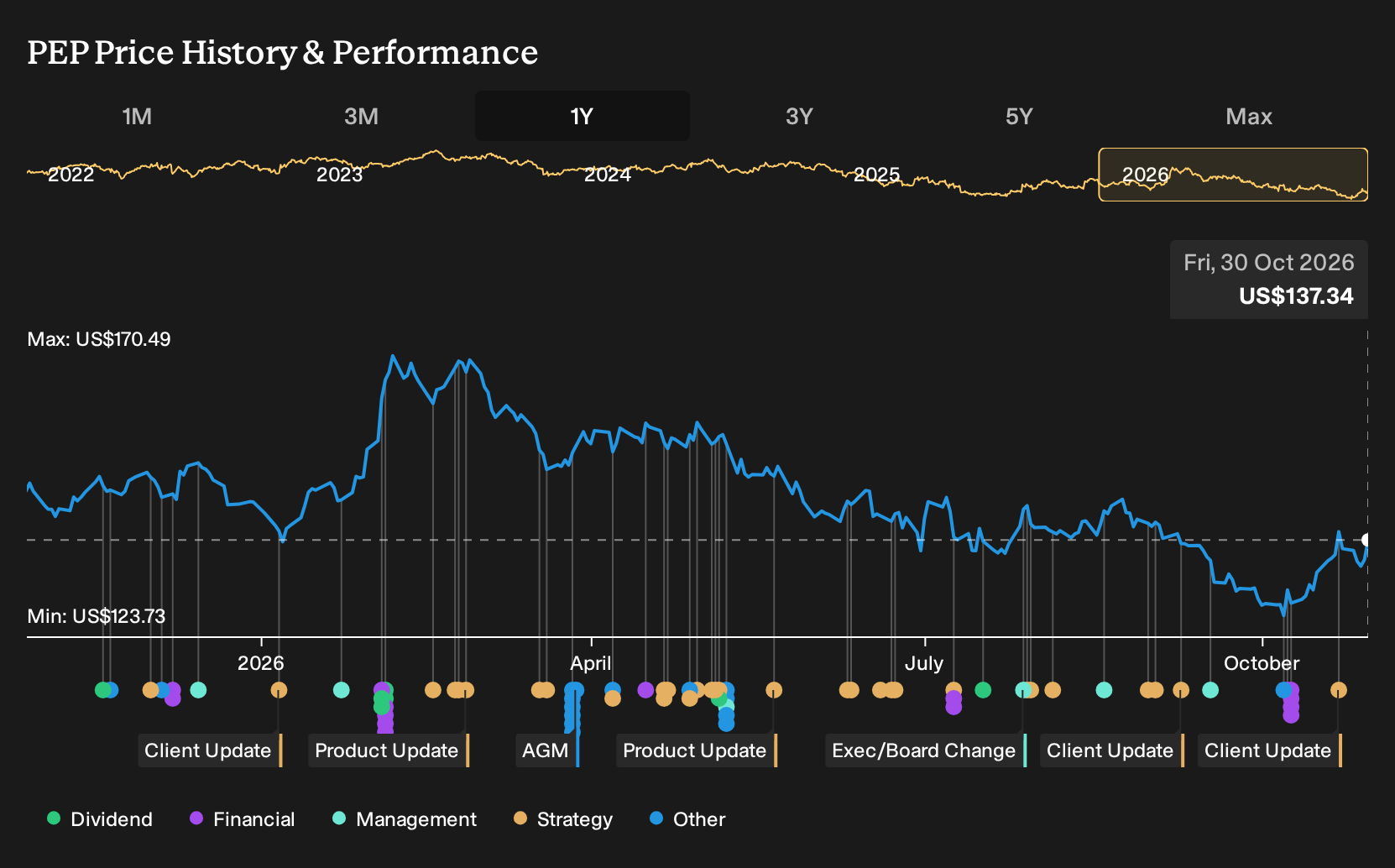
The recent focus on PepsiCo within the Invesco S&P Ultra Dividend Revenue ETF (RDIV), where it accounts for about 5.06% of assets, underlines how closely income oriented investors watch this business. A high and historically reliable 4.31% dividend sits alongside a stock that has lagged both the US market and US beverage peers over the past year.
For you, the link back to the Taco Bell deal is about execution and staying power. A long dated foodservice agreement may help underpin volume and cash flows as PepsiCo works through One North America integration, refranchising and technology rollouts. The risk side is that debt levels remain high, so missteps on productivity or further margin pressure would leave less room for error around that dividend story.
What PepsiCo's Analyst Numbers Assume
Analysts are effectively asking you to judge whether PepsiCo can keep turning incremental cost work and brand extensions like functional drinks into steadier earnings by the end of the decade. The Taco Bell partnership renewal feeds straight into that question because it ties a long shelf life foodservice channel to what is already a fairly tight earnings script.
Consensus forecasts point to modest expansion rather than a step change. Revenue is modeled to grow by 2.7% a year over the next three years, with profit margins nudging from 11.1% today to 11.5% by around 2029. On those numbers, earnings are expected to rise from US$10.9b today to US$12.3b by the 2029 financial year, a gain of about US$1.4b that needs cost discipline, steady pricing and no major missteps on plant closures or refranchising.
To make those assumptions line up with current Wall Street targets, the stock would trade on a P/E of 19.2x those 2029 earnings compared with 16.8x today. That multiple would still sit below the current 28.1x P/E ascribed to the wider GB beverage group. The gap leaves room for the view that PepsiCo is a lower growth, more income anchored beverage and snacks business, where slower revenue progress is accepted in return for perceived stability and a long payment record.
The forecast also bakes in a slow reduction in share count, with analysts expecting the number of shares outstanding to edge down by 0.34% per year over the next three years. That sort of shrink, if it happens, could help earnings per share grow a touch faster than total profit. This matters if operating trends in North America beverages stay subdued and more of the heavy lifting has to come from international markets and permissible snacks.
On the cash flow side of the story, the Simply Wall St model uses a 7.24% discount rate to pull those future streams back to today. A discount rate at that level reflects an assumption that PepsiCo continues to function as a relatively lower volatility consumer staple with meaningful debt, steady but unspectacular top line expansion, and an investor base that tends to focus on dividends and capital returns rather than quick share price moves.
PepsiCo's narrative projects US$106.4b revenue and US$12.3b earnings by 2029. This rests on 2.7% yearly revenue growth and about US$1.4b earnings increase from US$10.9b today.
Uncover why PepsiCo's fair value indicates a 3% potential upside to its current price before that discount narrows.
Exploring Other Perspectives
Fifteen fair value estimates from the Simply Wall St Community span roughly US$116 to US$273, so retail opinions on PepsiCo’s worth range widely. That spread meets a backdrop of cost inflation, plant closures and health regulation risk on one side, and the renewed Taco Bell partnership plus functional drinks push on the other. Investor views can differ sharply, so it makes sense to explore several of these community forecasts before forming a stance.
Explore 14 other PepsiCo fair value estimates, including one that suggests potential upside of up to 99% from the current price.
Reach Your Own Conclusion
Disagree with existing narratives? Extraordinary investment returns rarely come from following the herd, so go with your instincts.
- A great starting point for your PepsiCo research is our analysis highlighting 3 key rewards and 1 important warning sign that could impact your investment decision.
- See our latest analysis for PepsiCo. The report includes a comprehensive fundamental analysis summarized in a single visual, the Snowflake, making it easy to evaluate PepsiCo's overall financial health at a glance.
Looking for more PepsiCo investment ideas?
If PepsiCo sits at the income and resilience end of your watchlist, it can help to compare it with other businesses that share similar traits or offer a different mix of growth, balance sheet strength and yield. The Simply Wall St Screener gives you quick ways to surface stocks that fit what you care about most.
- If capital preservation and a smoother ride matter to you, scan a curated set of resilient candidates through the 29 resilient stocks with low risk scores for a clearer view of potential lower risk options.
- For readers who want quality at a fair price, sort through the 36 high quality undervalued stocks and see which businesses currently combine solid fundamentals with discounted valuations.
- If income is central to your plan, focus on higher yielding payers by reviewing the 5 dividend fortresses that could complement PepsiCo's dividend profile in your portfolio.
Have feedback on this article? Concerned about the content? Get in touch with us directly. Alternatively, email editorial-team@simplywallst.com