


3 Midstream Stocks With Fee Based Cash Flow as LNG Canada Expands
Global energy infrastructure is quietly reshaping itself as LNG Canada attracts fresh capital, balance sheets adjust and long-life pipelines and export projects lock in multi decade cash flow potential. Investors who ignore this shift risk missing where some of the more durable fee-based earnings could sit in future portfolios. This article explains how that news affects three LNG and midstream stocks exposed to these developments.
The stocks covered below are just a sample, and the full screen surfaced 13 more global listed energy infrastructure companies with LNG, pipeline and export terminal exposure that carry equally detailed stories. To size up that broader opportunity set, head straight into the Global Listed Energy Infrastructure (LNG & Midstream) screener to identify, compare and analyze the highest conviction ideas.
Keyera (TSX:KEY)
Overview: Keyera is a Calgary based midstream company that gathers and processes natural gas, then transports, stores and markets NGLs linked to LNG and pipeline infrastructure.
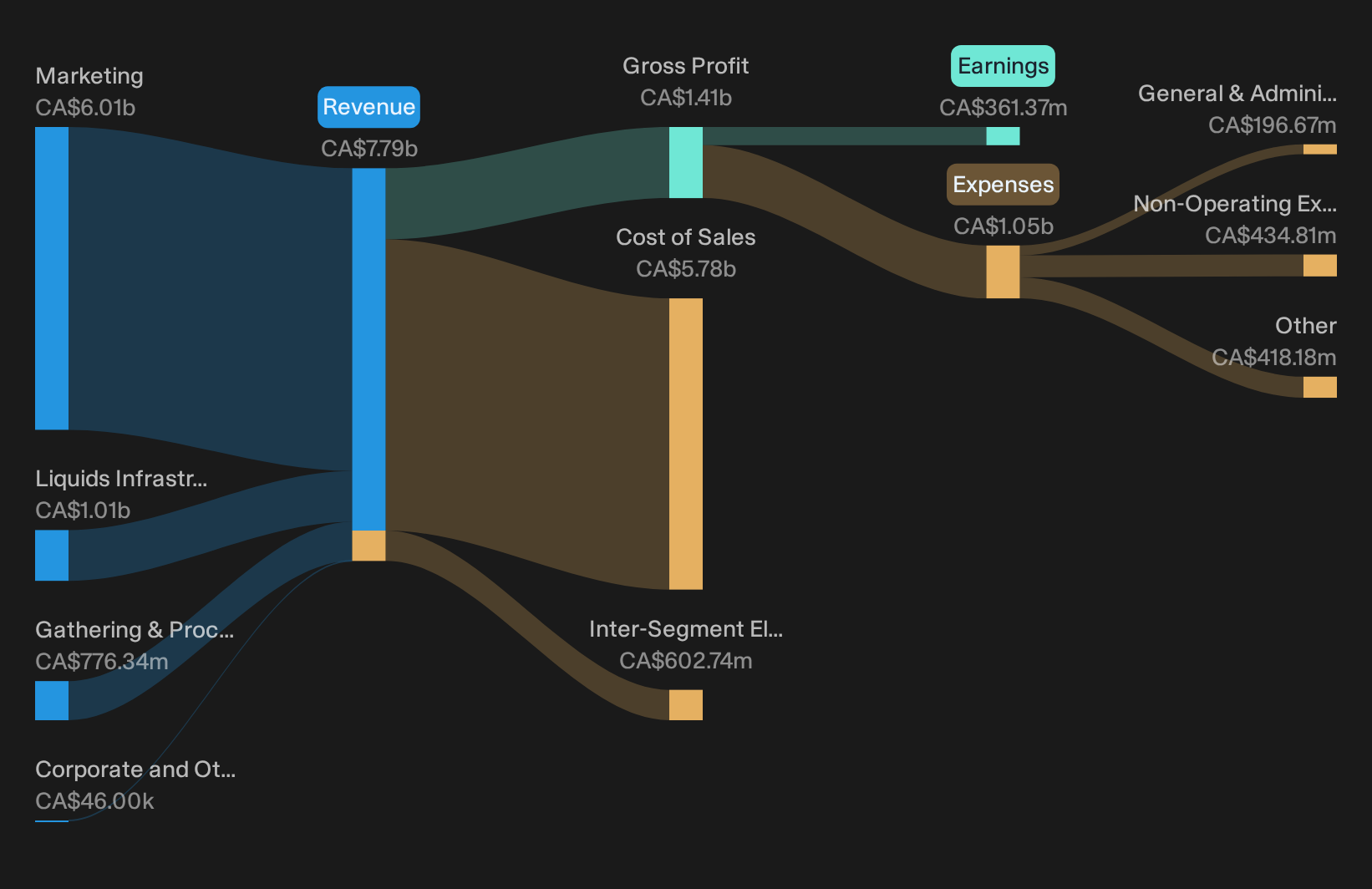
Operations: Keyera generates about CA$6.0b from Marketing, CA$1.0b from Liquids Infrastructure and CA$776 million from Gathering & Processing, with around CA$5.7b from Canada and CA$1.5b from the U.S.
Market Cap: CA$16.3b
Keyera matters for this LNG and midstream screen because its pipes, plants and storage caverns sit directly in the path of gas and NGL flows tied to Canadian export ambitions.
"Expansion of LNG export capacity and growth in petrochemical and oil sands activity in Canada continue to underpin expectations for higher natural gas and NGL throughput across Keyera’s integrated system, which can support fee-based revenue and earnings growth over time.
The real swing factor is how one pressure on funding and payout decisions eventually feeds through to the cash flow per share you care about.
That pressure on funding decisions is exactly what full narrative for Keyera unpacks, showing how Keyera’s capital choices could accelerate or quietly cap future cash flow momentum.
Pembina Pipeline (TSX:PPL)
Overview: Pembina Pipeline runs pipelines, storage, processing and export facilities that move crude oil, natural gas and NGLs, tying Western Canadian production into LNG linked and global energy infrastructure.
Operations: Pembina Pipeline generates about CA$3.5b from Pipelines, CA$1.2b from Facilities and CA$4.3b from Marketing & New Ventures, partly offset by CA$1.0b of eliminations.
Market Cap: CA$41.7b
Pembina Pipeline matters for this LNG and midstream screen because its pipelines, fractionation plants and export links turn Western Canadian gas and liquids into long-haul, fee-based transport and global seaborne flows.
"Ongoing build out of large, fee-based projects such as Cedar LNG, the Greenlight Electricity Centre and the Heartland Extraction Plant keeps Pembina Pipeline deploying capital into assets that are expected to add contracted EBITDA once in service. This would support future revenue and cash flow growth.
The real tension for Pembina Pipeline is how one unresolved constraint on those big project economics ultimately shapes the margin profile you rely on.
That margin question is exactly what the full narrative for Pembina Pipeline unpacks, showing where project returns could accelerate, stall, or be quietly reshaped by contract structure and capital choices.

Gibson Energy (TSX:GEI)
Overview: Gibson Energy gathers, stores and processes liquids and refined products through terminals, pipelines and rail facilities, giving investors midstream-style infrastructure exposure.
Operations: Gibson Energy generates about CA$12.4b from Marketing and CA$712 million from Infrastructure, mainly across Canada and the United States.
Market Cap: CA$5.9b
Gibson Energy fits this LNG and midstream screen because its tank farms, pipelines and rail connections earn fees on moving hydrocarbons rather than relying on commodity prices.
"Growing activity around Canadian pipeline egress, including new market access announcements, has already increased producer interest in storage and pipeline solutions. Management reports more inbound tank inquiries and short term tank contracting, which together point to future opportunities for incremental tankage, higher facility utilization and associated fee based revenue and earnings."
The appeal of Gibson Energy now largely depends on how one relatively quiet capital allocation decision influences future cash coverage and potential expansion.
That quiet decision is exactly what the full narrative for Gibson Energy unpacks, revealing where Gibson Energy’s cash coverage, expansion capacity and risk profile may be quietly decoupling from headline volumes.

Seeking Alternatives Beyond LNG Midstream?
Fresh ideas move first. Once momentum hits, ideal entry points get caught in the rush and pricing power starts slipping away. Scan under the radar for now and act now.
- Hunt for cash generative outliers with the 3 high quality undervalued stocks while they still trade as if the story has not caught up to the fundamentals.
- Target durable income payers through the 3 dividend fortresses before demand for higher yields sends these steady distributions higher on investors’ priority lists.
- Track the picks supporting electrification with the 42 power grid technology and infrastructure stocks while infrastructure demand is building and the best positioned operators are still largely overlooked.
Have feedback on this article? Concerned about the content? Get in touch with us directly. Alternatively, email editorial-team@simplywallst.com