


Learn Why The Bull Case For Vail Resorts Stock Could Change Following Proxy Fight
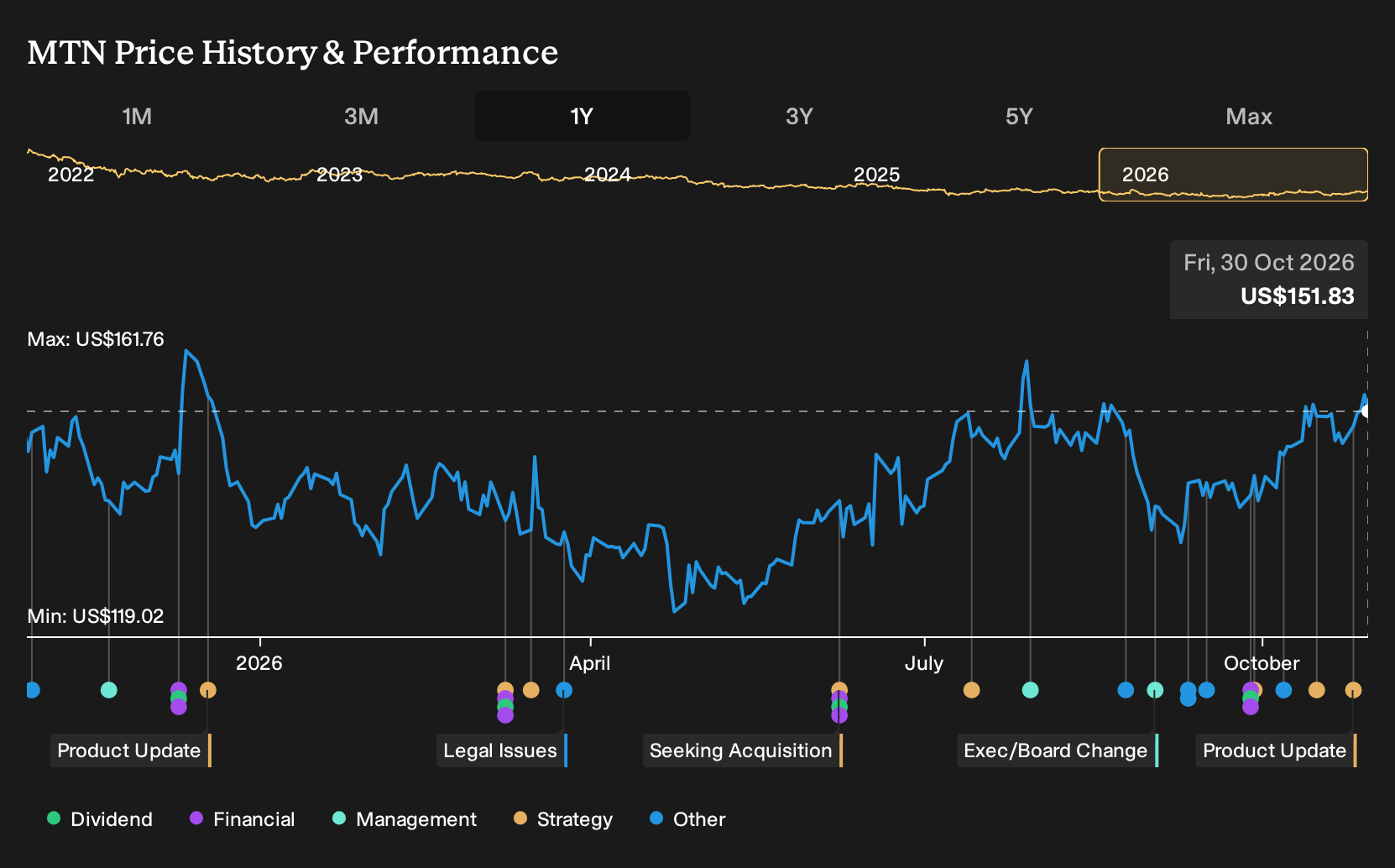
- Vail Resorts reported in October 2026 that it filed a definitive proxy statement, urging shareholders to back all nine board nominees while highlighting progress in guest satisfaction, digital initiatives, and its Resource Efficiency Transformation Plan.
- The proxy fight with Oasis Management and other shareholders places Vail Resorts’ cost savings program, Epic Experience rollout, and capital allocation priorities directly under investor scrutiny.
- The focus now turns to how this proxy battle over board control and strategy may reshape Vail Resorts’ broader investment narrative.
Scan how Vail Resorts’ proxy battle playbook compares with other capital intensive operators by lining up potential peers using list of solid balance sheet and fundamentals (24 results).
Vail Resorts Investment Narrative Recap
For you to stay interested in Vail Resorts, you need to believe the business can keep improving guest loyalty and earnings quality while managing weather risk, debt, and a dividend that is not fully covered by current cash flows. The board is pitching its cost savings and Epic Experience investments as the path to more stable margins despite softer Epic pass demand.
The near term swing factor is whether operational execution, including timing of openings and guest experience, offsets any pressure from later season visits and weaker advance commitments. The largest risk remains a repeat of very poor snow combined with high leverage, which management has linked to potential dividend pressure.
The food and après ski upgrades for the 2026/27 season tie directly into that near term thesis. If diners perceive better value through improved menus at inflation level pricing and new experiences such as Vail Ice Bar or Whistler Blackcomb's Caviar and Champagne, that supports the story of Epic Experience driving higher on mountain spend and repeat visits.
For investors watching catalysts, this rollout is an operational proof point that sits alongside the Epic app and My Epic Gear. The practical question is whether these guest focused moves help offset risks from weather, foreign exchange and leverage, and whether they translate into steadier resort EBITDA through a potentially choppy season.
Vail Resorts Earnings Setup Behind the Proxy Battle
Vail Resorts’ proxy contest is unfolding against an earnings framework that analysts have already mapped out in some detail. The current profit figure sits at about US$147.5 million, with consensus pointing to earnings of roughly US$269.9 million by 2029. That implies an earnings increase of roughly US$122 million from today’s level, which is a material step up that activists and the incumbent board are effectively arguing over how to deliver.
Revenue expectations form the other half of that picture. Forecasts call for the top line to grow by 4.5% per year over the next three years, supported by higher assumed margins that move from 5.2% to 8.3% over the same period. Put simply, analysts are not just counting on Vail Resorts to bring in more skier visits and ancillary spending. They are also baking in a better conversion of that activity into bottom line profit.
The numbers behind the current valuation framework make the boardroom dispute more concrete for you as a shareholder. The analyst set-up ties the story together as follows. By 2029, revenues are projected at about US$3.2b and earnings at roughly US$269.9 million. That forecast sits alongside a P/E ratio of 25.9x on those future earnings, compared with about 36.9x today and against an industry P/E of roughly 19.9x in US hospitality.
All of this matters because the proxy materials effectively ask you to decide whose plan is more likely to get anywhere near those assumptions. Management points to the Resource Efficiency Transformation Plan, Epic Experience spending and digital products as the drivers that could help close the gap from today’s US$147.5 million in earnings. Activist proposals around asset sales, cost cuts or different capital pacing reflect a different route to the same problem, which is how to support the earnings profile implied by the current analyst models without stretching the balance sheet.
Vail Resorts’ outlook currently embeds forecast revenue of about US$3.2b and earnings of roughly US$269.9 million by 2029. That path assumes roughly 4.5% yearly revenue growth and an earnings increase of about US$122 million from current earnings of US$147.5 million.
Uncover why Vail Resorts' fair value indicates that it is in line with its current price.
Exploring Other Perspectives
One alternative view focuses on Vail Resorts’ resort reported EBITDA target for fiscal 2027. Bullish analysts who were penciling in roughly 6% yearly revenue growth and about US$303.1 million in 2029 earnings before this proxy fight saw that guidance as underappreciated. You can treat this boardroom clash as a live test of that more optimistic script and decide whether those pre news assumptions still hold up.
Explore 2 other Vail Resorts fair value estimates, including one that suggests as much as 54% upside from the current price!
Decide For Yourself
Disagree with existing narratives? Extraordinary investment returns rarely come from following the herd, so consider trusting your own analysis.
- A great starting point for your Vail Resorts research is our analysis highlighting 2 key rewards and 3 important warning signs that could impact your investment decision.
- See our latest analysis for Vail Resorts. The report includes a comprehensive fundamental analysis summarized in a single visual, the Snowflake, making it easy to evaluate Vail Resorts' overall financial health at a glance.
Looking for more investment ideas beyond Vail Resorts?
If the Vail Resorts story has sharpened your thinking about risk, balance sheets, and earnings quality, you can use that same framework to widen your watchlist with companies that fit your preferred profile.
- If you want potential mispricings with solid fundamentals, consider companies trading below their estimated value using the 33 high quality undervalued stocks.
- If dependable income is a priority, focus on businesses with higher yields and stronger payout support through the 5 dividend fortresses.
- If capital preservation matters most, aim to reduce blind spots around financial resilience by filtering for sturdier profiles using the 29 resilient stocks with low risk scores.
Have feedback on this article? Concerned about the content? Get in touch with us directly. Alternatively, email editorial-team@simplywallst.com