


How Investors Are Reacting To Nissan (TSE:7201) Global Sales Fall 10%
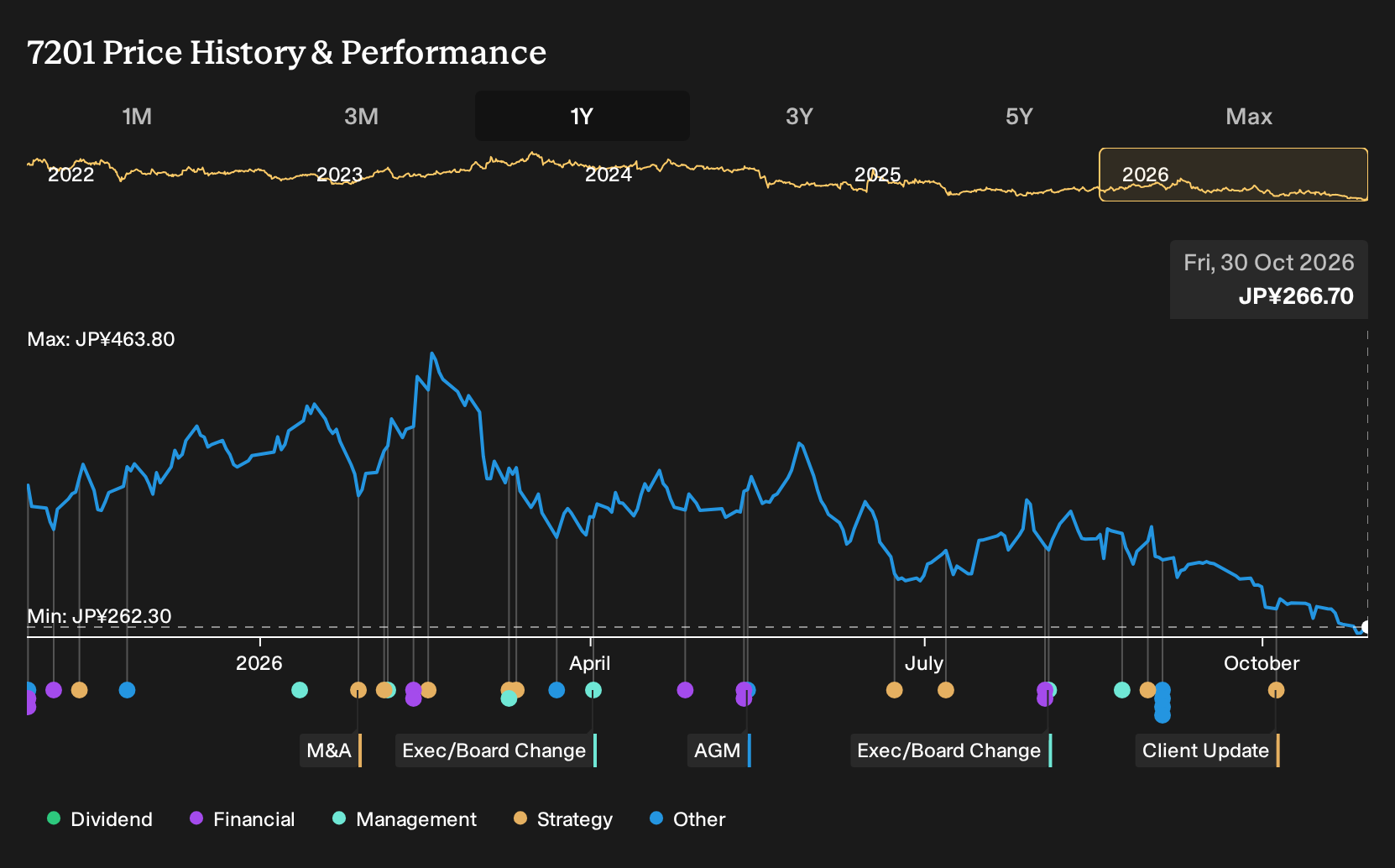
- Nissan Motor reported that global vehicle sales in September 2026 fell 10% to 249,759 units, with a more than 9% decline over the first nine months. Overseas demand weakened even as Japanese registrations rose 18% and production increased in Japan and the US.
- The split picture of stronger domestic sales, alongside an 11% drop in overseas volumes and a 12% contraction in global production, highlights how regional demand imbalances and capacity usage could complicate Nissan Motor’s cost reset and product mix plans.
- We will now look at how Nissan Motor's weaker overseas volumes, despite firmer Japanese demand, could reshape the existing investment narrative.
Balance Nissan Motor's regional pressure by scanning a hand-picked group of autos and industrials with healthier demand trends through the list of solid balance sheet and fundamentals (21 results)
Nissan Motor Investment Narrative Recap
To own Nissan Motor at this point, you basically need to believe the cost reset and mix shift can matter more than soft unit demand. The Re:Nissan program, electrified models and higher localization are all aimed at lifting margins and cash generation even if volumes do not help much. September’s 10% global sales drop and weaker overseas demand challenge that belief but do not rewrite it.
The key near term swing factor is still execution on restructuring and cost savings, especially with tariffs and logistics already weighing on profit. The biggest risk is that ongoing price pressure in China and softer overseas volumes keep factories underused just as Nissan Motor is consolidating plants, which could leave free cash flow and debt coverage under more strain.
With no fresh company announcements tied directly to this sales update, the most relevant reference point remains management’s existing focus on Re:Nissan. Identified savings of ¥315b on the way to a ¥500b goal, along with a 20% cut in engineering cost per hour, frame how Nissan Motor is trying to offset weaker overseas output.
For investors, the link is simple: if overseas demand stays under pressure, the value of that cost work, higher localization in the US and the push into electrified models becomes even more important as a cushion for margins and free cash flow. The risk is that tariff and logistics costs plus restructuring friction erode those benefits faster than operations can absorb the current sales mix.
Nissan Motor's current analyst narrative points to revenues of ¥13,443.7b and earnings of ¥191.3b by 2029, based on an assumed 3.1% yearly revenue growth rate. That path implies an earnings swing of about ¥605b from today’s earnings loss of ¥413.6b to the forecast profit of ¥191.3b in 2029.
Uncover why Nissan Motor's fair value indicates a 44% potential upside to its current price before that discount to Nissan Motor's outlook closes.
Exploring Other Perspectives
Some of the most optimistic analysts frame Nissan Motor’s export push from China as the real swing factor. Before this sales update, that group was modelling revenues of about ¥14,828.5b and earnings near ¥619.8b by 2029. You now have one cohort leaning into that export story, while others stress weak overseas demand. It is worth comparing both views and asking how this latest volume data might shift them.
Explore 4 other Nissan Motor fair value estimates, including one that suggests up to 277% upside from the current price!
Decide For Yourself
Disagree with existing narratives? Extraordinary investment results rarely come from following the herd, so go with your instincts.
- A great starting point for your Nissan Motor research is our analysis highlighting 3 key rewards and 1 important warning sign that could impact your investment decision.
- See our latest analysis for Nissan Motor. The report includes a comprehensive fundamental analysis summarized in a single visual, the Snowflake, making it easy to evaluate Nissan Motor's overall financial health at a glance.
Looking for more Nissan Motor investment ideas?
If the Nissan Motor story has you rethinking where risk and reward feel acceptable, it can help to line it up against other listed businesses with different balance sheets, income profiles and return drivers.
- For investors hunting for underappreciated quality, compare Nissan Motor with companies that currently screen as 16 high quality undervalued stocks.
- If capital protection sits higher on your list than headline growth, weigh Nissan Motor against 23 resilient stocks with low risk scores that aim to keep downside pressures in check.
- Income focused readers can benchmark Nissan Motor beside 28 dividend fortresses that pair higher yields with more resilient payout histories.
Have feedback on this article? Concerned about the content? Get in touch with us directly. Alternatively, email editorial-team@simplywallst.com