


Did New Drillship Contracts Just Shift Transocean's (RIG) Investment Narrative?
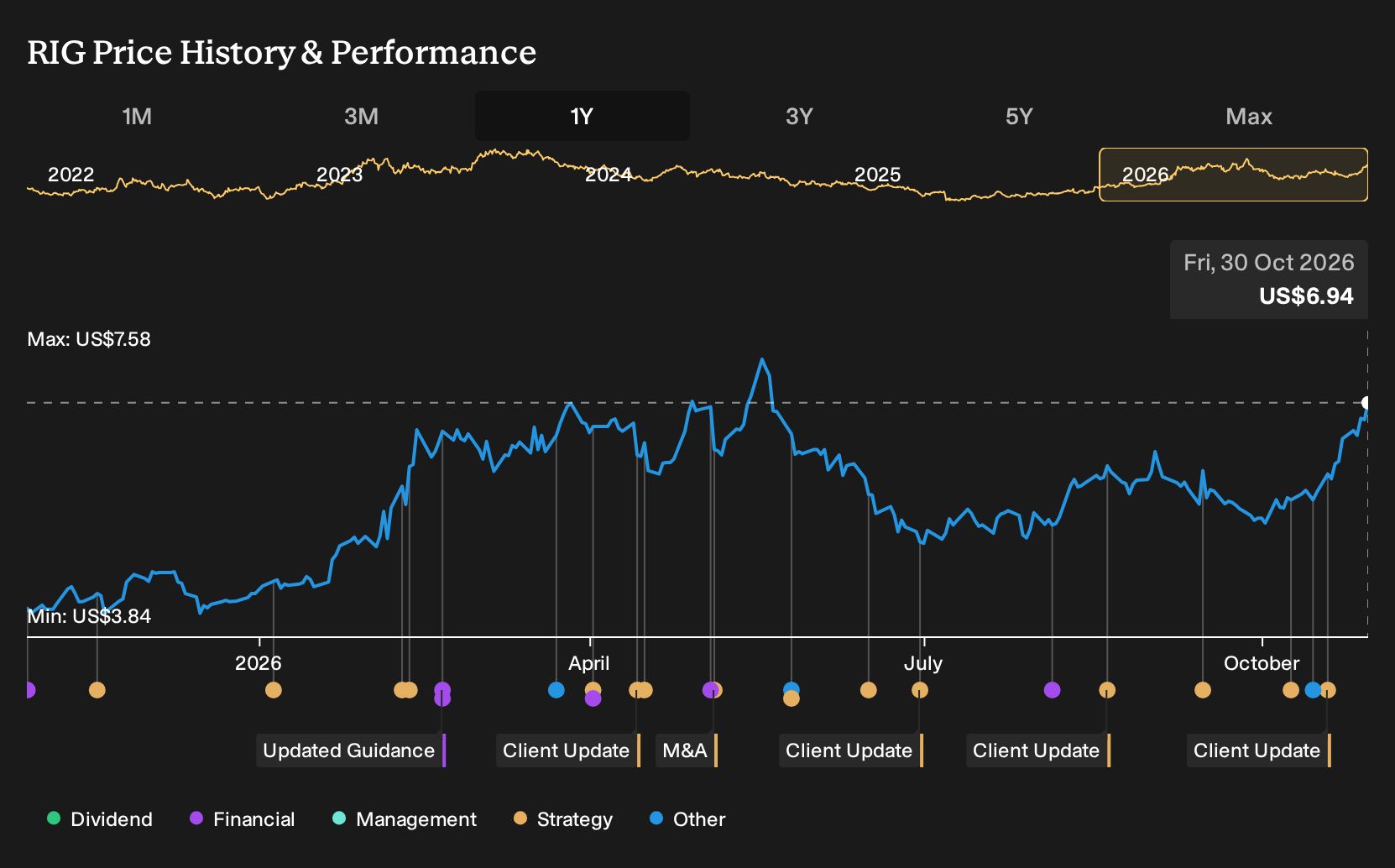
- Transocean announced in October 2026 that two ultra-deepwater drillships in the U.S. Gulf, Deepwater Proteus and Deepwater Conqueror, received new contracts adding about $550 million to firm backlog, with work expected to begin in 2027.
- The back-to-back campaigns for these rigs reduce idle time risk and extend revenue visibility, which directly ties Transocean’s high-spec fleet utilization to longer-term cash flow planning.
- We will now look at how Transocean's investment narrative could be influenced by this $550 million ultra-deepwater backlog addition.
Scan beyond Transocean to see how other contract-rich energy drillers and offshore plays stack up in the 33 high quality undervalued stocks.
Transocean Investment Narrative Recap
To own Transocean, you need to be comfortable with a highly cyclical, capital intensive driller that is trying to turn a large contract backlog into steadier cash generation. The key short term swing factor remains how efficiently that portfolio of ultra deepwater rigs stays working at solid dayrates. This new U.S. Gulf work supports that operating story rather than changing it.
Debt and refinancing risk still sit in the foreground, so the main worry is any gap between contracted revenue and actual cash conversion. The Proteus and Conqueror awards slightly ease utilization concerns heading into 2027. They do not remove exposure to offshore dayrate volatility or potential softness in future tendering.
The October 2026 announcement for Deepwater Proteus and Deepwater Conqueror is the clearest operational marker linked to the existing Transocean thesis. Around US$550 million of firm backlog tied to ultra deepwater rigs in the U.S. Gulf helps underpin activity as analysts already focus on utilization approaching tight levels into 2027.
For you as a shareholder, the interesting link is how this incremental backlog interacts with the goal of deleveraging. The more high spec rigs are locked into multi year campaigns, the more room management potentially has to address interest costs and refinancing, while still carrying the ongoing risks tied to concentrated customers and any slowdown in offshore spending.
What The Transocean Forecasts Are Asking You To Believe
Analysts frame Transocean's backlog story inside a set of explicit revenue and profit assumptions that run out to 2029. The consensus view has top line performance declining by 3.5% each year over the next 3 years even as the business is expected to move from heavy losses to modest profitability. That mix of softer revenue and improving margins is central to how they reconcile the current balance sheet with the long contract book, including the new U.S. Gulf work for Deepwater Proteus and Deepwater Conqueror.
On earnings, the shift is stark. The company is currently reported at a loss of about US$2.8b. Analyst models point to earnings of US$253.3m by 2029. That is a swing of roughly US$3.1b from today's loss to the forecast profit, driven in those models by margin repair rather than rapid sales expansion. When you read a bullish or bearish Transocean pitch, this is the size of the earnings turnaround that is implicitly included.
Those same projections assume profit margins move from roughly a negative 66.8% today to a positive 6.8% in 3 years. The gap is large. It rests on a mix of firmer dayrates, stronger utilization, and tighter cost discipline translating more of that US$7b plus backlog into cash. For an investor, the question is not whether margin improvement is mathematically possible. The question is how comfortable you are with the operational execution and industry conditions required to get even part of the way there.
On capital structure, analyst work assumes the share count grows by around 7.0% per year for three years. That implies some degree of equity issuance or equity-linked compensation on top of existing dilution. Anyone building a personal model for Transocean needs to think about how potential new shares interact with that backlog-driven recovery story, especially if refinancing or balance sheet repair relies on equity markets again.
Valuation links all of these moving parts. The consensus price target of US$6.58 sits above a current share price quoted at US$5.14, with the most optimistic analysts at US$10.0 and the most cautious at US$4.0. For that midpoint view to make sense, forecasts point to 2029 revenue around US$3.7b and earnings of US$253.3m, with the stock trading on a P/E of 45.5x. That multiple is higher than the 26.3x cited for the wider U.S. energy services peer group, so investors would effectively be paying for a cleaner balance sheet and more reliable cash generation than the company has shown so far.
Transocean's narrative projects US$3.7b revenue and US$253.3m earnings by 2029. This assumes a 3.5% yearly revenue decline and an earnings improvement of roughly US$3.1b from a loss of about US$2.8b today.
Uncover how Transocean's fair value indicates a 5% potential downside to its current price, reflecting a valuation premium that leaves little room for error.
Exploring Other Perspectives
In the alternate view, rising logistics and fuel costs are the problem to watch, not just debt. Those bearish analysts were penciling in revenue of about US$3.5b and earnings of roughly US$300.2m by 2029 before this new US$550m Transocean backlog. That cohort’s US$4.5 target shows how sharply opinions can differ, so it is worth comparing these expectations with your own before deciding how this new U.S. Gulf work might reshape the story.
Explore 4 other Transocean fair value estimates, including one that suggests up to 5% downside from the current price.
Form Your Own Verdict
Disagree with existing narratives? Extraordinary investment returns rarely come from following the herd, so consider forming your own view.
- A great starting point for your Transocean research is our analysis highlighting 1 key reward that could impact your investment decision.
- See our latest analysis for Transocean. The report includes a comprehensive fundamental analysis summarized in a single visual, the Snowflake, making it easy to evaluate Transocean's overall financial health at a glance.
Looking For More Investment Ideas Beyond Transocean?
Once you have a view on Transocean, it can help to compare that thesis with other opportunities that share similar qualities, whether that is valuation, balance sheet strength, or risk profile. The Simply Wall St Screener lets you do exactly that in a structured way.
- If you want potential value combined with quality fundamentals, start with a curated 33 high quality undervalued stocks and see which businesses match your checklist.
- For investors who care most about resilient balance sheets and solid underlying metrics, filter the market using a list of solid balance sheet and fundamentals (24 results) to widen your watchlist without lowering your standards.
- If you prefer to hunt for less crowded opportunities, focus on a 19 high quality undiscovered gems and compare those under-followed stocks with your Transocean thesis.
Have feedback on this article? Concerned about the content? Get in touch with us directly. Alternatively, email editorial-team@simplywallst.com