


Doximity (DOCS) Tests Its AI Safety Story On A Near Fair Value Stock
Doximity (DOCS) just rolled out DoseCheck, a free safety layer inside its Ask product that cross checks AI generated drug dosing against structured data, FDA labels, and clinical guidelines.
Doximity’s recent product rollouts are landing against a mixed trading backdrop, with the share price at US$32.76 after a 1-day share price return that declined 2.59% and a 7-day share price return that fell 1.89%. At the same time, the 30-day share price return of 17.29% and 90-day share price return of 51.25% point to building short term momentum. Over a longer window, performance is more uneven, with the year to date share price return down 24.32%, a 1-year total shareholder return that declined 50.36%, a 3-year total shareholder return of 49.45% and a 5-year total shareholder return that fell 51.72%. This leaves recent gains sitting on top of a much tougher longer term journey for investors.
Capitalize on the shift toward clinically focused AI by scanning a curated group of 34 healthcare AI stocks, which, like Doximity, are tying real-world patient safety features to their technology.Doximity now trades slightly above average analyst targets yet screens at a modest intrinsic discount. After a sharp rebound off the lows, is that market hesitation overdone or an appropriate level of caution?
Most Popular Narrative: 2.8% Undervalued
Doximity’s most followed valuation story pegs fair value at $33.70, just above the last close at $32.76, which points to a mild discount rather than a deep value setup.
What I like about Doximity is that there really is a very high viewership / user base of active practicing Physicians in the US and that is not invaluable and definitely could be monetized perhaps more efficiently. I also think that Doximity offers a lot of interesting tools for Physicians a lot of which you’re free and really marketed towards I think Physicians who are more in private practice. It’s a little bit unclear how much value that provides given that most Physicians and practitioners these days are employed and not a private practice.
See why 10 investors see Doximity as 3% undervalued.
According to Dc12, the draw is less about a headline growth rate and more about the combination of a large physician audience, brand familiarity, and increasingly polished clinical tools. That framing helps explain why this narrative still sees value even as Doximity’s own model assumes a relatively measured 17% revenue growth rate, a 30.4% profit margin and an 8.00% discount rate instead of more aggressive blue sky assumptions.
Where some readers may pause is the gap between this storyline and recent fundamentals. The firm recorded $655.57m in revenue and $167.05m in net income, yet profit margins stepped down from 39.9% to 25.5% over the past year and earnings fell 29%. Earnings are also forecast to rise 6.4% per year with revenue expected to grow 6% per year, which trails the broader US market forecasts of 17.2% earnings growth and 13.3% revenue growth according to the statements data.
Even with those headwinds, the narrative still tags Doximity as undervalued, largely because the fair value estimate of $33.70 sits close to but above the current share price and the stock trades at a 6.5% discount to the SWS DCF model estimate of $35.04. That tension between slowing near term growth and long term monetization potential of a highly engaged US clinician base is what current holders and prospective investors appear to be weighing most closely.
Result: Fair Value of $33.70 (UNDERVALUED)
Still, two pressure points could undercut that 2.8% undervalued story: slower revenue and net income growth around 6%, and continued margin compression from prior levels.
Find out about the key risks to this Doximity narrative.
Another View: What Doximity’s P/E Implies
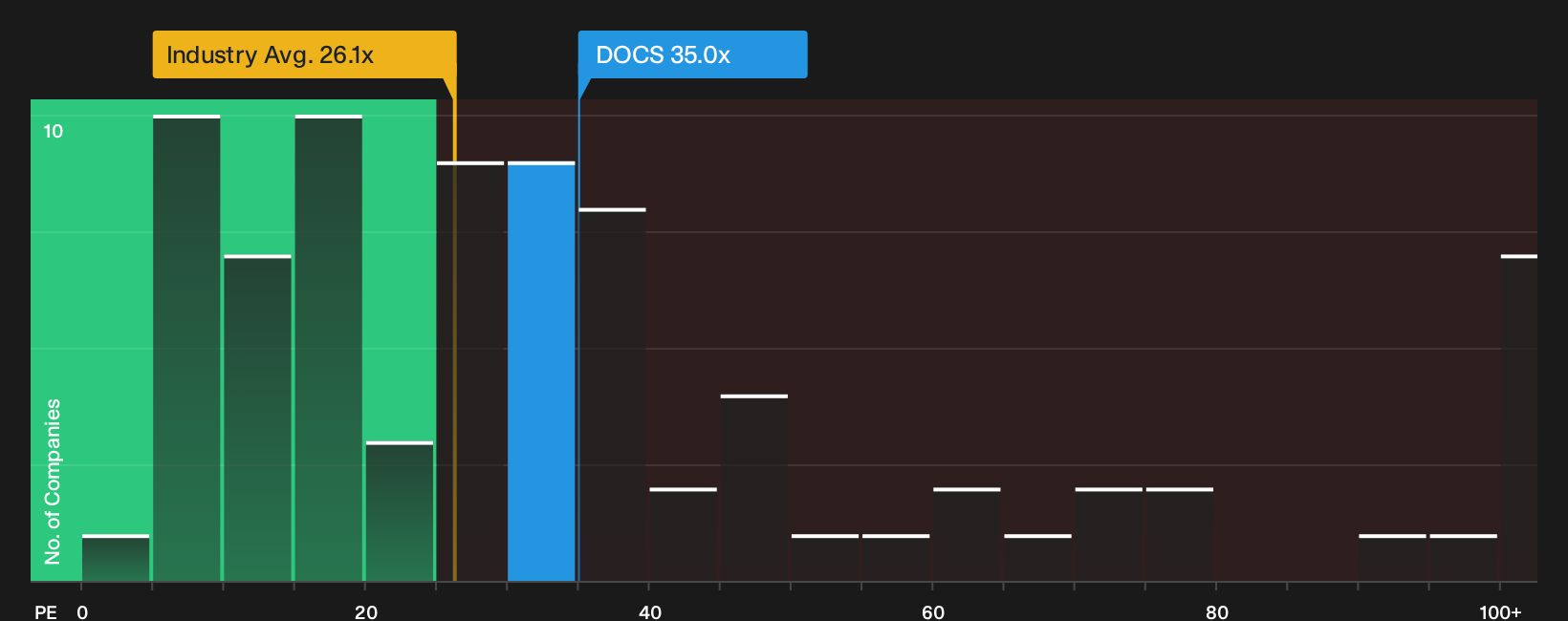
Doximity looks mildly cheap on fair value models, yet the P/E ratio of 35x tells a different story. That level is richer than the global Healthcare Services average of 26.1x and also above a fair ratio estimate of 27.3x, even though it sits below the peer group at 58.9x. For anyone watching DOCS after the recent rebound, the question is whether paying a premium P/E for slower forecast growth represents opportunity or valuation risk.
Our multiples work raises those questions, and the valuation breakdown goes deeper into what that higher P/E versus the industry and fair ratio might mean for your downside and upside skew, See what the numbers say about this price — find out in our valuation breakdown..
Next Steps
With mixed signals across Doximity’s valuation, growth, and product rollouts, it helps to pressure test the data yourself and move quickly while sentiment is still split. To weigh both the bright spots and the concerns side by side, start with 2 key rewards and 2 important warning signs.
Looking for more Doximity sized opportunities?
If Doximity has you thinking harder about pricing, growth, and risk, do not stop here. Broaden your watchlist with a few targeted idea lists.
- Target resilient balance sheets by scanning a curated list of solid balance sheet and fundamentals (24 results) that can help you stress test your portfolio against rougher conditions.
- Hunt for mispriced potential through a focused 19 high quality undiscovered gems that highlights quality companies the wider market may not be watching yet.
- Anchor your income stream by reviewing a hand picked 5 dividend fortresses that concentrates on higher yielding businesses with support from underlying fundamentals.
Have feedback on this article? Concerned about the content? Get in touch with us directly. Alternatively, email editorial-team@simplywallst.com