


Is AI Platform Rollout Altering The Investment Case For Honeywell (HON)?
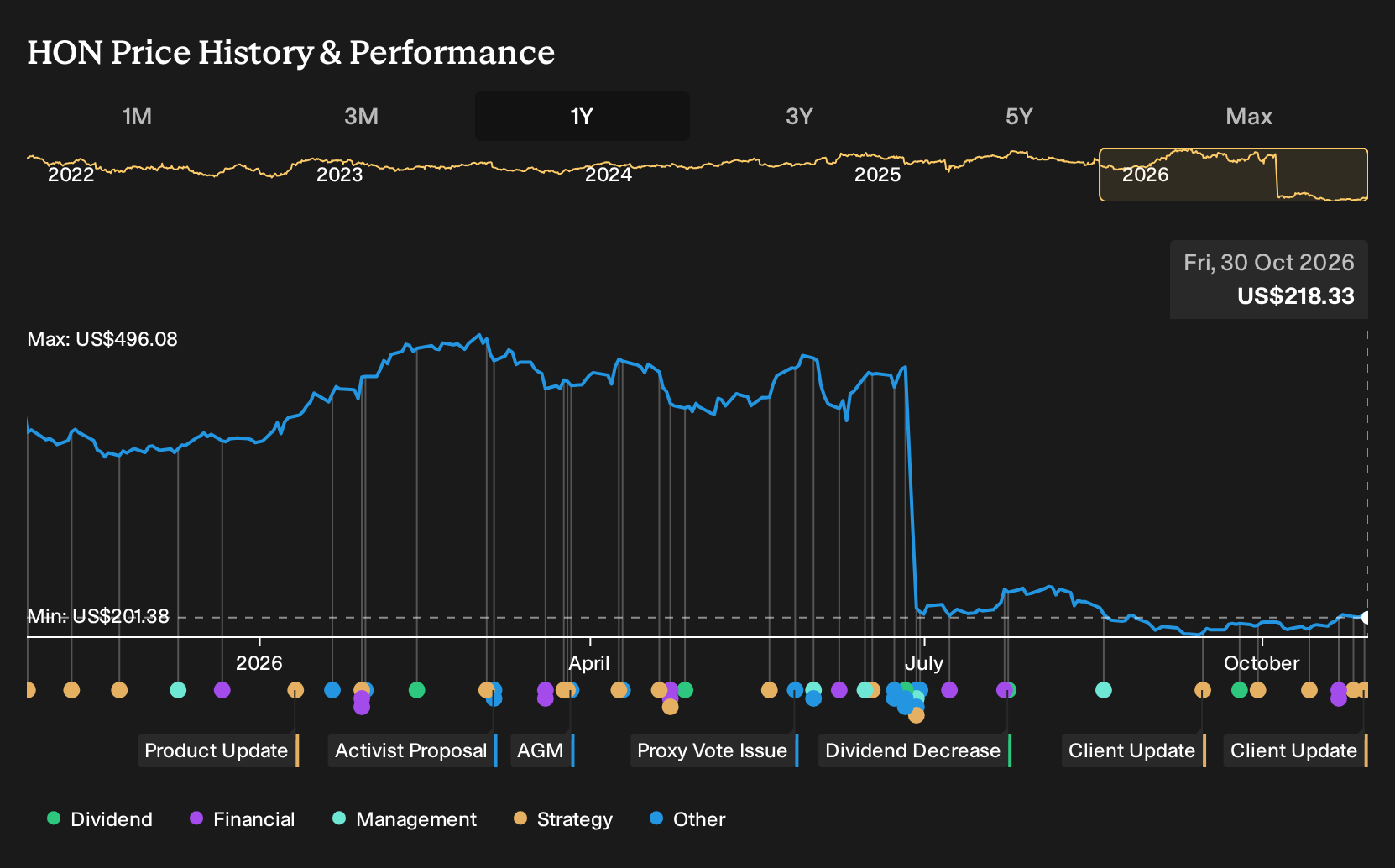
- Honeywell International recently reported third quarter and nine-month 2026 results, raised full-year sales guidance to US$20.0b to US$20.1b, launched its Forge Plant Cognition industrial AI platform at the Dangote refinery in Nigeria, and expanded its connected cabin automation system across Royal Caribbean’s three in-service Icon Class ships.
- The combination of industrial AI deployment at one of the world’s largest single-train refineries and large-scale cruise cabin automation showcases Honeywell International’s push toward higher-value software, services, and connected automation that link physical assets to digital control platforms.
- We will examine how Honeywell International’s automation-focused investment narrative is shaped by the Forge Plant Cognition AI rollout.
Honeywell International Investment Narrative Recap
To own Honeywell International, you need to believe the reshaped, automation-focused portfolio can convert products like Forge Cognition and connected cabins into steadier software and services revenue. The raised 2026 sales guidance to US$20.0b to US$20.1b points to management confidence, but short term sentiment still leans heavily on execution in higher growth verticals and cost control.
The biggest near term swing factor remains how cleanly Honeywell International handles the separation into three public companies while protecting margins. The main risk is that weaker end market demand or separation costs erode the margin expansion narrative. The latest earnings mix does not materially change that risk reward balance yet.
The Forge Plant Cognition rollout at Dangote’s refinery looks most relevant for the current thesis around automation and software. Honeywell International is positioning this AI platform as a bridge between its UOP process expertise and ongoing automation projects. This directly links to the goal of lifting software and services from roughly 40% to 45% of revenue over time.
Management cites preliminary estimates of more than US$0.29 a barrel in operational benefit at Lekki, or over US$60m a year at full throughput, which gives investors a concrete reference point for potential customer value. The key execution watchpoints are replicating this at other refineries, managing AI deployment risk, and converting these projects into recurring Forge-related revenue that supports margins through future industry cycles.
Honeywell International's narrative projects US$22.3b revenue and US$3.2b earnings by 2029, with analysts assuming revenue will decrease by 16.4% a year and earnings will fall by US$5.1b from US$8.3b today to reach that level.
Uncover why Honeywell International's fair value indicates an 18% potential upside to its current price that may not last much longer.
Exploring Other Perspectives
One alternate view sees Honeywell International’s connected cabins and refinery AI as exciting, yet still worries about margins getting squeezed if pricing only keeps pace with 3% to 4% cost inflation. The most pessimistic analysts were penciling in revenue of about US$18.9b and earnings near US$2.1b by 2029. Those forecasts imply a far weaker profit profile than the baseline consensus. Opinions clearly span a wide range, so treat this news as an opportunity to compare different narratives and decide which assumptions align most closely with your own.
Explore 8 other Honeywell International fair value estimates, including one that suggests as much as 21% downside from the current price.
Reach Your Own Conclusion
Disagree with existing narratives? Extraordinary investment returns rarely come from following the herd, so go with your instincts.
- A great starting point for your Honeywell International research is our analysis highlighting 3 key rewards and 3 important warning signs that could impact your investment decision.
- See our latest analysis for Honeywell International. The report includes a comprehensive fundamental analysis summarized in a single visual, the Snowflake, making it easy to evaluate Honeywell International's overall financial health at a glance.
Looking For More Investment Ideas Beyond Honeywell International?
If Honeywell International has sharpened your interest in automation and industrial software, it can be useful to compare it with other businesses that have different balance sheets, income profiles, and dividend approaches. The Simply Wall St Screener lets you move from one stock story to a broader watchlist that fits your own risk tolerance and return goals.
- Focus on quality first by starting with companies that pair resilient finances with cleaner balance sheets using our list of solid balance sheet and fundamentals (24 results).
- If you want ideas that may still be off most investors’ radar, broaden your watchlist with a handpicked group of 19 high quality undiscovered gems.
- For readers who care most about income, build a shortlist of cash return candidates through a curated set of 5 dividend fortresses.
Have feedback on this article? Concerned about the content? Get in touch with us directly. Alternatively, email editorial-team@simplywallst.com