


Tower Stock Outlook Brightens After Revenue Guidance And 2028 Targets Rise
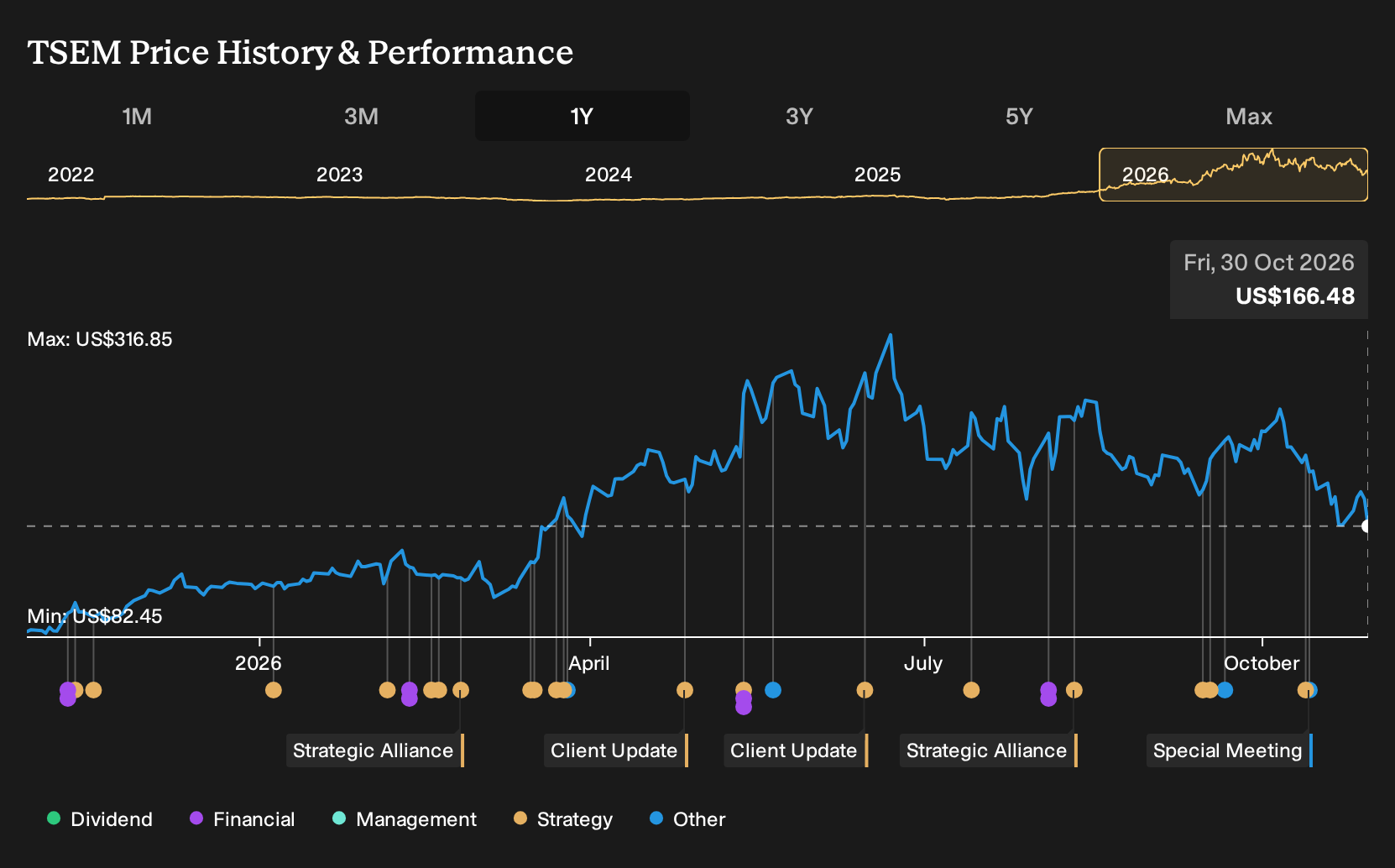
- Tower Semiconductor recently issued an upbeat revenue outlook ahead of its fiscal Q3 2026 earnings report and increased its 2028 business model targets, reflecting management’s confidence in demand for its foundry services.
- The company highlighted silicon photonics for AI optical transceivers as a key driver, signaling a deeper shift toward higher value mixed-signal platforms and long-term capacity commitments.
- We will examine how Tower Semiconductor's investment narrative is shaped by management's raised 2028 targets and its emphasis on silicon photonics.
Scan beyond Tower Semiconductor and see how other chip players exposed to AI demand stack up in our curated list of 54 AI infrastructure stocks.
Tower Semiconductor Investment Narrative Recap
To own Tower Semiconductor, you need to believe that its silicon photonics and high value RF and SiGe platforms can support sustained demand as new AI and 5G workloads scale. The raised 2028 model and upbeat Q3 2026 revenue outlook speak to that confidence, but the key near term catalyst remains execution on those capacity ramps and translating contracted demand into loaded fabs.
The biggest current risk is simple. Tower is committing billions of US dollars to silicon photonics and 300mm expansion while RF mobile and 300mm RFSOI have already seen recent revenue declines during technology transitions. If wafer demand or design ramps soften against that higher fixed cost base, utilization and margins could come under pressure.
The most relevant recent update is management lifting its 2028 business model targets alongside a strong 2026 outlook. That is directly tied to silicon photonics, where Tower already has about US$1.3b of contracted 2027 revenue and an annualized run rate above US$680m as of Q2 2026. Those numbers show real customer commitments behind the AI optical story, not just slideware.
For you as an investor, that guidance shift reframes the catalysts and the risk skew. Higher long term margin targets and a business mix tilting toward silicon photonics and SiGe create more operating leverage if fabs stay full, yet leave less room for disappointment at a rich P/E. The Japan 300mm buildout, and how quickly it is absorbed, now sits at the center of that equation.
Tower Semiconductor's current analyst setup points to revenues of US$4.2b and earnings of US$1.3b by 2029, anchored on an assumed 35.3% yearly revenue growth rate and a jump in profit from US$289.6m today to that 2029 consensus figure. This implies roughly a 4.5x increase in earnings over that period.
Uncover why Tower Semiconductor's fair value indicates an 88% potential upside to its current price that could narrow quickly.
Exploring Other Perspectives
You see Tower Semiconductor’s raised 2028 model tied to AI optics. The most cautious analysts worry that silicon photonics demand normalizes and that the more than 5x capacity plans sit underused. Their older forecasts had revenue at about US$4.0b and earnings near US$1.0b by 2029, well below the US$1.3b consensus, which could shift after this news.
Explore 3 other Tower Semiconductor fair value estimates, including one that suggests as much as 79% downside from the current price!
Decide For Yourself
Disagree with existing narratives? Extraordinary investment returns rarely come from following the herd, so rely on your own assessment.
- A great starting point for your Tower Semiconductor research is our analysis highlighting 3 key rewards and 2 important warning signs that could impact your investment decision.
- See our latest analysis for Tower Semiconductor. The report includes a comprehensive fundamental analysis summarized in a single visual, the Snowflake, making it easy to evaluate Tower Semiconductor's overall financial health at a glance.
Looking For More Investment Ideas Beyond Tower Semiconductor?
If the Tower Semiconductor story has sharpened your view on AI, photonics, and capacity investment, it can help to line it up against other opportunities that fit your preferred style of investing.
- If you want potential mispricing combined with strong fundamentals, start by scanning our 30 high quality undervalued stocks that match those criteria.
- If capital preservation and stability matter most to you, focus on our 29 resilient stocks with low risk scores that score well on resilience and risk metrics.
- If you prefer resilient businesses with cleaner balance sheets, build a shortlist using our list of solid balance sheet and fundamentals (24 results) and compare them to Tower Semiconductor on your own terms.
Have feedback on this article? Concerned about the content? Get in touch with us directly. Alternatively, email editorial-team@simplywallst.com