


Mixed Earnings Report Might Change The Case For Investing In Yara International Stock (OB:YAR)
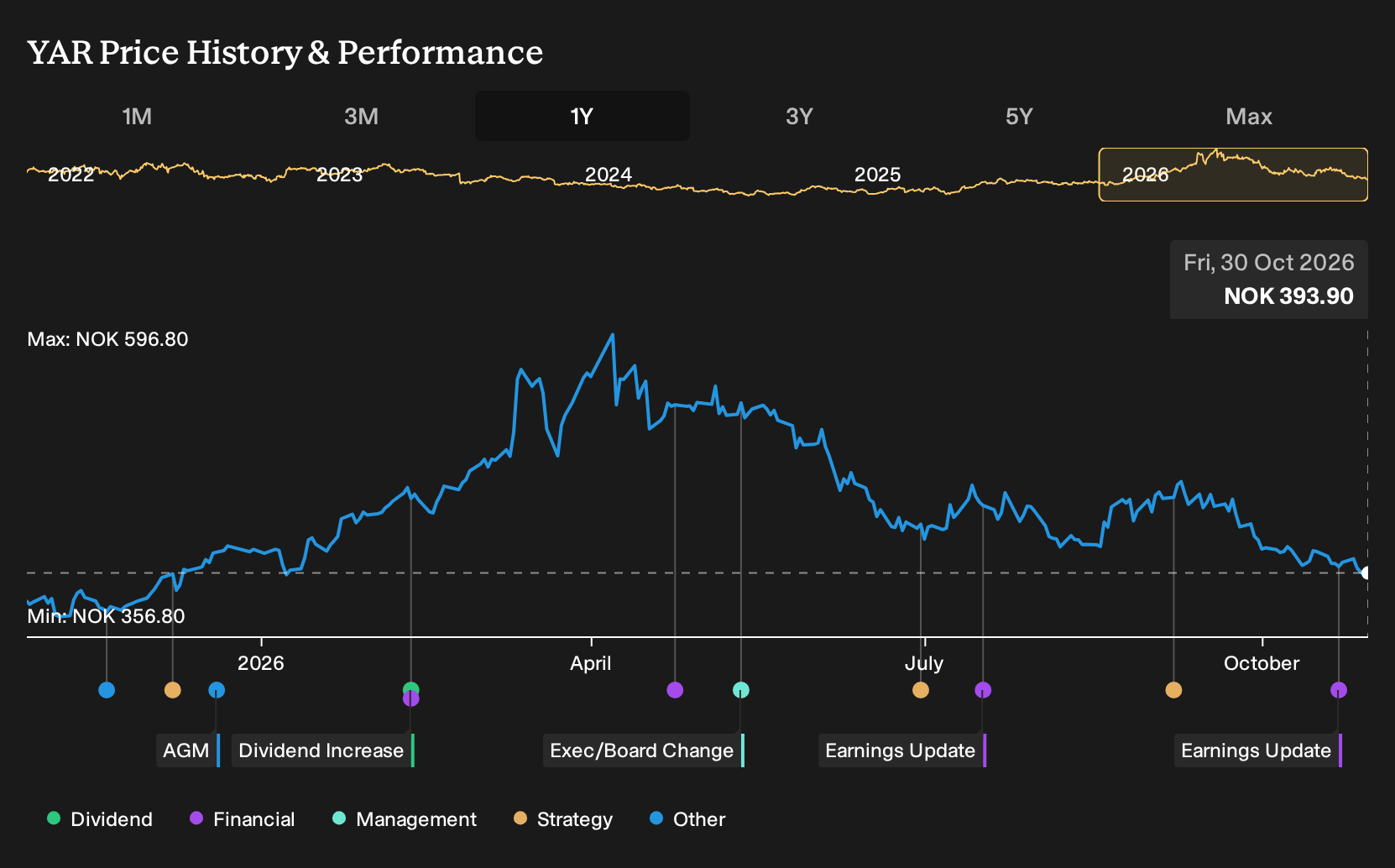
- Yara International reported third quarter 2026 revenue of US$4,478 million and net income of US$197 million, with nine month earnings of US$1,067 million.
- The third quarter showed higher sales alongside lower profit, while nine month earnings per share from continuing operations edged up to US$4.19.
- This earnings report highlights a mixed picture for Yara International, with differing trends in revenue and profit that may influence how investors view the company.
Yara International Investment Narrative Recap
To own Yara International, you need to be comfortable with a fertilizer business where volume demand can look steady while profitability swings with product mix, costs, and pricing power. The latest quarter fits that pattern. Revenue for the three months to September 2026 was US$4,478 million with net income of US$197 million, so the nearer term focus stays on margin quality rather than pure top line.
The key short term swing factor is whether management can defend margins in higher value products while input costs and competition move around. Earnings per share from continuing operations fell to US$0.78 in the quarter yet reached US$4.19 over nine months, which points to volatility rather than a clear break in the thesis. That makes execution risk on pricing and costs the main issue to watch from here.
The most relevant update is this October earnings release itself, because it shows the tension between higher sales and softer quarterly profit. Revenue for the nine months reached US$13.165b and net income came in at US$1.067b, only slightly above the prior period. That mix matters for a business where investors often look closely at cash generation and balance sheet resilience.
For a reader focused on catalysts, the data point that earnings per share from continuing operations moved from US$4.03 to US$4.19 over nine months sits against analyst expectations for declining earnings in coming years. That gap between reported progress and cautious forecasts keeps attention on how Yara International handles project spending, specialty fertilizer margins, and any policy developments around clean ammonia, because those areas may shape whether recent profit trends are sustained or fade.
Yara International's narrative projects US$16.6b revenue and US$724.1 million earnings by 2029. This implies a 1.0% yearly revenue decline and an earnings decrease of about US$675.9 million from US$1.4b today.
Uncover how Yara International's fair value points to a 17% potential upside to its current price, which could narrow quickly if sentiment improves.
Exploring Other Perspectives
One bullish twist on Yara International centers on earnings power rather than volume risk. The most optimistic analysts were modeling revenue of about US$19.2b and earnings near US$1.7b by 2029 before this report, far above the baseline US$16.6b and US$724.1 million view. That gap shows how sharply opinions can differ, so it is worth exploring several forecasts and deciding which assumptions feel realistic after these results.
Explore 5 other Yara International fair value estimates, including one that suggests as much as 250% potential increase from the current price.
Form Your Own Verdict
Disagree with existing narratives? Extraordinary investment returns rarely come from following the herd, so go with your instincts.
- A great starting point for your Yara International research is our analysis highlighting 3 key rewards and 2 important warning signs that could impact your investment decision.
- See our latest analysis for Yara International. The report includes a comprehensive fundamental analysis summarized in a single visual, the Snowflake, making it easy to evaluate Yara International's overall financial health at a glance.
Looking for more investment ideas beyond Yara International?
If Yara International's mixed earnings story has sharpened your focus on risk, reward, and balance sheet strength, it can help to widen the lens and scan other opportunities that fit your preferred style of investing.
- For investors who want potential upside without ignoring financial resilience, review a list of solid balance sheet and fundamentals (203 results) that filters for companies with room to grow and the balance sheet to support it through tougher periods.
- If capital preservation ranks near the top of your priorities, consider a 218 resilient stocks with low risk scores that highlights businesses with more measured risk profiles based on their fundamentals.
- When you are hunting for opportunities that might be off most investors' radar, check a 602 high quality undiscovered gems that focuses on quality metrics rather than headline popularity.
Have feedback on this article? Concerned about the content? Get in touch with us directly. Alternatively, email editorial-team@simplywallst.com