


Stock Ownership Plus Option Selling: Comparing WULF, OKLO and GTLB in Rising, Flat and Falling Markets
Introduction
What does a large option premium actually do for a trade? One way to answer is to put three stocks through the same test: a 10% gain, no change, and a 10% decline.
Our latest Bull Strangle watch list included TeraWulf (WULF), Oklo (OKLO), and GitLab (GTLB). Each offered a different combination of stock price, call strike, put strike, and option premium. Comparing their outcomes under identical stock moves shows how those pieces work together—and where the premium cushion ends.
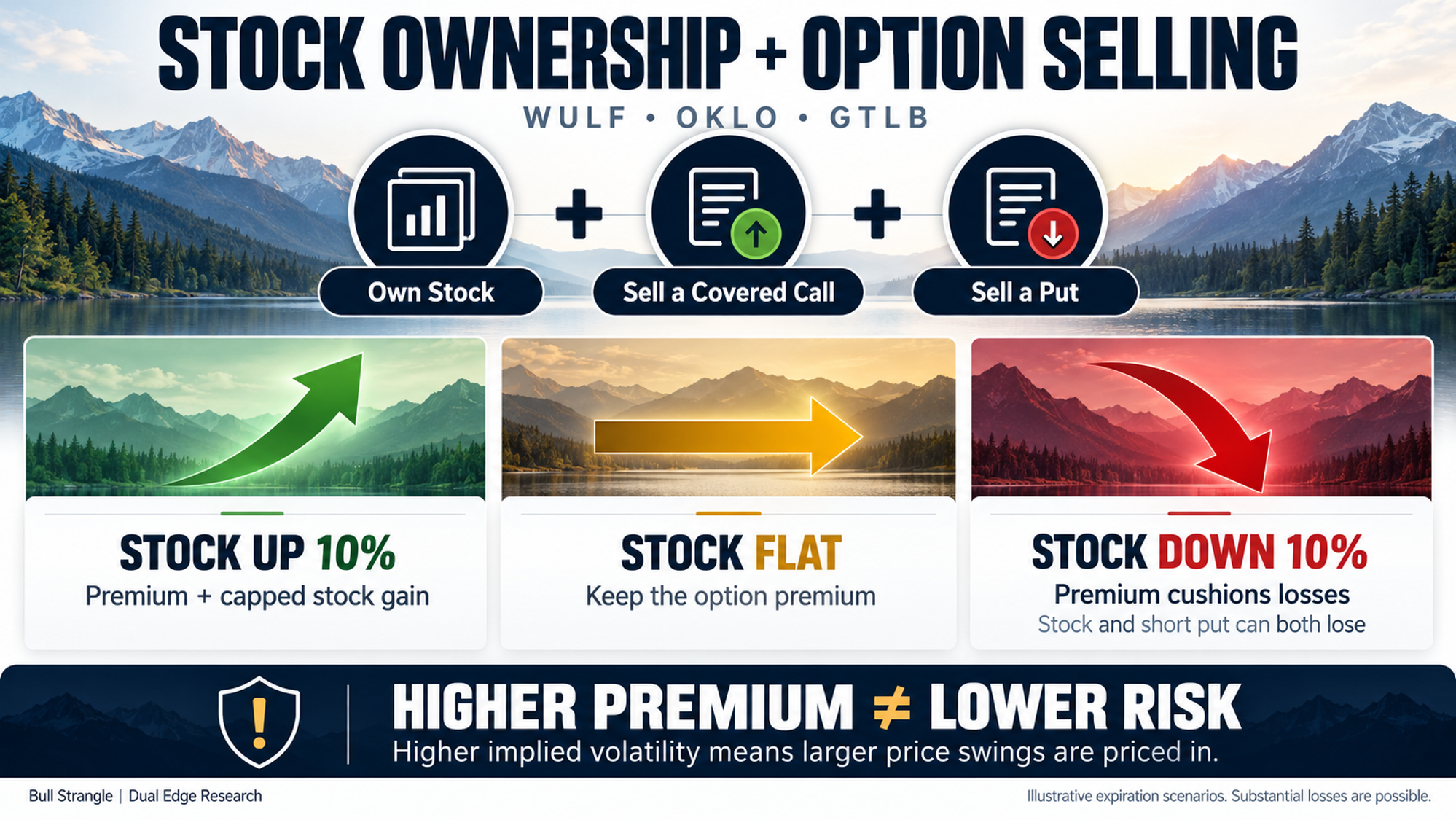
Three stocks, one consistent comparison
For each example, we buy 100 shares and sell one out-of-the-money call and one out-of-the-money put. The shares cover the call; the put obligates us to buy another 100 shares if assigned. We assume standard contracts, matching expirations, and positions held through expiration without early assignment.
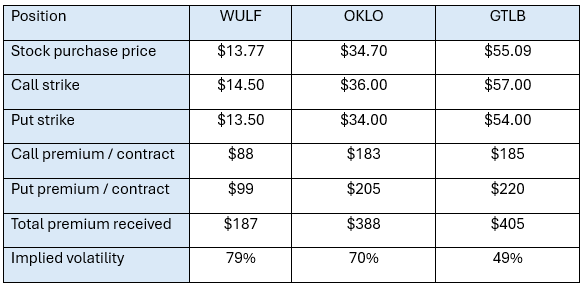
Prices are Friday-close quotes from the newsletter, not executed fills. The scenarios exclude commissions, taxes, and dividends. Actual prices and contract terms must be checked before trading.
The results: up 10%, flat, and down 10%
The table shows the combined profit or loss on the shares and both options. Percentages use the initial stock purchase cost so the three differently priced stocks can be compared on the same basis.
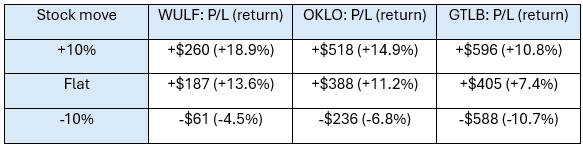
Dollar results are rounded to the nearest dollar; percentages are calculated from unrounded results. These are hypothetical expiration outcomes, not forecasts or returns on all capital committed to the position.
When the stocks gain 10%
A 10% gain puts all three stocks above their call strikes. The calls are assigned, and you sell the original shares at those strikes. The puts expire worthless. Each position earns the combined premium plus the stock gain from the purchase price to the call strike.
For WULF, that is $187 in premium plus $73 in stock appreciation, for a $260 gross profit. OKLO produces $518, and GTLB $596. GTLB earns the most dollars per 100 shares, but WULF earns the highest percentage on the original stock cost.
The trade-off is capped upside. Once the stock finishes above the call strike, further appreciation does not increase the position’s expiration profit.
When the stocks finish flat
At their original purchase prices, all three stocks remain between their put and call strikes. Both options expire worthless, and the shares show no price gain or loss. The combined premium becomes the gross profit.
WULF retains $187, OKLO $388, and GTLB $405. Relative to the original stock cost, that is 13.6%, 11.2%, and 7.4%, respectively. This illustrates how option premium can produce a positive outcome without stock appreciation.
When the stocks lose 10%
A 10% decline puts all three stocks below their put strikes. The original shares lose value, the calls expire worthless, and the short puts add losses. The premium offsets some of the damage, but it doesn't eliminate it.
For WULF, the stock finishes at $12.393. The original shares lose $137.70, and the short put adds a $110.70 loss. Subtracting the $187 premium leaves a net loss of $61.40. The same calculation produces losses of $236 for OKLO and $587.80 for GTLB.
WULF therefore has the smallest percentage loss in this test. Selling excess shares after put assignment removes the additional ongoing stock exposure, but does not reverse the loss already incurred.
Why the highest premium is not automatically the best trade
WULF delivers the strongest percentage result when all three stocks move by the same percentage. But equal percentage moves do not represent equal volatility exposure. GTLB’s implied volatility was 49%, compared with 70% for OKLO and 79% for WULF. For the same holding period, a 10% move in GTLB translates approximately into a 14.3% move in OKLO and a 16.1% move in WULF when scaled by their respective implied volatilities.
The approximation is: comparable percentage move = 10% × stock implied volatility ÷ 49%. It compares movements of equal size relative to each stock’s volatility, assuming the IV figures refer to comparable horizons. It does not predict that the stocks will move together or establish identical real-world probabilities; volatility skew, changing IV, and price jumps can affect outcomes.
That distinction changes the downside comparison. Retaining the same positions, premiums, and expiration assumptions produces the following results:
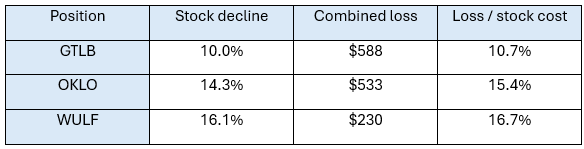
Results use unrounded IV-scaled moves; losses are rounded to the nearest dollar. Percentages use initial stock purchase cost and exclude additional put-funding capital and transaction costs.
WULF’s larger premium still absorbs part of the decline, but its apparent advantage in the equal-10% comparison disappears. On this volatility-scaled downside test, GTLB has the smallest percentage loss. This is one stress scenario, not a complete assessment of which trade is best.
The larger premium therefore needs to be considered alongside the larger price movement being priced into the options. Comparing identical stock moves shows how the strategy works; comparing volatility-scaled moves helps explain why the richest premium does not automatically offer the most favorable risk.
Capital also matters. The return percentages above exclude the additional cash or buying power needed for the put. For WULF, purchasing 100 shares and reserving the full $13.50 put-strike amount requires $2,727 before premium, or $2,540 after the credit. Its flat-stock profit of $187 is about 7.4% of that net fully funded amount. Broker margin requirements may differ.
The comparison shows what premium can accomplish: enhance capped upside, create income in a flat market, and cushion a decline. Selecting the trade still requires checking earnings, liquidity, stock ranking, position size,and portfolio exposure. The best fit depends on the entire position and the risk the account can support.
About the Bull Strangle
The Bull Strangle Newsletter combines screened stock ownership with call-and-put selling in a four-week ladder. Learn more at www.BullStrangle.com.
Want to build a more complete trading toolkit?
The Bull Strangle Newsletter focuses on stocks and options, combining stock ownership with disciplined option-selling techniques designed to generate consistent income while managing risk.
The Smart Spreads Newsletter focuses on seasonal commodity spreads, a historically proven approach that seeks opportunities across agricultural, energy, metal, and financial futures markets.
Each strategy is designed to stand on its own, but together they provide a diversified approach that can perform across a wide range of market environments. For traders looking to deepen their education, The Bull Strangle Strategy and Trading Commodity Spreads are both available on Amazon.
Visit BullStrangle.com to subscribe for just $1 for the first month.
For a video overview of the Bull Strangle Newsletter
For a video overview of the Smart Spreads Newsletter
Darren Carlat
Dual Edge Research
(214) 636-3133
DualEdgeResearch@gmail.com
Disclaimer
This information is for informational purposes only and should not be considered investment advice. Past performance is not indicative of future results, and all investments carry inherent risk. Consult with a financial advisor before making any investment decisions.