


Should Strong Q3 Earnings Require Action From Nasdaq (NDAQ) Investors?
- Nasdaq reported third quarter 2026 revenue of US$1,481 million and net income of US$540 million, with both figures above the prior year period and earnings per share higher on a basic and diluted basis.
- The latest results highlight how Nasdaq’s mix of trading, data, index and financial technology services is contributing to higher earnings per share from continuing operations.
- Investor attention now turns to how this third quarter earnings performance from Nasdaq might influence the existing investment narrative.
Nasdaq Investment Narrative Recap
To own Nasdaq, you need to believe that its mix of exchanges, index and data franchises, and financial technology will keep pulling more activity and recurring revenue onto its platforms. In the near term, the main focus is execution in Financial Technology, where management is investing in AI, regulatory tech and 23/5 trading while keeping an eye on expense growth.
Right now the biggest risk is that higher operating costs and heavy investment dilute the benefit of the recent earnings strength if client adoption slows. The latest leadership moves in Asia-Pacific and on the board look directionally supportive, but on their own they do not materially change that risk reward balance.
The most relevant recent move for that story is Nasdaq appointing Andrew Murray as Senior Vice President, Financial Technology, Asia-Pacific and basing him in Singapore. Combined with Bob McCooey’s earlier relocation, this places more senior decision makers close to a region where many banks, brokers and exchanges are prioritising technology upgrades.
For you as a shareholder, this matters because the Financial Technology division is a key growth driver alongside Markets and Capital Access Platforms. Success in Asia-Pacific can support adoption of platforms like Verafin, AxiomSL and Calypso, while any execution missteps or weaker than expected client demand in the region would weigh on the catalysts that investors are watching.
What The Current Consensus Implies For Nasdaq
Analysts are effectively asking you to underwrite a specific earnings path for Nasdaq. The current consensus builds around revenue rising at 8.2% a year for the next few years, earnings today of US$2.1b, and a move to US$2.6b of profit by 2029. That lifts earnings by about US$500m, which is a step up that depends on the market infrastructure and financial technology mix continuing to pull more transactional and recurring activity into the group.
On these assumptions, the story is that Nasdaq leans on index and data franchises, plus financial crime and regulatory platforms, to support earnings per share even as margins soften slightly from 36.1% to 35.2%. The same forecast set has earnings per share climbing to US$5.03 by 2029, helped by analysts expecting the share count to fall by roughly 2.12% each year. That combination of modestly lower margins, higher total profit and fewer shares is what underpins the consensus earnings profile you see in the stock today.
Those forward numbers also rely on investors being comfortable with Nasdaq trading on a higher multiple of its projected profit than it does on its current earnings base. The consensus framework points to a P/E of 29.4x on 2029 earnings, compared with about 27.5x on today’s earnings, and still below the 38.3x level quoted for the broader US capital markets peer group. For you, the key question is whether that richer multiple on a larger earnings pool feels reasonable given your own expectations for how the group’s trading venues and technology franchises develop over the rest of the decade.
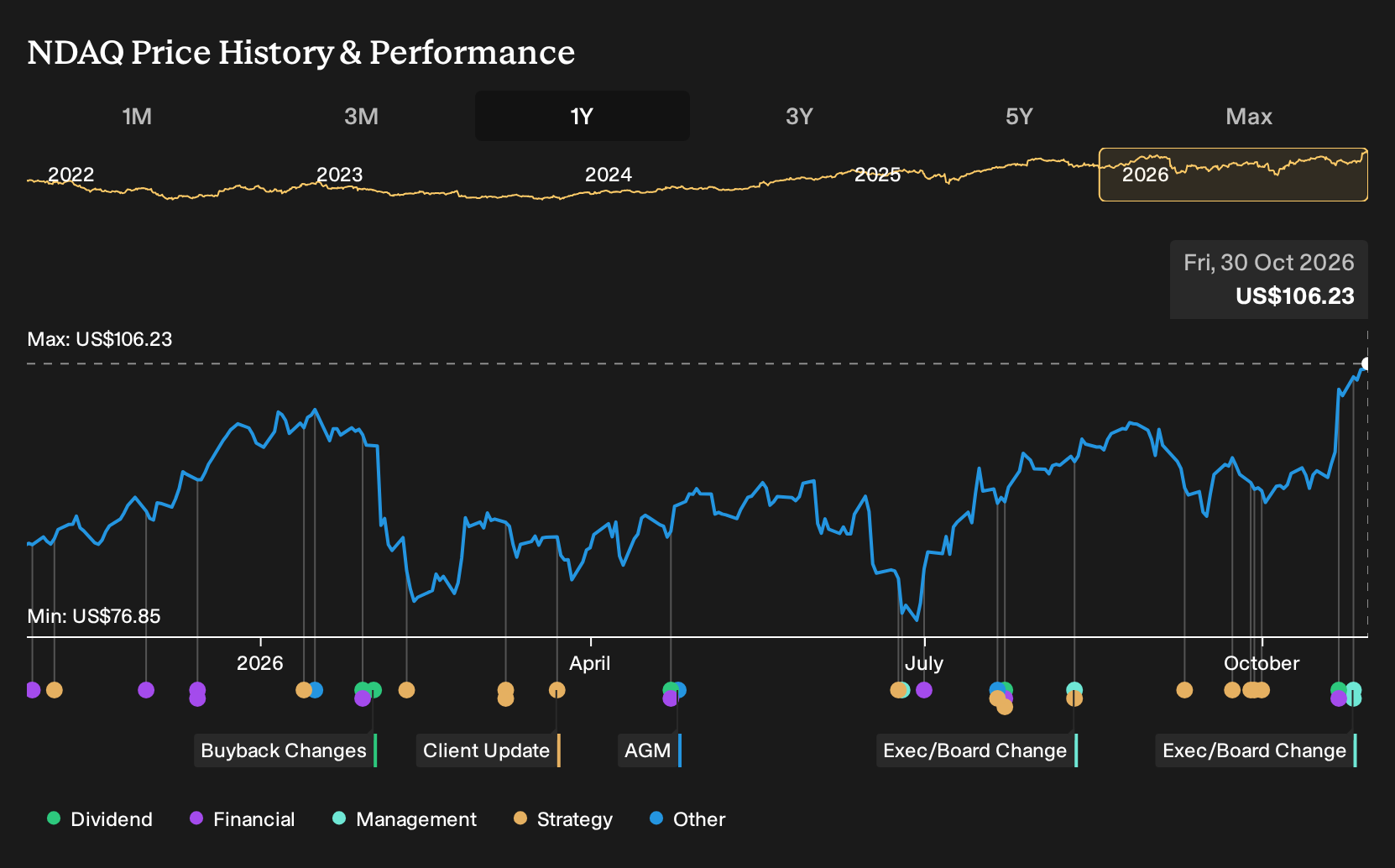
Valuation work built around this scenario ties those operational forecasts directly into headline targets for the stock. The analyst group cited in the report is using a discount rate of roughly 8.2% and arrives at a consensus price target of US$114.25, with the most optimistic view at US$133 and the most cautious at US$87. With a recent share price of US$102.56, the average target sits about 10.2% above where Nasdaq currently trades. This indicates that the market is already pricing in a fair amount of faith in those 2029 revenue and earnings assumptions.
Nasdaq's narrative projects US$7.3b revenue and US$2.6b earnings by 2029. This implies 8.2% yearly revenue growth and an earnings increase of about US$500m from US$2.1b today.
Uncover why Nasdaq's fair value indicates an 8% potential upside to its current price that could narrow quickly.
Exploring Other Perspectives
Five fair value estimates from the Simply Wall St Community cluster mostly between about US$90 and US$114, with one view already aligned to the US$114.25 analyst target and the lowest near US$90. That spread reflects how differently retail investors can frame Nasdaq. Upcoming expense trends, Asia-Pacific expansion and board changes provide additional angles to test your own view.
Explore 4 other Nasdaq fair value estimates, including one that suggests as much as 15% downside from the current price.
The Verdict Is Yours
Disagree with existing narratives? Extraordinary investment returns rarely come from following the herd, so trust your own analysis.
- A great starting point for your Nasdaq research is our analysis highlighting 3 key rewards and 2 important warning signs that could impact your investment decision.
- See our latest analysis for Nasdaq. The report includes a comprehensive fundamental analysis summarized in a single visual, the Snowflake, making it easy to evaluate Nasdaq's overall financial health at a glance.
Looking For More Investment Ideas Beyond Nasdaq?
If this Nasdaq update has sharpened your view on market infrastructure and financial technology, it can be useful to line it up against a wider watchlist. The Simply Wall St Screener helps you quickly surface other listed businesses that fit the kind of balance sheet strength, income profile or valuation setup you want to compare against Nasdaq.
- If capital preservation is your first filter, start with companies that score well on resilience and financial risk using the 30 resilient stocks with low risk scores.
- If income is the priority, scan for companies offering robust yield profiles and payout histories through the 5 dividend fortresses.
- If you want ideas where quality and valuation intersect, look across companies flagged as potential mispricings in the 18 high quality undiscovered gems.
Have feedback on this article? Concerned about the content? Get in touch with us directly. Alternatively, email editorial-team@simplywallst.com