


Beijer Ref (OM:BEIJ B) Posted Strong Q3 Growth, Is The Valuation Still Compelling?
Beijer Ref (OM:BEIJ B) drew fresh attention after its third quarter report on 22 October 2026, which paired higher sales and earnings with a planned leadership shift to incoming CEO Jonas Steen.
Recent trading suggests investors are leaning into that story. The share price is up 17.16% over the past 90 days and has a 6.69% year to date share price return, while the 3-year total shareholder return of 42.87% points to momentum that has been building over a longer stretch.
Scan other refrigeration and HVAC players showing similar leadership shifts and earnings momentum using our curated list of 603 high quality undiscovered gems while Beijer Ref remains in focus.
After a 17% three month surge and fresh earnings momentum under incoming CEO Jonas Steen, the question for Beijer Ref now is whether the current valuation still compensates you for the risks.
Most Popular Narrative: 8% Undervalued
Beijer Ref last closed at SEK157, compared with a widely followed fair value narrative of SEK171. This narrative is built on detailed growth and margin assumptions and a 6.7% discount rate.
The ongoing global transition to lower GWP refrigerants, now reinforced by tighter EU quota cuts and an announced ban on synthetic refrigerants from 2030, continues to support Beijer Ref’s sustainable portfolio and can further lift revenue and price mix in cooling and refrigeration.
Underpenetrated European HVAC markets, combined with recent heat waves that are creating installer bottlenecks and strong backlogs in countries such as France, the U.K. and parts of Central Europe, point to a long demand runway that can support higher HVAC revenue and improved earnings power for Beijer Ref.
See why 11 investors see Beijer Ref as 8% undervalued.
Result: Fair Value of SEK171 (UNDERVALUED)
Still, the Beijer Ref story can fray if regulatory rules on refrigerants shift direction, or if recent North American acquisitions drag on profitability longer than expected.
Find out about the key risks to this Beijer Ref narrative.
Another View: Beijer Ref Through A Cash Flow Lens
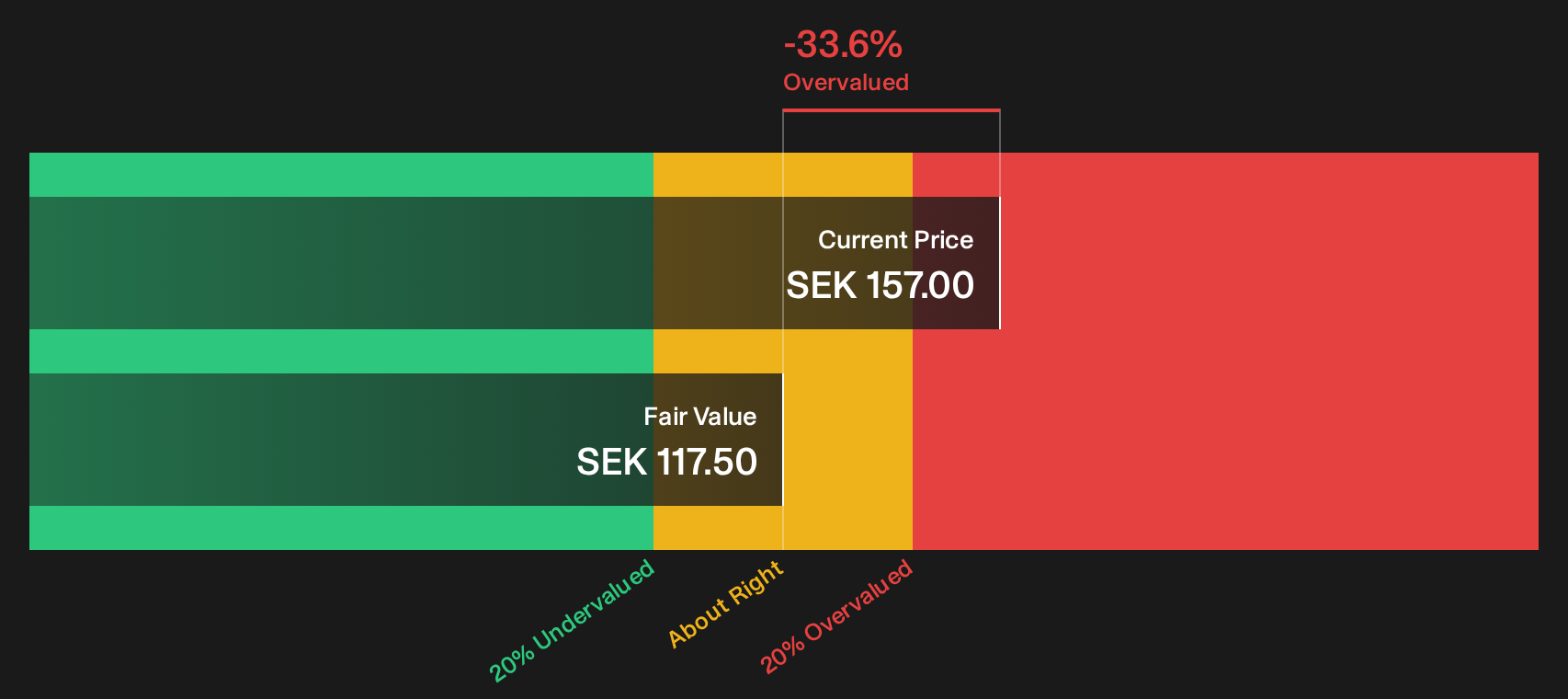
The fair value story around Beijer Ref shifts once future cash generation is put under the microscope. The SWS DCF model points to a value of SEK117.62 per share, with the current SEK157 price sitting above that estimate, so on this lens the stock screens as overvalued rather than undervalued.
This gap means the cash flow view asks you to pay a higher price today than the model suggests those future streams might justify. It raises a simple question for investors: Are the analyst growth and margin assumptions strong enough to bridge that DCF gap over time, or is it better treated as a valuation risk signal?
Our DCF model is only one tool in the kit. It helps you test whether the story you believe in still stacks up when every krona of projected cash is discounted back to today. Look into how the SWS DCF model arrives at its fair value.
Simply Wall St performs a discounted cash flow (DCF) on every stock in the world every day (check out Beijer Ref for example). We show the entire calculation in full. You can track the result in your watchlist or portfolio and be alerted when this changes, or use our stock screener to discover 199 high quality undervalued stocks. If you save a screener we even alert you when new companies match - so you never miss a potential opportunity.
Next Steps
Mixed signals on Beijer Ref or a clear opportunity? If investors are leaning optimistic, move quickly, review the numbers yourself, then weigh the 2 key rewards.
Looking for more investment ideas beyond Beijer Ref?
You do not need to stop your research at Beijer Ref. Use the Simply Wall Street Screener to spot other opportunities that match the way you like to invest.
- Target resilient cash generators by scanning a list of solid balance sheet and fundamentals (203 results) that can better withstand shocks and keep funding their own growth.
- Zero in on potential mispricings with a curated 199 high quality undervalued stocks that may offer more quality for every dollar you commit.
- Stack the odds toward capital preservation using a 218 resilient stocks with low risk scores that prioritises sturdier business models and cleaner balance sheets.
Have feedback on this article? Concerned about the content? Get in touch with us directly. Alternatively, email editorial-team@simplywallst.com