


AI trading is buying on dips. Isn't it working this time? Technology stock financial reports were severely punished, and the volatility of US stocks soared
The Zhitong Finance App learned that in the US stock market, stock investors are imposing one of the harshest penalties in history on companies whose performance falls short of expectations; at the same time, strategists are warning that profit growth may have peaked.
Missing expectations comes at a cost: the sell-off in the communications services sector is the steepest since 2019
Amazon (AMZN.US) fell on Friday, becoming the latest company to experience a sharp sell-off after earnings reports. The collapse of AI-related stocks dragged the main benchmark index into the worst day since June. The day before, the performance of Google's parent company Alphabet (GOOGL.US) was disappointing, and the stock price recorded the biggest drop in recorded history. Today, investors in the communications services sector are punishing less than expected performance, reaching the highest level since Bloomberg began collecting this data in 2019; the same dynamic is unfolding in the highly weighted technology sector.
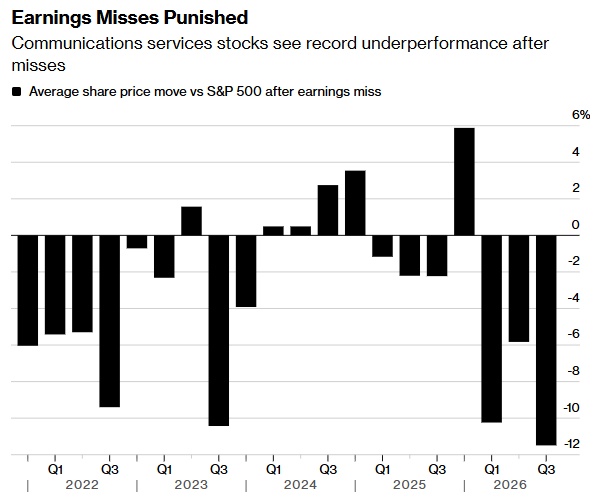
Chris Zaccarelli, chief investment officer at Northlight Asset Management, said that the market is “much more sensitive than normal” and investors would rather sell first and ask questions later than be trapped to bear further losses.
Profit growth is decelerating
From Wells Fargo to Franklin Templeton, strategists at various institutions have been predicting in recent weeks that the S&P 500's corporate profit expansion will slow down as interest rates rise, tariff pressure, and high oil prices drag down performance. By about one-third of the earnings season, these predictions were verified: the data showed that profit growth had slipped to around 26% — still high by historical standards, but lower than 32% in the second quarter.
The deceleration is led by the largest sector in the market. According to the data, the profit growth rate of the technology sector is expected to fall from nearly 77% in the previous quarter to 65% in the third quarter; the communications services sector is also expected to drop to only 3.2%, which was close to 10% previously.
What's even more troubling is the difficulty of exceeding expectations: the ratio of S&P 500 companies outperforming Wall Street expectations is at its lowest level this year, and this is true in various sectors such as technology, optional consumption, and finance.
Keith Lerner, chief investment officer and chief market strategist at Truist Advisory Services, said: “If 50% of the market were concentrated in these two segments, people would ask for something extra, and they would need more evidence to prove that the deal still stands.” Slowing growth is challenging this narrative.
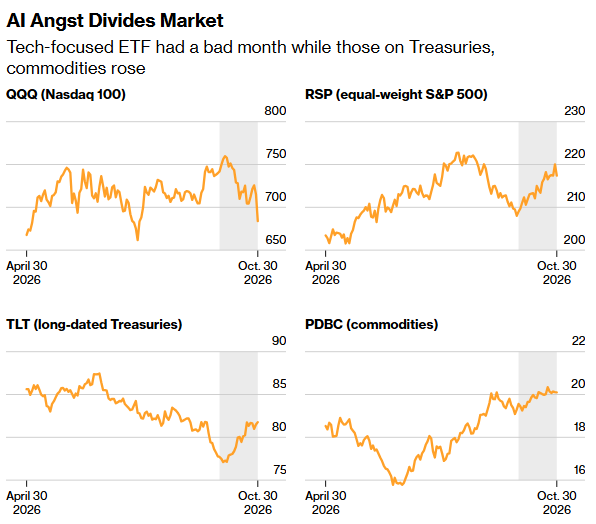
The truth is that only two sectors, technology and communications services, are declining this month, and every other corner of the market is rising.
The climax of the three-week sell-off: the NASDAQ 100 fell 3.5%, and Intel (INTC.US) recorded the biggest decline in more than 40 years
The three-week debacle was driven by growing anxiety about whether the technology could generate enough profits to support a debt-driven investment boom. Friday was its climax: the Nasdaq 100 index fell 3.5%, the deepest one-day decline since early June.
Intel plummeted 29% due to weak sales guidance, the biggest drop in more than 40 years, and dragged down other chip makers such as Nvidia (NVDA.US) and Broadcom (QCOM.US). Both Amazon and Alphabet are falling — they are sticking to aggressive AI spending plans even as core businesses cool down. As losses continued to expand during the day, declines also dragged down other major indices, and capital flocked to traditional havens.
The three major US stock indices collectively closed down: the Dow fell 1.09%, the S&P 500 fell 1.82%, the Nasdaq Composite Index fell 2.86%, the Philadelphia Semiconductor Index fell 7.2%; and Intel fell 28.58% in a single day, the biggest one-day decline in over 40 years. The closing decline was less than the deepest level of the session, but the S&P 500, which once fell 2.5% during the session, indicates that the selling pressure is complete.
Eric Beiley, executive managing director of wealth management at The Beiley Group under Steward Partners, said, “These fluctuations are frightening — they show that there is a lot of risk in the stock market.” The agency has been hedging exposure to chip stocks and buying shares in healthcare and consumer companies. “Investors are becoming increasingly nervous and uncertain whether AI spending will actually pay off.”
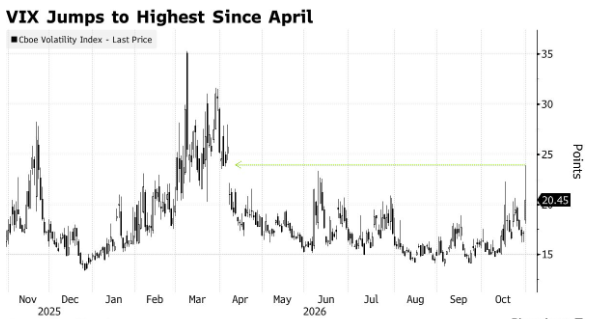
Volatility: VIX hits highest since April
US options volatility soared on Friday. The Cboe Volatility Index (VIX) hit its highest level since April in intraday time, and investors scrambled to buy protection against a further decline in the S&P 500 index — the benchmark index once fell 2.5% to 7527 points.
The sell-off earlier this month focused on the tech-focused Nasdaq 100 index, while Friday's decline spilled over to a wider range of stocks. There was demand for overall portfolio hedging in the market, and VIX call options were particularly boosted by buying. The bad days of technology stocks are usually good for value sectors, such as essential consumer goods; however, the trend of various stocks was more synchronized during the sell-off on Friday.
“Once the S&P 500 fell below 7600, that rotating deal seemed to break down a bit,” said Brent Kochuba, founder of the options research firm SpotGamma. “We are now facing a decent sell-off.”
Another detail is that volatility has previously been seriously underestimated: since the US reached a fragile cease-fire with Iran in April, stock market volatility has been suppressed against other assets such as interest rates. Prior to Friday's opening, although futures indicated that the stock market would open significantly lower, the S&P 500 options market had a fairly calm price fluctuation of 0.5%. “Prior to this incident today, S&P's volatility was really underestimated,” Kochuba said.
This time, the buyout did not pay off
This isn't the first time that tech stocks are feared; past pullbacks have all rewarded the “buy with a drop” mentality — chipmakers that have benefited from AI spending have rebounded time and time again. But since the Nasdaq 100 began another round of decline at the beginning of this month, this has not happened: rising interest rates are squeezing companies and amplifying concerns about whether AI can deliver the expected profit feast.
The cost is already reflected in performance. From this month to last Friday, hedge funds lost 3.3%, with long and short combinations performing the worst against the market since the beginning of 2021 (customer data compiled by J.P. Morgan Chase).
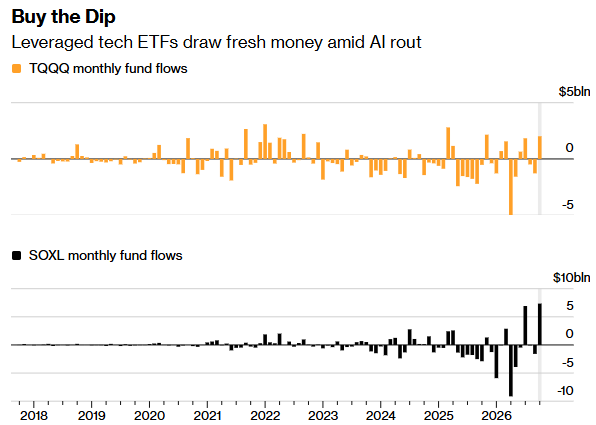
However, retail investors are still buying and falling. The Direxion Daily Semiconductor Bull 3X ETF (SOXL), which provides three times the daily revenue of the chip index, attracted a record $7 billion in capital inflows this month; ProShares UltraPro QQQ (TQQQ), which also tracks the NASDAQ 100 with triple leverage, attracted $2 billion.
Alexander Altmann, head of global equity tactical strategy at Barclays, said, “It is difficult to knock retail investors out of their positions in the short term because buying and falling is clearly always the right deal. You need to see structural changes in certain behaviors, which are more determined by the economic context than by the market itself. If people start losing their jobs, that's usually when retail behavior changes.”
The return of diversification: 60/40 correction, equal weight to run the best since 2009
The diversification strategies that were put on hold when the influx of tech stocks flooded into them have now taken on new life. Treasury bonds, investment-grade bonds, defensive stocks, and commodities combined recorded their best monthly returns since late 2020.
Mark Freeman, chief investment officer at Socorro Asset Management, said, “Momentum investing goes both ways — especially when it's overheld, as is the case now. With yields rising, investors now have options other than stocks.”
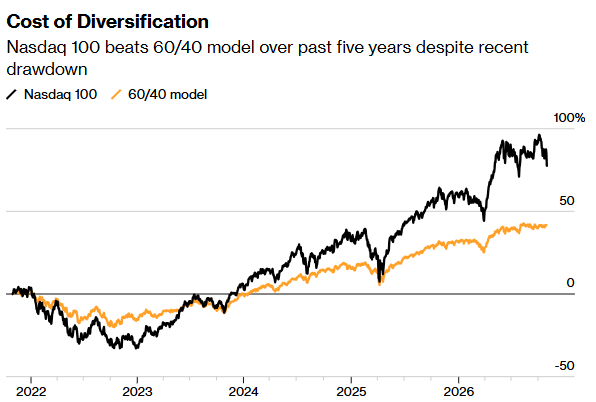
Specifically, the 60/40 equity portfolio returned more than 1% this month, thanks to the resilience of fixed income; the largest ETF (TLT) tracking long-term treasury bonds rose by more than 5%, the best monthly performance in over a year. Within stocks, utilities and essential consumer goods, which are seen as less sensitive to economic fluctuations, each rose more than 10% in October; the S&P 500, which treated Meta and Fox equally and eliminated excessive influence from large companies, rose nearly 5%, and recorded the best monthly excess performance since 2009 compared to the market capitalization weighted version. Energy stocks provided an additional buffer as crude oil prices rose.
Another safe-haven signal: less volatile stocks outperformed more volatile stocks, the biggest since 2002.
Semiconductor stocks led the decline in the tech sector in October, with both Alphabet and Meta reporting negative free cash flow, highlighting the risk of companies borrowing heavily to compete for AI dominance — which will drive global bond issuance to record highs in 2026.
Sarah Ketterer, CEO of Causeway Capital Management, said, “Investors are uneasy because the promise of free cash flow is now even farther.”
But really unrelated assets aren't easy to find
It's not easy to completely decouple from AI. In recent years, speculation about the impact of AI has reshaped the stock market: it has boosted expected winners while hitting established software companies that are seen as losers. Even treasury bonds may have been affected — a torrent of corporate bond issues is competing with the US government for investors' cash.
Jack Janasiewicz, portfolio manager at Natixis Investment Managers, said that all of this makes it difficult to find assets that are truly diversified and aren't influenced in some way by AI emotions. “Positive correlation is one thing; negative correlation is another. But what you really want is zero correlation, because that means all types of assets can go up and go their own separate ways. It's one of the biggest issues we've had to deal with over the past few months to ensure we have a better balance between AI and non-AI transactions.”
The year after the peak is the key
For the bulls, the framework isn't about “whether or not it peaks.” Research estimates that the S&P 500's profit growth rate will be closer to 20% from 2027 to the first quarter of 2028. Jeff Schulze, chief investment strategist at the Franklin Templeton Research Institute, points out that this level is above the historical 10% threshold required for “the market to continue to rise after peaking growth.”
“More important than a peak in earnings is how fast your profit grew in the year after peaking,” Schulze said. According to this outlook, “If we only deliver on current market earnings expectations for 2028, the 2027 S&P 500 could bring high single-digit to low double-digit returns.”
Kimberly Forrest, chief investment officer at Bokeh Capital Partners, said that investors are “cutting excess earnings on some technology stocks” and buying other cheaper stocks rather than completely retreating from a stock market that will still achieve profitable growth (even at a slower rate).
Zaccarelli's reminder is more straightforward: “If profits in a particular area fall short of expectations, I think you'll see rapid repricing in all relevant areas.”