


How Investors Are Reacting To Severn Trent (LSE:SVT) Bonus Ban
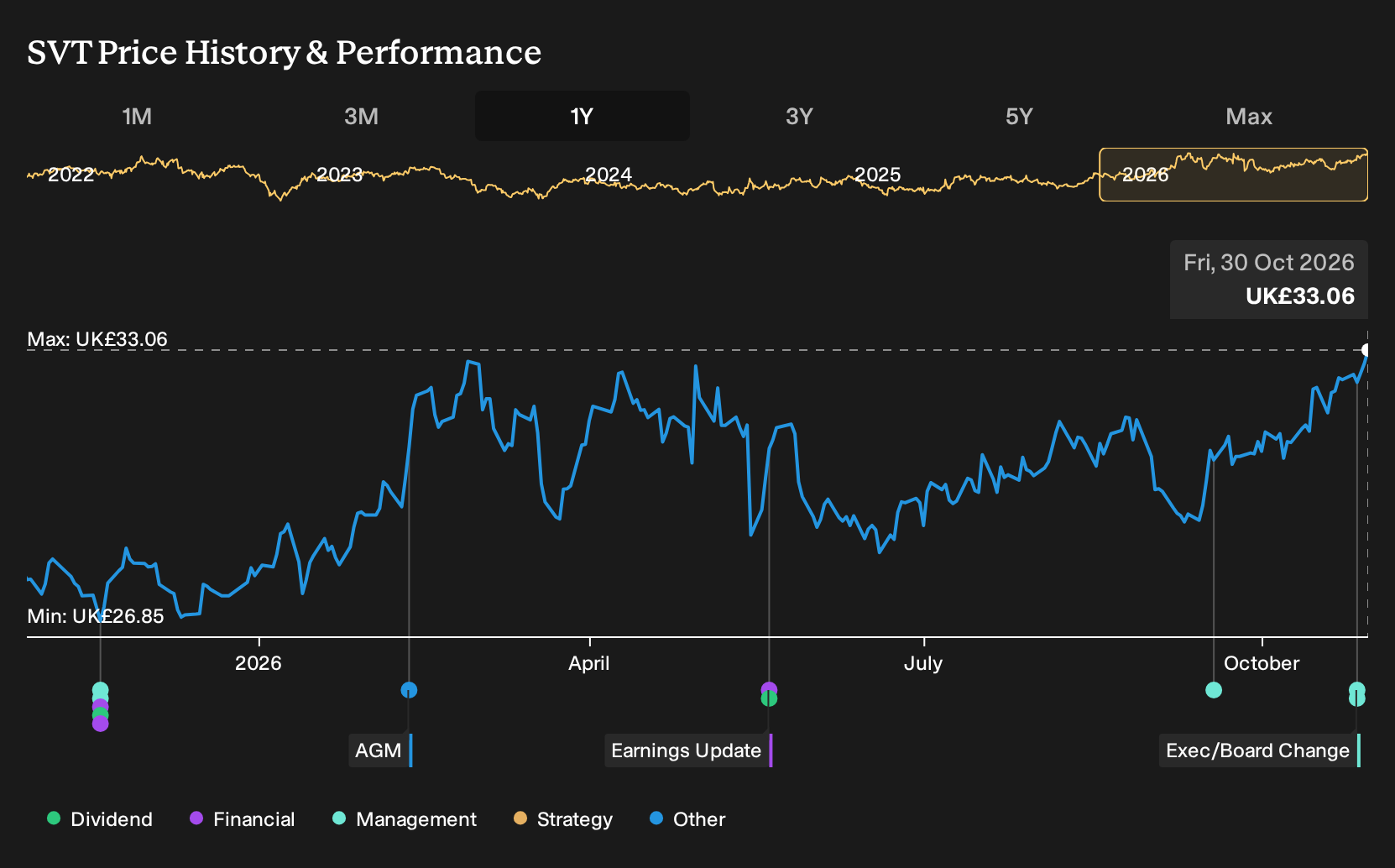
- Severn Trent reported that CFO and Executive Director Helen Miles will leave after a 12 month notice period to become CFO of Vistry, while the Environment Agency confirmed that Severn Trent executives are blocked from receiving bonuses because the utility was held liable for category 1 pollution incidents despite a four star environmental rating.
- The bonus restriction increases pressure on Severn Trent's leadership at a time when management is already managing a CFO transition and regulatory scrutiny around serious pollution events.
- We will now look at how Severn Trent's investment narrative may shift as executive bonuses are withheld following serious pollution findings.
Compare how Severn Trent's situation stacks up against a hand picked 5 resilient stocks with low risk scores that aim to keep regulatory and balance sheet shocks to a minimum.
Severn Trent Investment Narrative Recap
To own Severn Trent you need to be comfortable with a heavily regulated utility that is leaning on a £15b AMP8 investment plan, ODI rewards and efficiency gains to support its earnings profile. The bonus ban and pollution finding raise questions about how regulators judge performance, although the operational plan around asset growth and cost savings still sits at the centre of the near term story.
The biggest immediate swing factor is how Ofwat and the Environment Agency treat Severn Trent in ongoing determinations and investigations. The key risk right now is that tighter outcomes on allowed returns, penalties or ODI rewards collide with rising enhancement totex, which could squeeze net margins if efficiency targets prove hard to deliver.
The announcement that CFO Helen Miles will leave Severn Trent after a 12 month notice period to join Vistry is the most relevant update. A long handover should help continuity as the utility pushes on with AMP8 spending, AI enabled monitoring and renewable self generation projects that underpin its ODI and efficiency ambitions.
A CFO search running alongside regulatory scrutiny and the bonus restriction keeps execution risk in focus. Investors will likely pay close attention to the new finance lead’s ability to keep funding costs under control, protect interest coverage and support a dividend that is currently described as not well covered by earnings or free cash flow.
How Severn Trent’s Forecasts Line Up With Bonus And Regulatory Pressure
Forecasts for Severn Trent point to a business that analysts still model around revenue growth, higher margins and larger earnings, even as regulators block bonuses and probe serious pollution incidents. The numbers matter because they show how much headroom is built into expectations at a time when management attention is split between fixing operational failings and keeping a £15b AMP8 plan on track.
On the revenue side, analysts are working off an annual growth assumption of 9.3% over the next three years. That is the pace implicitly underpinning the latest consensus view on the stock and it reflects a belief that the regulated asset base and ODI rewards can support higher allowed income under the current plan.
Profitability assumptions move in the same direction. Forecasts use a margin profile that rises from 13.1% earnings today to 16.5% in about three years, which is a meaningful uplift when layered onto a growing asset base. For a reader, the key point is that Severn Trent is being modelled as a utility that not only grows its top line but also converts a larger slice of that turnover into profit.
At the earnings level, consensus figures frame the debate in concrete terms. Earnings today are quoted at £371.0m, with analysts expecting £609.2m by around 2029, which is an increase of about £238m. That trajectory sits alongside an earnings per share figure of £2.03 in the forecast period and assumes the share count remains broadly flat, so the uplift is driven by operations rather than financial engineering.
Severn Trent's narrative projects £3.7b revenue and £609.2m earnings by 2029. This requires 9.3% yearly revenue growth and an earnings increase of about £238m from £371.0m today.
Valuation assumptions knit these operational metrics into a single reference point. Analysts are using those 2029 earnings of £609.2m to anchor a consensus price target of £32.57, which implies a P/E of 20.0x on the forecast figure, compared with 25.2x on current earnings and 18.4x for the wider GB water utilities peer group. That mix of slightly lower future P/E than today, but still higher than the sector, indicates that the market view bakes in some premium for the business even after the pollution rulings and bonus block.
The forecast revenue of £3.7b by 2029 is the other key plank in that fair value story. It reflects the expectation that Severn Trent will keep converting its AMP8 capex programme, ODI incentives and efficiency savings into allowed turnover over time. Any change in regulatory appetite for rewards and penalties, or any slippage in delivery on PFAS, dry weather flow work and energy projects, could push the actual top line away from these modelled paths.
For investors weighing Severn Trent against lower risk utilities screened to minimise regulatory and balance sheet shocks, these consensus inputs give a clear hurdle rate. To match the analyst script, the group needs to hold revenue on a roughly 9.3% annual path, lift margins into the mid teens, convert that into around £609.2m of profit by 2029 and still trade on a 20.0x P/E that sits above the sector. The bonus cap and pollution findings introduce an extra question mark over how much regulatory trust and financial slack Severn Trent really has to deliver that mix.
Uncover why Severn Trent's fair value aligns with its current price.
Exploring Other Perspectives
The Simply Wall St Community offers three fair value views on Severn Trent, stretching from £9.20 to about £32.57 per share, which already signals wide disagreement among private investors. Set that against bonus bans, regulatory investigations and a CFO transition, and you are looking at a story where you really need to compare several competing narratives before committing fresh capital.
Explore 2 other Severn Trent fair value estimates, including one that suggests it could be worth as much as £32.57.
Form Your Own Verdict
Don't just follow the ticker. Dig into the data and build a conviction that's truly your own.
- A great starting point for your Severn Trent research is our analysis highlighting 2 key rewards and 2 important warning signs that could impact your investment decision.
- See our latest analysis for Severn Trent. The report includes a comprehensive fundamental analysis summarized in a single visual, the Snowflake, making it easy to evaluate Severn Trent's overall financial health at a glance.
Looking For More Investment Ideas Beyond Severn Trent?
If Severn Trent is only one piece of your watchlist, it can help to compare it with other companies that score well on the factors you care about most. The Simply Wall St Screener lets you filter for different styles of opportunity so you can pressure test your thesis against fresh ideas.
- If capital preservation and a smoother ride matter most to you, start with a 5 resilient stocks with low risk scores that aims to keep business shocks and drawdowns contained.
- If you prefer to let the numbers work in your favour, scan a 12 high quality undervalued stocks that combines quality fundamentals with what analysts see as room in the share price.
- If you are hunting for income ideas, focus on a 5 dividend fortresses that offers yields above 5% while still aiming for resilience.
Have feedback on this article? Concerned about the content? Get in touch with us directly. Alternatively, email editorial-team@simplywallst.com