


How Investors Are Reacting To Levi Shares After Earnings Beat
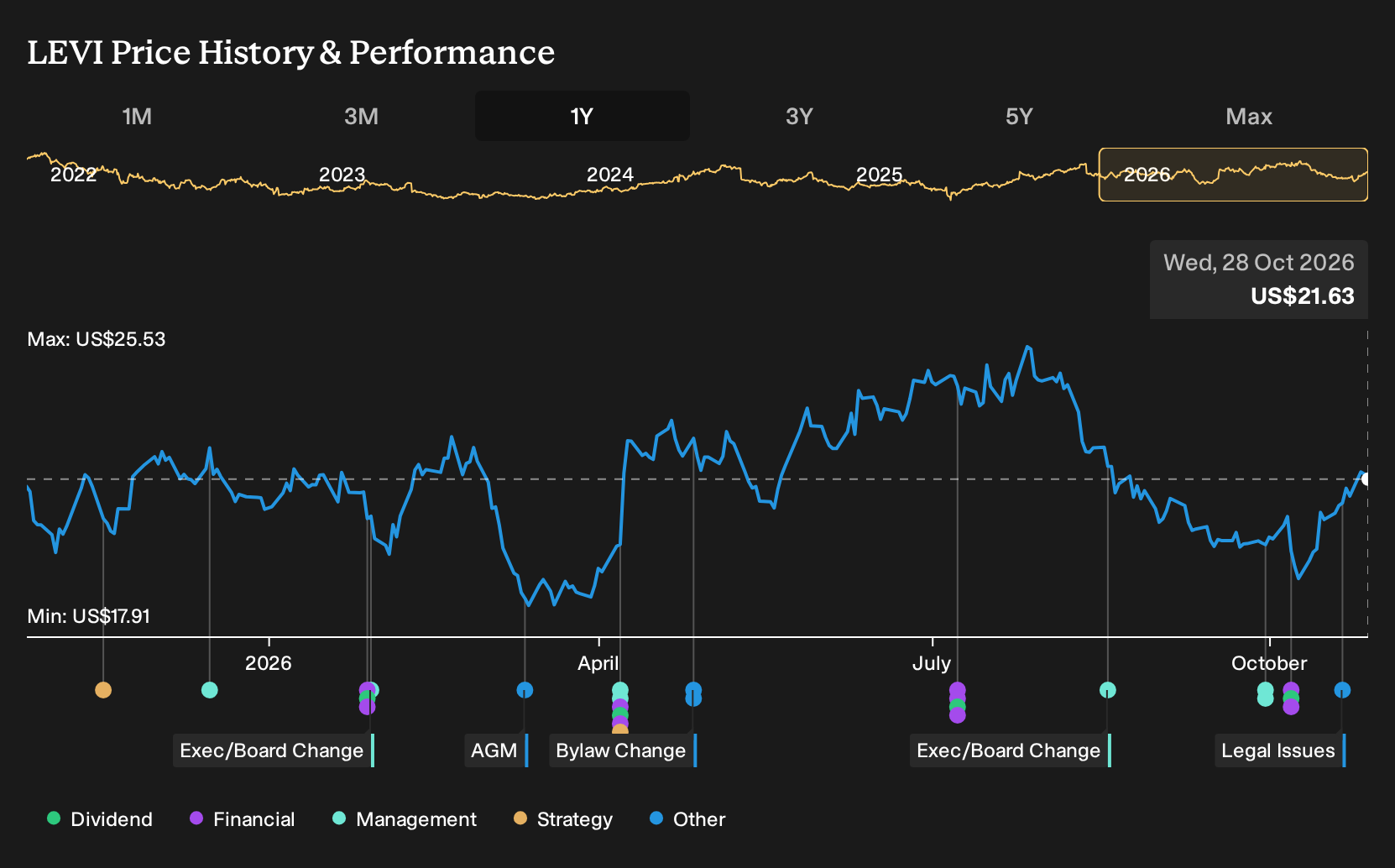
- Levi Strauss recently faced a class action lawsuit over past tariff related price increases, while also reporting quarterly revenue of US$1.61b and earnings that exceeded analyst expectations.
- The combination of higher ticket prices on core items like Ribcage Straight Ankle and original fit jeans, along with stronger international and direct to consumer performance, raises fresh questions about how pricing power and legal risk interact for Levi Strauss.
- Now the focus turns to how Levi Strauss's earnings beat and tariff related lawsuit could reshape the longer term investment narrative.
Levi Strauss Investment Narrative Recap
To own Levi Strauss, you need to believe the apparel group can keep leaning into higher margin mix, especially direct to consumer, women’s and premium denim, while keeping supply chain projects like Groveport from eating those gains. The recent tariff lawsuit targets how past prices were set rather than the health of core demand, so the near term product and channel mix catalyst still sits in the foreground.
The bigger risk near term sits in execution. Extra legal costs or potential customer refunds could pressure margins at the same time as logistics expenses and DTC investments remain high. If that combination slows margin progress or crimps cash available for growth initiatives, the current earnings trajectory could be harder to maintain.
The class action suit over tariff related price increases is the announcement that matters most here because it touches pricing power, brand perception and future profitability in one go. Levi Strauss applied for an US$80 million tariff refund, while consumers paid higher ticket prices on items such as Ribcage Straight Ankle and original fit jeans without clear disclosure.
For you as an investor, the link back to catalysts is straightforward. The equity story leans on premiumization, higher average unit revenue and growth in direct channels. All of these elements assume customers accept pricing and trust the label. Any outcome that dents that trust, or redirects future cash toward legal settlements instead of DTC, digital or international build out, would cut into that thesis.
Levi Strauss' current analyst narrative points to revenues of US$7.7b and earnings of US$836.2m by 2029, based on assumed 5.2% yearly revenue growth and an earnings increase of about US$282.1m from US$554.1m today.
Uncover why Levi Strauss' fair value indicates a 27% potential upside to its current price, which could close faster than many investors expect.
Exploring Other Perspectives
For a very different angle, focus on the legal risk itself. The most bullish analysts were assuming Levi Strauss could lift revenue to about US$8.2b and earnings to roughly US$941.3m by 2029, with margins rising to 11.4%. Those numbers came before this tariff lawsuit, so you should expect opinions to shift and should explore several viewpoints.
Explore 4 other Levi Strauss fair value estimates, including one that indicates up to 27% potential upside from the current price.
Decide For Yourself
Don't just follow the ticker. Dig into the data and build a conviction that's truly your own.
- A great starting point for your Levi Strauss research is our analysis highlighting 3 key rewards and 1 important warning sign that could impact your investment decision.
- See our latest analysis for Levi Strauss. The report includes a comprehensive fundamental analysis summarized in a single visual, the Snowflake, making it easy to evaluate Levi Strauss' overall financial health at a glance.
Looking for More Investment Ideas Beyond Levi Strauss?
If the Levi Strauss story has you thinking about where pricing power, balance sheet strength and income potential intersect, it can help to line it up against other businesses screened with the same discipline.
- For investors who want quality at a discount, start with companies that combine robust fundamentals and attractive valuations through the 26 high quality undervalued stocks.
- If capital preservation is front of mind, filter for businesses with steadier profiles by using the 32 resilient stocks with low risk scores.
- When you want resilience backed by solid finances, focus on companies with strong balance sheets and underlying fundamentals through the list of solid balance sheet and fundamentals (24 results).
Have feedback on this article? Concerned about the content? Get in touch with us directly. Alternatively, email editorial-team@simplywallst.com