


Google Just Solved a Major Quantum Computing Problem. Here’s Why Investors Still Have a 10-Year Wait.
Quantum computing has promised to transform everything from drug discovery to cybersecurity, potentially solving problems that would take today's most powerful supercomputers thousands of years. The technology has attracted billions of dollars in investment. But turning laboratory experiments into commercially useful machines remains an enormous engineering challenge.
Unlike artificial intelligence (AI), where businesses already generate revenue from commercial applications, quantum computing is still largely in its research phase. Yet progress is accelerating, and Alphabet (GOOGL) just delivered another breakthrough.
Google's latest achievement brings practical quantum computing closer, but investors shouldn't mistake a technological milestone for an imminent commercial revolution.
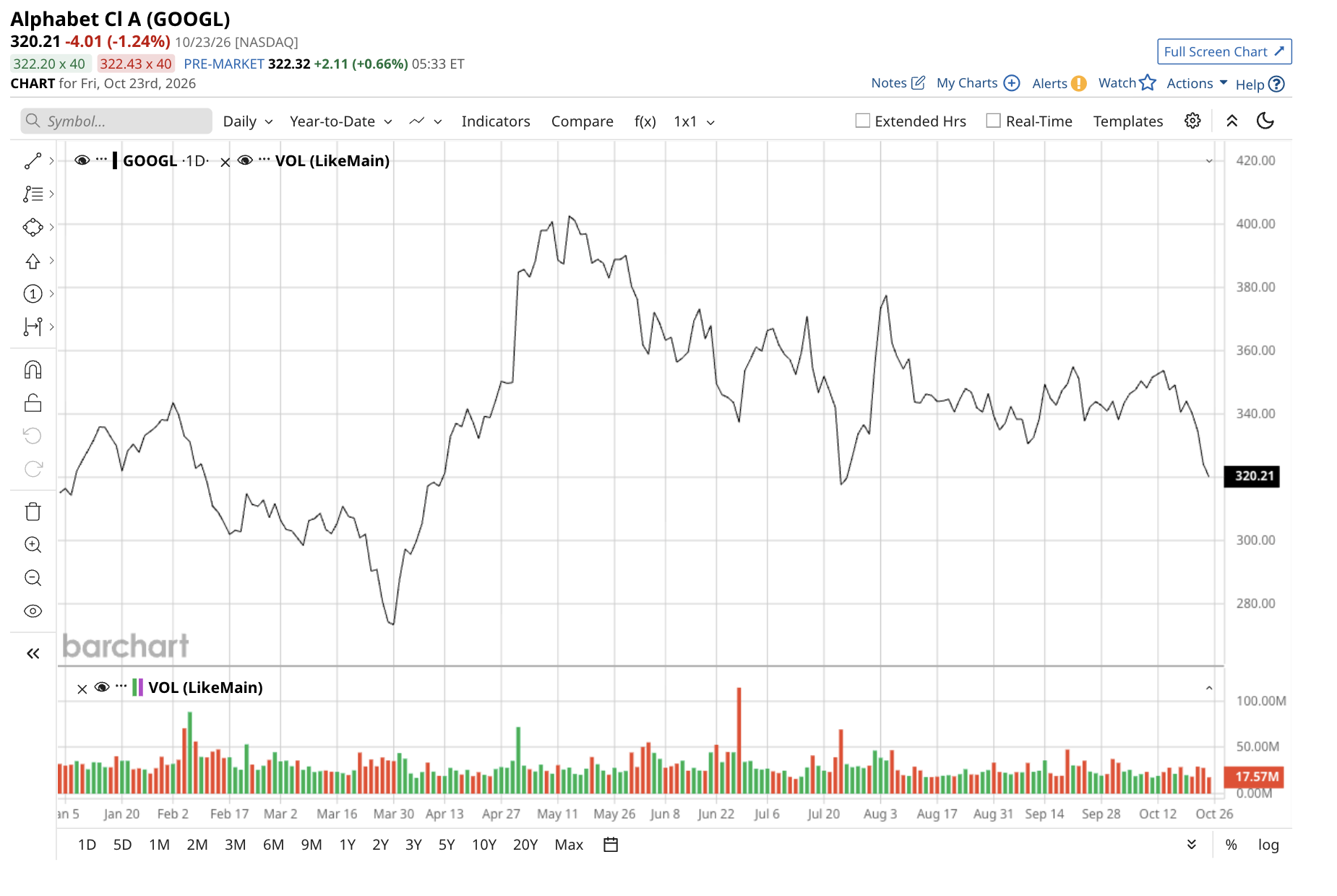
Google's 40-Fold Quantum Computing Breakthrough
On Oct. 15, Google Quantum AI announced that its Willow quantum processor successfully demonstrated a technique called "magic state cultivation."
The achievement sounds like something from a Harry Potter book, but the science behind it addresses quantum computing's biggest weakness: errors. Quantum bits, or qubits, are extraordinarily fragile. Tiny disturbances can corrupt calculations, making complex computations unreliable.
Google's technique reduced errors in specially prepared quantum states by approximately 40-fold, achieving 99.99% logical fidelity for operations called T-gates. These operations are essential for performing advanced quantum calculations.
According to Google's research team, preparing these states using older methods could consume as much as 95% of a quantum computer's capacity. The breakthrough offers a potentially more efficient alternative.
There's a catch, though. The experiment retained only about 8% of attempts, and its 40-fold improvement applies specifically to magic-state errors, not the entire quantum computer.
Google has proved the technique works. It hasn't proved that it can operate economically at commercial scale.
Why 1 Million Qubits Changes Everything
Google's Willow processor contains 105 physical qubits. Its ultimate roadmap envisions approximately 1 million. The reason for that enormous difference is that physical qubits aren't the same as logical qubits.
A logical qubit combines multiple physical qubits to detect and correct errors. Depending on the hardware, error rates, and algorithm, hundreds or thousands of physical qubits may be required to create one reliable logical qubit.
Scaling up creates three interconnected problems.
First, there's cooling. Superconducting quantum processors operate near absolute zero, requiring specialized refrigeration systems. Expanding capacity introduces additional heat that threatens their delicate quantum states.
Second, we have wiring. Physical qubits require carefully controlled electrical signals. Building systems with hundreds of thousands of qubits demands new control electronics rather than simply adding more cables.
The third issue is processing. Classical computers must continuously interpret error-correction measurements fast enough to keep quantum calculations reliable.
These hurdles help explain why companies developing quantum computing infrastructure are pursuing different architectures. IonQ (IONQ), for example, uses trapped ions rather than Google's superconducting approach.
The Commercial Quantum Computing Timeline
Google isn't alone in racing toward fault-tolerant quantum computing. IBM (IBM) has published a roadmap targeting 200 logical qubits capable of executing 100 million quantum gates by 2029, followed by 2,000 logical qubits and 1 billion gates in 2033 or later. IBM's commitment to commercial quantum computing infrastructure illustrates why the next decade could reshape the industry.
Yet these are engineering targets, not guaranteed commercial launch dates. Early fault-tolerant systems also won't necessarily deliver widespread economic benefits immediately. That explains why the 2030 to 2035 period remains a reasonable planning horizon for increasingly capable quantum systems, rather than a firm deadline for mass adoption.
The Key Takeaway
In short, Google's achievement removes uncertainty surrounding one critical quantum-computing technique, but scaling that discovery into a commercially valuable machine remains years away.
For investors, Alphabet offers exposure to quantum computing without requiring the technology to generate near-term profits. The company's existing advertising and cloud businesses provide a financial foundation that smaller quantum specialists lack. Meanwhile, government investment in quantum computing could support development across the industry.
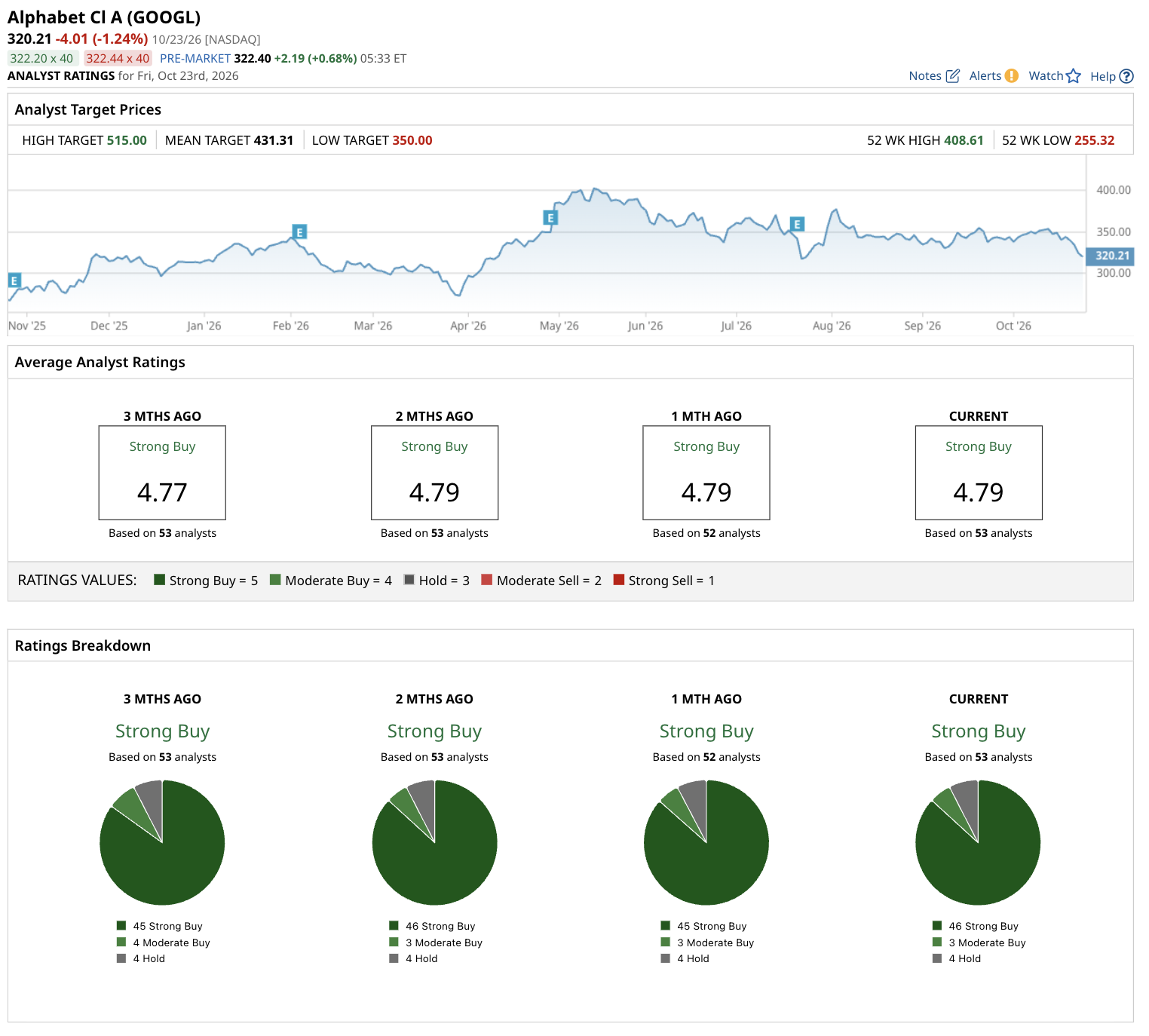
Wall Street remains bullish on Alphabet, with 46 of the 53 analysts with coverage rating GOOGL stock as a "Strong Buy." The mean price target of $431.31 implies 35% potential upside from current levels, but few analysts are factoring quantum computing into their calculations.
Still, the opportunity is enormous. But commercial success will ultimately depend on how reliably, affordably, and repeatedly these machines solve real-world problems. Google has taken another step toward that future. The finish line remains some distance away. Alphabet stock may be one you want to ride to that destination.
On the date of publication, Rich Duprey did not have (either directly or indirectly) positions in any of the securities mentioned in this article. All information and data in this article is solely for informational purposes. For more information please view the Barchart Disclosure Policy here.