


Higher Short Term Yields Could Lift Progressive Stock And Other U.S. Insurers
Markets are glued to every Fed word right now, as sticky inflation, oil at triple digits and talk of more hikes keep pressure on valuations and nerves tight. Short term yields have moved from background noise to a potential swing factor for investors who care where insurers park their cash. This piece unpacks that story and then spotlights three U.S. property and casualty stocks exposed to this rate narrative.
The three insurers covered below are only a starting sample, and the full screen surfaced 23 more U.S. property and casualty groups with equally compelling rate stories and underwriting angles that this article does not touch.
If you want to identify, compare and analyze the full universe of potential beneficiaries of higher short term yields, head straight to the U.S. Property & Casualty Insurers Benefiting from Higher Short-Term Yields screener.
Progressive (PGR)
Progressive sits near the center of this higher short term yield story, because its large personal and commercial auto book, plus related property lines, feed into a sizeable bond portfolio where elevated rates can quickly filter into earnings.
Progressive is a major U.S. personal and commercial insurer focused on autos, specialty vehicles and property, earning all of its roughly US$91.7b in revenue in the United States, with a market value of about US$132.2b.
"Progressive's scale, data analytics, and rapid pricing response mechanisms continue to support share gains in personal auto as it now holds 18.6% market share and has become the largest U.S. personal auto writer by direct premiums written. This position can influence net premiums written and earnings."
The real swing factor for Progressive in a higher rate world is how one pressure on profitability evolves from here.
That pressure point is exactly what the full narrative for Progressive unpacks, showing how Progressive could convert higher short term yields into accelerating earnings power without losing underwriting discipline.

Selective Insurance Group (SIGI)
Selective Insurance Group taps directly into the higher short term yield theme by pairing traditional P&C underwriting with a sizeable, bond-heavy investment portfolio that can turn today’s rate backdrop into a meaningful earnings engine.
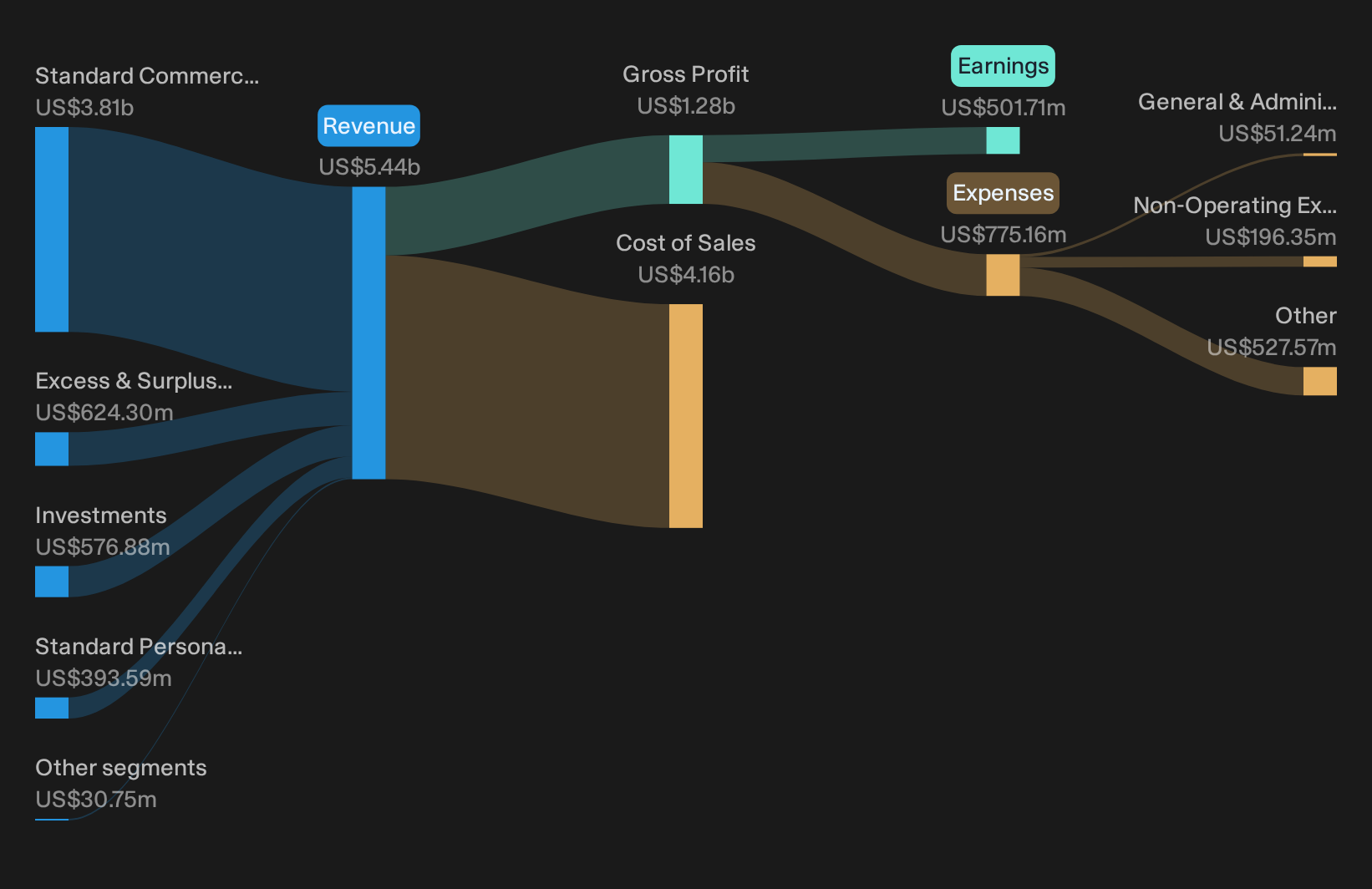
Selective Insurance Group provides U.S. casualty, property and flood coverage across commercial, personal and E&S lines, with most revenue from Standard Commercial Lines at about US$3.8b, E&S at US$624 million and personal lines at US$394 million, plus US$577 million from investments. The company has a market value near US$5.7b.
"The increasing contribution from net investment income, with after tax NII of about US$119m in 2Q 2026 and updated 2026 guidance of US$480m, is supported by an A plus rated fixed income portfolio and could remain a key driver of overall earnings, even if premium growth in some lines is constrained by underwriting discipline."
A key question is what happens to margins if one pressure point inside the casualty book proves tougher to control than current assumptions imply.
If that pressure point is tougher than it looks, the full narrative for Selective Insurance Group shows how Selective Insurance Group could still turn the rate backdrop into accelerating earnings power.
Kinsale Capital Group (KNSL)
Kinsale Capital Group is a U.S. specialty property and casualty insurer aligned with this higher short term yield theme, since its traditional underwriting model and bond portfolio tie operating results closely to where short dated rates settle.
Kinsale Capital Group generates all of its roughly US$2.0b in revenue from excess and surplus lines insurance in the United States and has a market value of about US$8.2b.
Kinsale Capital Group writes niche commercial and high value personal policies nationwide through independent brokers, so every underwriting decision and investment move feeds into how effectively the firm can turn today’s interest rate backdrop into sustainable profit.
"A structural cost edge, reflected in an expense ratio around 21% compared with many peers in the mid 30s or above 40%, suggests Kinsale’s profitability advantage is already well established and can keep net margins strong enough to justify a premium valuation even as top line growth moderates."
The key issue for Kinsale Capital Group is what happens if one quiet pressure inside its specialty book starts to reduce those cost and pricing advantages.
If that quiet pressure is masking something bigger in Kinsale Capital Group’s specialty book, the full narrative for Kinsale Capital Group shows how the cost edge could still accelerate.

Seeking Alternatives Before The Crowd?
Fresh ideas often move first. Strong balance sheets, new themes and early momentum can advance once money rotates, leaving latecomers chasing moves that already reversed. Act now.
- Spot under-the-radar quality before momentum headlines hit by running the 21 high quality undiscovered gems that filters for robust fundamentals while the stories are still under the radar for now.
- Target resilient compounders while volatility distracts everyone else and scan the 30 resilient stocks with low risk scores so you focus on sturdier businesses before the crowd notices.
- Follow potential infrastructure buildouts as grids modernize globally and track suppliers with the 42 power grid technology and infrastructure stocks while it still reflects early stage momentum.
Have feedback on this article? Concerned about the content? Get in touch with us directly. Alternatively, email editorial-team@simplywallst.com