


Did Strong Q3 Earnings Just Shift PNC’s (PNC) Investment Narrative?
- PNC Financial Services Group reported third quarter 2026 results with net interest income of US$4,206 million and net income of US$2,081 million, alongside completed fixed income offerings totaling US$1.5b in variable rate senior notes due 2029.
- The mix of higher net interest income, rising net loan charge offs of US$257 million and new callable unsecured funding provides a clearer view of how PNC Financial Services Group is balancing earnings, credit costs and capital structure.
- We will now look at how PNC Financial Services Group's higher net interest income fits into its broader investment narrative and long term story.
Compare PNC Financial Services Group's funding and earnings mix with a curated list of solid balance sheet and fundamentals (24 results) that may offer similar credit discipline and capital structure stories.
PNC Financial Services Group Investment Narrative Recap
For PNC Financial Services Group, being a shareholder means believing the bank can keep converting its tech and AI spending, branch buildout and fee businesses into steadier earnings, even as credit costs fluctuate. The recent jump in net interest income and net income suggests the core engine is working, while fee lines and expenses remain key swing factors.
The short term catalyst is execution on efficiency and digital initiatives that aim to support margins without over relying on loan growth. Rising net loan charge offs and any turn in credit conditions sit as the biggest operational risk. The new callable variable rate funding slightly refines the balance sheet but does not fundamentally change that risk reward equation.
The fresh US$1.5b of senior unsecured variable rate notes due 2029 looks most relevant here because it directly touches PNC Financial Services Group’s funding and interest rate profile. Callable fixed to floating and pure floating structures give management more levers to match asset yields and deposit behavior, especially as the rate cycle evolves.
This funding move sits alongside the earnings update as a test of how well the bank aligns its capital structure with its AI heavy efficiency program and branch expansion plans. For investors, the key question is whether this mix of higher net interest income, controlled expenses and actively managed wholesale funding supports the catalysts more quickly than credit costs, fee volatility or sentiment headwinds undermine them.
Analyst Framework Behind The PNC Financial Services Group Story
Analysts are tying PNC Financial Services Group's long term tech and branch expansion plan to a specific financial destination rather than just broad optimism. The forecasts assume revenue grows by 5.4% a year while profit margins stay at about 30.2%. This keeps the model grounded in a steady earnings profile instead of a big margin reset. That combination underpins the view that the current AI heavy efficiency spend and physical footprint buildout can feed into a larger but similar quality earnings base over time.
The earnings bridge is explicit. Consensus points to profit of US$8.8b by 2029 from about US$7.5b today, which implies an increase of roughly US$1.3b over the period. That step up lines up with the thesis that AI supported cost control and growing fee based lines can add scale without materially changing how the bank earns each dollar. For investors, the question is less about hyper growth and more about whether this measured uplift in earnings feels achievable given what PNC Financial Services Group is already doing in technology, automation and branch expansion.
On revenue, the same 2029 marker is doing a lot of work. The analyst setup requires PNC Financial Services Group to reach about US$29.2b in sales while holding earnings at roughly US$8.8b. That outcome keeps the implied margin near the current 30.2% level and supports the idea that management is aiming for operating leverage that is meaningful but not transformative. If you think the AI program, national expansion and fee income mix can sustain a 5.4% annual top line climb with margins roughly flat, the long term narrative is internally consistent with the numbers on the page.
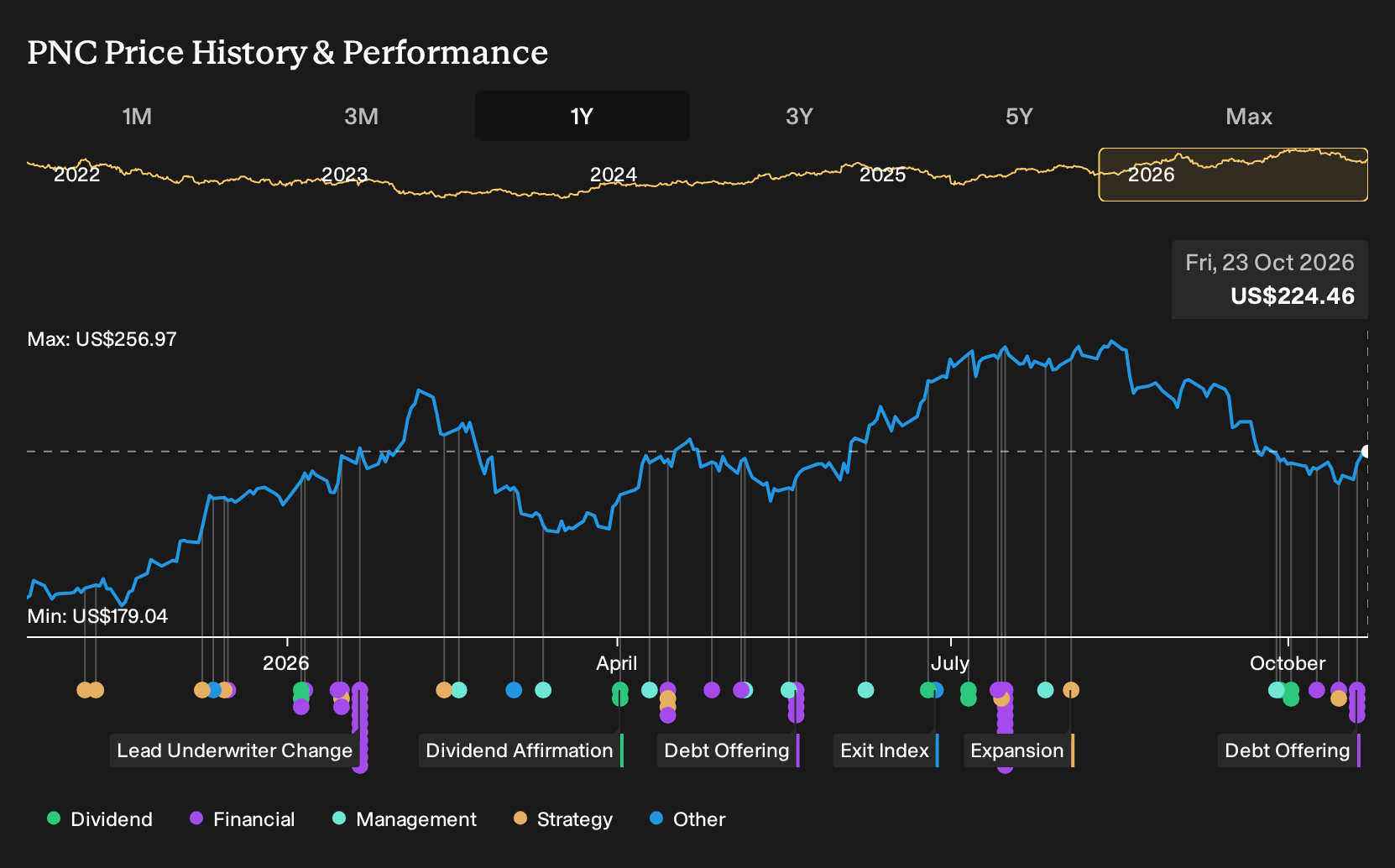
The valuation overlay then focuses on how the market might price those future profits. The consensus price target is US$263.71 per share against a recent price of US$222.89. It is built on the assumption that the stock could trade at a P/E of 15.4x on 2029 earnings, compared with about 11.7x today and 11.5x for the broader US banks group. That gap between current and assumed multiple highlights the judgment call investors face on PNC Financial Services Group. The model is not only about earnings growth. It also reflects an expectation that investors may be willing to pay a higher price per dollar of profit if the AI and branch strategy plays out as outlined.
Those same forecasts also include modest dilution through share count growth of about 1.3% a year over the next three years. That means any per share outcome you focus on, whether earnings or dividends, has to outpace the expanding share base to feel worthwhile. For holders of PNC Financial Services Group, this is where capital returns and buyback decisions intersect with the long term operating story. The more effectively management offsets new issuance with repurchases or higher profitability, the closer the per share metrics will track the headline earnings path analysts are using.
None of these figures guarantee an outcome. They convert a qualitative story about AI, efficiency and branch density into a set of revenue, margin and valuation checkpoints you can test. If your own view of fee income resilience, credit behavior or the appropriate P/E for large US banks diverges from these assumptions, you can adjust the US$29.2b revenue or US$8.8b earnings destination and arrive at a different sense of what PNC Financial Services Group is worth today. The key is treating the consensus case as a starting framework rather than a conclusion.
PNC Financial Services Group's narrative projects US$29.2b revenue and US$8.8b earnings by 2029. This requires 5.4% yearly revenue growth and about US$1.3b earnings increase from US$7.5b today.
Uncover why PNC Financial Services Group's fair value indicates a 17% potential upside to its current price that may not last much longer.
Exploring Other Perspectives
Two fair value estimates from the Simply Wall St Community span roughly US$263.71 to US$392.22 per share, which is a wide gap for the same PNC Financial Services Group earnings story. That spread, set before the latest charge offs and 2029 funding moves, shows how sharply opinions can diverge. Use it as a cue to explore several contrasting viewpoints, especially as rising credit costs and heavier AI investment shape the next phase of performance.
Explore another PNC Financial Services Group fair value estimate, including one that suggests as much as 75% upside from the current price.
Reach Your Own Conclusion
Disagree with existing narratives? Extraordinary investment returns rarely come from following the herd, so go with your instincts.
- A great starting point for your PNC Financial Services Group research is our analysis highlighting 4 key rewards that could impact your investment decision.
- See our latest analysis for PNC Financial Services Group. The report includes a comprehensive fundamental analysis summarized in a single visual, the Snowflake, making it easy to evaluate PNC Financial Services Group's overall financial health at a glance.
Looking for more investment ideas beyond PNC Financial Services Group?
If the PNC Financial Services Group story has sharpened your thinking about balance sheets, earnings quality and valuation, it can help to line it up against a wider field of potential opportunities using the Simply Wall St Screener.
- For investors who want potential value combined with quality fundamentals, scan a curated pool through 29 high quality undervalued stocks that fit a similar disciplined profile.
- If capital preservation sits high on your priority list, filter for stability first by running a search across 30 resilient stocks with low risk scores that score well on resilience.
- To widen the opportunity set beyond widely followed stocks, consider a focused universe of 21 high quality undiscovered gems that pair strong numbers with lower profile coverage.
Have feedback on this article? Concerned about the content? Get in touch with us directly. Alternatively, email editorial-team@simplywallst.com