


Learn Why The Bull Case For Veeva Systems Stock Could Change Following IQVIA Clinical Tool Standardization
- IQVIA disclosed that it has adopted multiple Veeva Systems clinical products, including CTMS, eTMF, Study Startup, and Site Connect, as enterprise standard tools for use across its clinical development portfolio.
- This deeper alignment means IQVIA can offer sponsors a full Veeva technology stack, which directly ties Veeva Systems products into more day to day clinical trial execution decisions.
- We will now look at how Veeva Systems’ broader investment narrative could shift as IQVIA standardizes on its clinical applications.
Compare Veeva Systems with other health data and clinical trial platforms by scanning a curated set of 34 healthcare AI stocks that could see similar interest as digital infrastructure becomes more embedded in drug development.
Veeva Systems Investment Narrative Recap
To own Veeva Systems, you need to believe its life sciences cloud can keep expanding into new workloads as older R&D tools like eTMF and CTMS mature. The IQVIA decision reinforces that view on the clinical side, since it puts more of Veeva’s stack directly into large trial workflows and can support broader usage if execution stays tight.
The near term swing factor still looks like how quickly newer clinical and quality modules and early AI offerings scale against that saturation risk. The biggest watchpoint remains expense pressure from AI platforms like Falcon if customer uptake or pricing lags. The IQVIA news helps sentiment around R&D Cloud, but does not remove those risks.
The IQVIA standardization is tightly linked to one of the clearest existing catalysts. Analysts already framed future R&D growth on a shift from saturated tools to newer applications such as EDC, eCOA, RTSM, Safety, LIMS and clinical AI. Having a major contract research organization run multiple Veeva clinical products as defaults lines up with that transition.
For you as an investor, the interesting part is operational. Sponsors that work through IQVIA now have an easier path to adopt a fuller Veeva Systems stack, from data capture to trial management. That can support usage growth in the newer modules that need to scale, while also raising the bar for execution, uptime and support across a larger, more complex deployment footprint.
How Consensus Forecasts Frame The Veeva Systems Setup
Analyst models around Veeva Systems give you a rough blueprint for what needs to happen for the current story to hold together. They point to a business that is already profitable today, with US$1.0b of earnings, and that is being underwritten on the idea that clinical and data products tied to IQVIA type deployments can support higher profit over time.
Veeva Systems' narrative projects US$4.9b revenue and US$1.5b earnings by 2029. This implies 12.4% yearly revenue growth and an earnings increase of about US$500m from US$1.0b today.
The same forecasts embed a modest margin lift, from 29.3% earnings today to 30.6% in three years. That is a fairly tight range. It tells you analysts are not baking in a radical shift in profitability so much as a steady expansion of the existing engine as more workloads move onto the platform.
On these October 2029 earnings estimates of US$1.5b, the sell side is working with a future P/E of 38.6x, compared with 48.1x today and a sector level multiple of 36.0x for US healthcare services. That gap to the wider industry implies investors are already paying a premium for the quality of the software mix and the perceived durability of subscription cash flows.
There is also some spread in those earnings expectations. Consensus sits at US$1.5b but the most optimistic forecasts run to US$1.7b, which gives you a sense of how much different views on AI, data and large clinical deals such as IQVIA can move the model.
Veeva Systems Valuation Check Against 2029 Targets
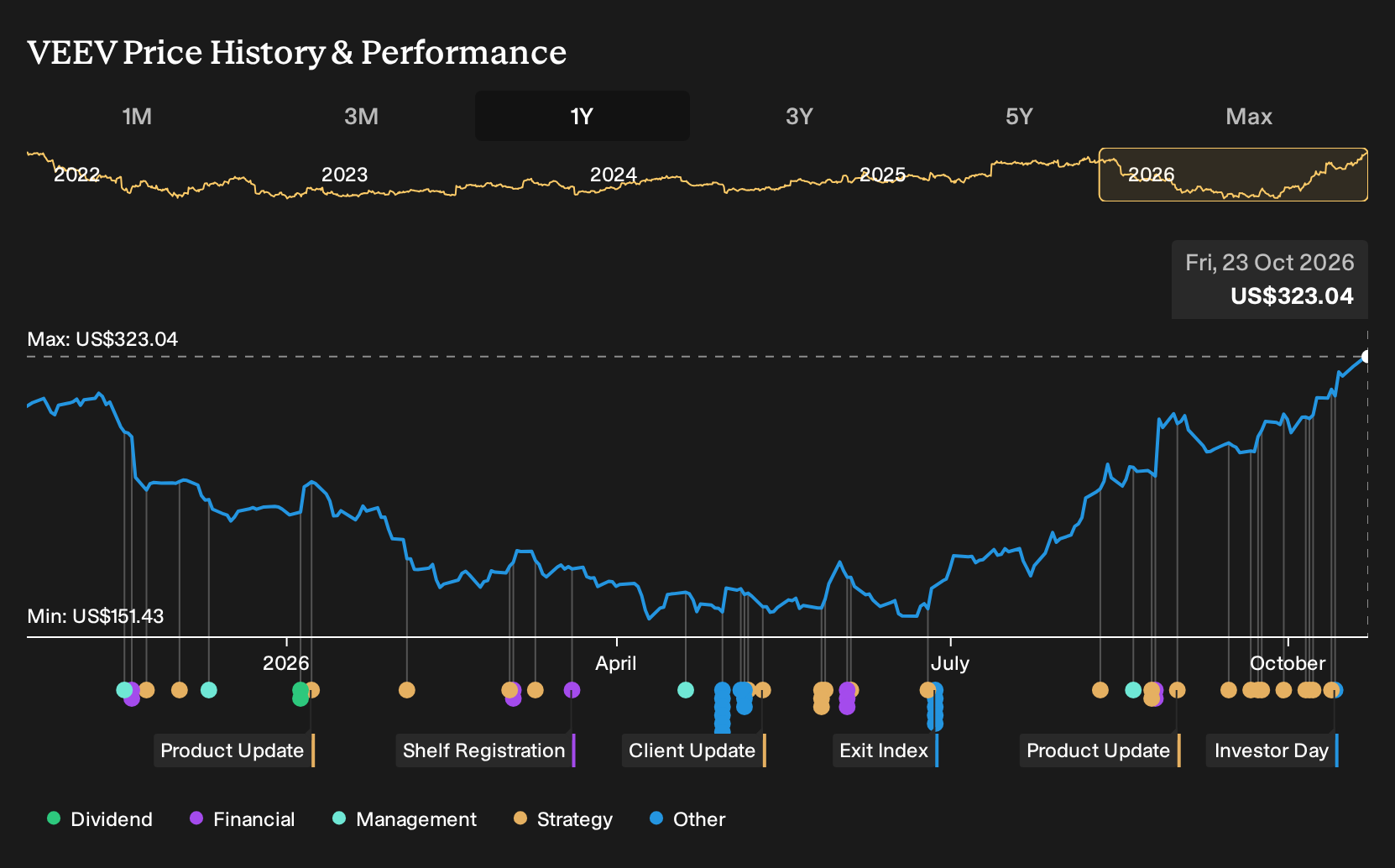
Market pricing today already leans heavily on that 2029 setup. At a recent share price of US$301.63, the average analyst target of US$297.04 sits only 1.5% lower, which signals a view that Veeva Systems is roughly in line with those embedded expectations.
To line up with that consensus, you would need to be comfortable with the idea that revenues reach US$4.9b and earnings reach US$1.5b by 2029, and that the stock trades on a P/E of 38.6x at that point. The implied discount rate for those cash flows sits around 8.1%, close to the 8.07% rate used in the Simply Wall St report, so the model is not relying on unusually cheap capital.
Analyst price targets span a wide band, from US$180.0 on the low side to US$343.0 at the top end. That range reflects very different views on how quickly newer products like Vault AI, Falcon, and the broader clinical portfolio leveraged by IQVIA actually turn into earnings.
For you as an investor, the key takeaway is simple. The current valuation already prices in meaningful progress on revenue growth, margin expansion and execution on the IQVIA aligned clinical stack, so your own thesis needs to be clear on where you agree or disagree with those 2029 assumptions.
Uncover why Veeva Systems' fair value indicates an 8% potential downside to its current price that leaves little room for error.
Exploring Other Perspectives
One alternate, more optimistic view leans heavily on Veeva Systems’ AI agents. Bullish analysts were already modeling revenue of US$5.1b and earnings of US$1.7b by 2029 before this IQVIA news. You can treat that as a ceiling scenario that may shift again as investors reassess how deeply AI ties into these new deployments.
Explore 7 other Veeva Systems fair value estimates, including one that indicates up to 19% upside from the current price.
The Verdict Is Yours
Don't just follow the ticker; dig into the data and build a conviction that's truly your own.
- A great starting point for your Veeva Systems research is our analysis highlighting 2 key rewards and 1 important warning sign that could impact your investment decision.
- See our latest analysis for Veeva Systems. The report includes a comprehensive fundamental analysis summarized in a single visual, the Snowflake, making it easy to evaluate Veeva Systems' overall financial health at a glance.
Looking For More Investment Ideas Beyond Veeva Systems?
If Veeva Systems has sharpened your appetite for quality business models, it can be useful to cross check your thesis against a wider watchlist. The Simply Wall St Screener lets you quickly filter for other opportunities that match the balance of risk, quality and income you are aiming for.
- For investors who care most about valuation support and business quality, scan a curated pool of 29 high quality undervalued stocks that already combine strong fundamentals with cheaper pricing.
- If resilience and capital preservation sit at the top of your checklist, focus your search on a 30 resilient stocks with low risk scores that tilts toward sturdier balance sheets and lower overall risk scores.
- Those hunting for ideas that the crowd may have overlooked can start with a 21 high quality undiscovered gems that filters for solid fundamentals in stocks that are not yet widely followed.
Have feedback on this article? Concerned about the content? Get in touch with us directly. Alternatively, email editorial-team@simplywallst.com