


ECB President's dispute focuses on the ability to extinguish the crisis: France's debt risk is a litmus test
The Zhitong Finance App learned that the dispute for the position of ECB president is increasingly focusing on a core issue: which candidate can best deal with the “volunteer police” in the bond market. As France's debt woes evoke memories of the Eurozone's turmoil, and current governor Lagarde is preparing to leave office early, Dutchman Claes Nott and Spaniard Pablo Hernandez Decos may soon take over amid financial turmoil.
According to people familiar with the matter, market tension has become an increasingly important factor in the ECB's next move. Observers from within the Eurozone said that the government's judgment on the candidate's ability to manage the crisis is leading the selection of the candidate for governor. Since the qualifications of the two are difficult to distinguish, it is even more important to assess their credibility, authority, and character in the midst of turmoil. For the ECB, these issues are more important in the long run because the monetary union lacks fiscal integration, and this asymmetry itself is fragile. Lagarde and both of his predecessors have experienced crises, and policymakers are still worried about more trouble.
The current problem is that the combination of global scrutiny of public finance and concerns about high energy costs has left France in trouble. Never before has market speculation focused so ominously on the Eurozone's large and critical member states. It is difficult for the French government to pass the budget. Urban unrest highlights political challenges. Treasury bond yields have been alerted, which may eventually prompt the ECB to fight the fires.
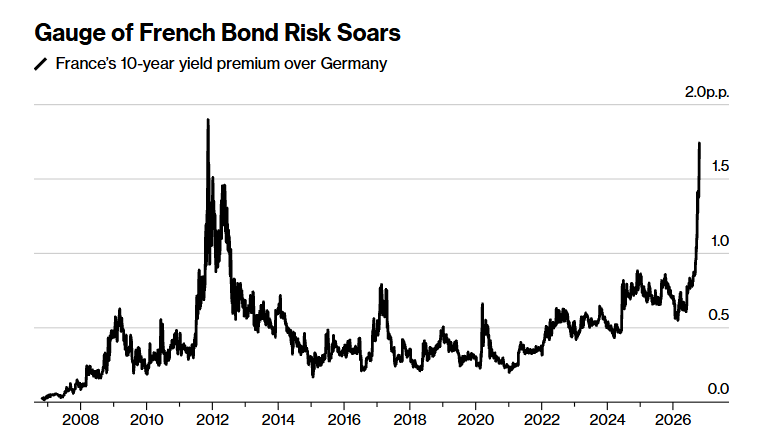
Former ECB chief economist Peter Pratt said that if the financial market collapses, the central bank must intervene, but the problem facing any governor is “how to do it and how fast”; strict conditions are needed, and all risks that may lead to fiscal dominance or weaken the central bank's independence must be avoided, and “it is particularly important right now.”
Lagarde has indicated that he will leave office early, but the timing has not been announced. Working assumptions within the Eurozone increasingly focus on leaving office in January. If so, this week's decision will be her penultimate. German Chancellor Mertz said on Monday that the Executive Board will find a solution very quickly if necessary. People familiar with the matter said he met with Decos last week and met with Nott earlier this month. Eurozone finance ministers have also extended the application deadline to replace outgoing German executive board member Schnabel from October 28 to November 27; there are signs that what the Greek prime minister called a “big deal” surrounding the position of governor and two other ECB positions is in the works.
At a time when bond market tension heats up, the next governor will have to face investors betting on the ECB's aid to France. The preferences of key countries are no secret: France values being willing to use any tool, and is exemplified by Mario Draghi's 2012 commitment to defend the euro “at any cost”; budget hawks like Germany want to set a higher threshold for action.
There was little difference in the two candidates' curricula. Nott was the governor of the Bank of the Netherlands for 14 years and the chairman of the Financial Stability Board. In his early years, he was regarded as a hawkish, and his position softened during his tenure; this month's paper for the Peterson Institute for International Economics in Washington was similar to a declaration, calling himself a “skeptic to a principled pragmatist.” In the article, he said that the acceptance of new tools, including transmission protection tools (TPIs), was not due to passion for monetary activism, but rather the recognition that allowing fragmentation to disrupt the transmission of monetary policy or the single currency is incompatible with the ECB's mission of stabilizing prices. Nott also served as a senior official in the Dutch Ministry of Finance and has experience in fiscal policy formulation and political trade-offs.
Decos is currently the president of the Bank for International Settlements and the former chairman of the Basel Committee on Banking Supervision. He is considered more dovish but less aggressive. He also experienced the Eurozone debt crisis firsthand as a Bank of Spain official, and like Knott, supported the ECB's emergency measures in recent years. In his speech this month, he said that if market dysfunction threatens financial stability or monetary policy transmission, the central bank needs to intervene; however, when debt is high and demand for public financing is huge, even well-designed operations may be interpreted from a fiscal perspective. Decos has served on the Eurozone central bank's public finance working group and is familiar with regional policies; his experience advocating fiscal prudence in Spain may be useful when it is necessary to remain firm about France's relaxation of fiscal discipline.
Both are former ECB governing board members, have doctorates and years of experience setting interest rates in the Eurozone. Knott, 59, or Decos, 54, will both be the youngest ECB president to date, and both are regarded as reliable candidates. Emmanuel Mensch, co-director of the Frankfurt Central Bank Center, said that the two have no major ideological differences and are very experienced in monetary policy and financial stability issues. This similarity makes this competition the first time in the euro's history that there are no strong orthodox differences between governors. Observers in the central bank community say that the difference between the two is “dark gray” rather than black and white; compared to Lagarde, the comparison is greater — Lagarde was the first woman, the first politician ECB president, and the only person who did not manage the central bank.
Whoever wins will face politically sensitive players. Draghi said this month that open discussions within France over ECB aid have made the current situation unsettling. “This will only make intervention more difficult”; the ECB does not want to be part of any specific country's political infighting.