


Cash Flow Outlook Could Reframe Verisk Stock Value
- Verisk Analytics recently respected a Delaware Supreme Court order affirming a Chancery Court judgment on the AccuLynx transaction, which still depends on customary closing conditions and ongoing FTC review.
- Fresh analyst work highlights how event driven insurance workloads, such as claims linked to Hurricane Isaias, are shaping Verisk Analytics' cash generation profile and valuation debate.
- We will now look at how this cash flow focused commentary on Verisk Analytics could influence the company’s broader investment narrative.
Verisk Analytics Investment Narrative Recap
To own Verisk Analytics you need to believe its data and software remain embedded in insurer workflows and that AI products, catastrophe tools and premium linked pricing keep cash generation relatively resilient even when insured losses or policy volumes move around. The big short term swing factor is how event driven claims work and transactional activity track through the next few quarters.
The AccuLynx ruling and ongoing FTC review look more procedural than game changing for the near term thesis. The larger risk still sits with insurance clients tightening analytics budgets or lighter catastrophe seasons weighing on transaction based revenue, especially in Property and Restoration Solutions and more cyclical marketing exposure.
The most relevant update here is Verisk’s focus on expanding AI enabled tools like XactAI and Premium Audit AI alongside catastrophe modeling platforms such as the reengineered U.S. tropical cyclone model and Synergy Studio. These offerings link directly to how the group handles spikes in claims work from events such as Hurricane Isaias.
If those products keep gaining usage and support pricing, they can help cushion softer transaction volumes in quieter storm periods and support the argument that Verisk Analytics’ cash flows are more tied to embedded workflows than to any single weather season. Execution risk is real, though, particularly with customers facing inflation, regulatory shifts and reconstruction cost pressure.
What The Verisk Analytics Consensus Is Really Pricing In
Verisk Analytics' current sell side framework ties the cash flow story directly to a handful of fairly clear numbers rather than vague optimism. Analysts are working off revenue growth assumptions of 6.6% a year over the next three years, profit margins that move from 28.2% today to 33.0%, and a path where earnings today of US$885.5m reach US$1.3b by 2029. That implies an earnings increase of roughly US$414.5m on current levels, with the forecast year framed around 2029 as the anchor point for the cash generation debate.
Verisk Analytics' narrative projects US$3.8b revenue and US$1.3b earnings by 2029. This rests on 6.6% yearly revenue growth and an earnings increase of about US$414.5m from US$885.5m today.
Those headline figures sit alongside a valuation sketch that leans heavily on multiples discipline rather than blue sky storytelling. The analyst framework assumes Verisk trades on a P/E of 24.1x on those 2029 earnings, compared with 26.0x today and a current industry marker of 22.3x for US professional services peers. Put differently, the story is less about multiple expansion and more about compounding earnings and shrinking the share count, with forecasts calling for shares outstanding to decline 6.61% a year over the next three years.
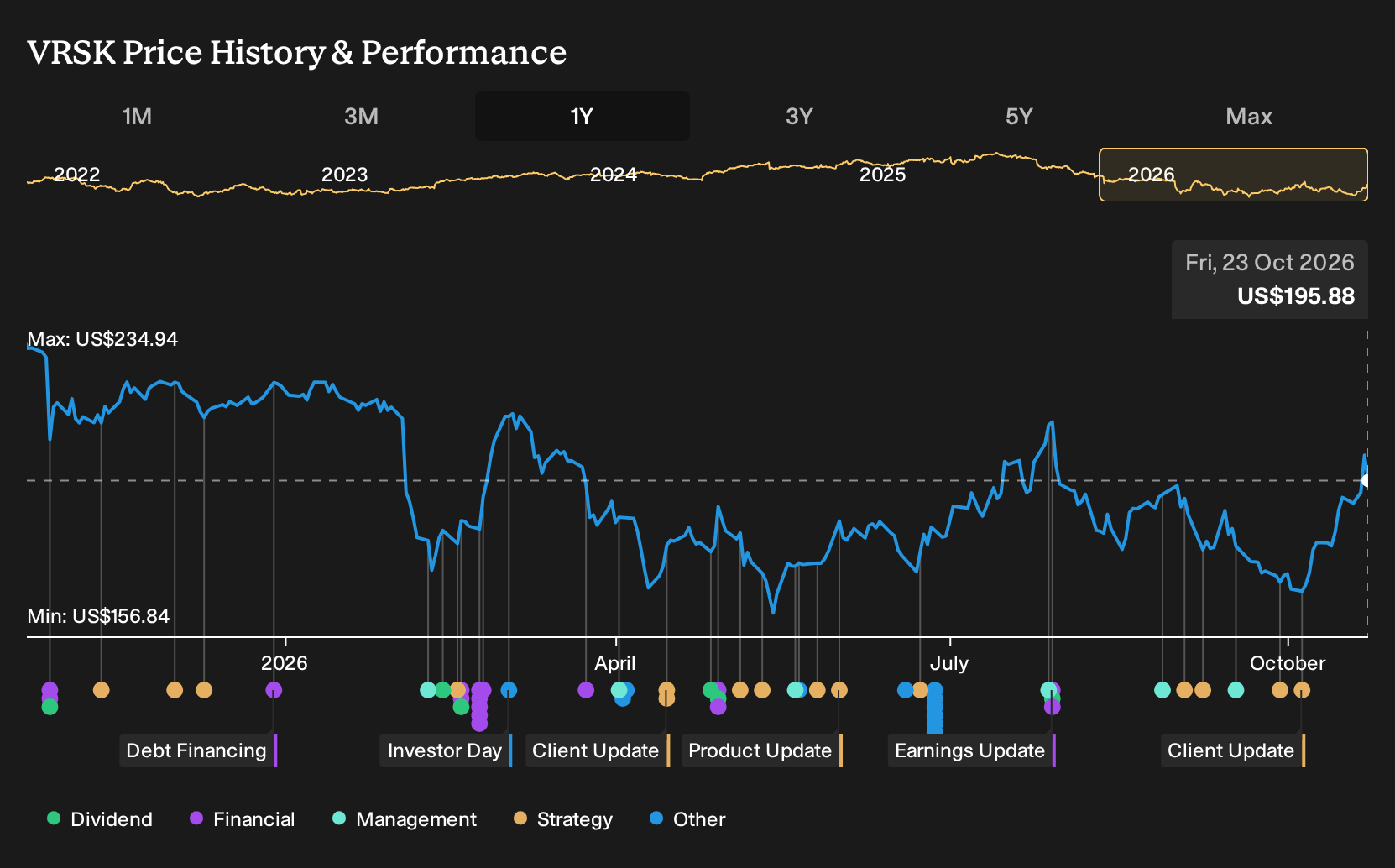
The consensus price target of US$227.94 versus a current share price of US$176.65 reflects that structure. Analysts are effectively saying that if Verisk Analytics gets to US$3.8b of revenue and US$1.3b of earnings by 2029, and if the market is willing to apply a mid 20s P/E to those profits, then today’s equity value screens below that implied outcome. For you, the real question is whether the AI tools, catastrophe platforms and premium linked pricing can plausibly support the move from US$885.5m of earnings to US$1.3b without leaning on heroic assumptions about the broader insurance cycle.
Uncover how Verisk Analytics' fair value indicates a 16% potential upside to its current price before the market closes that valuation gap.
Exploring Other Perspectives
Five fair value estimates from the Simply Wall St Community span a wide band, from US$76.85 at the low end to US$288.58 at the top, so opinion on Verisk Analytics is anything but uniform. Those views were formed before the AccuLynx ruling and FTC review progress, events that could reshape how you think about cash resilience and risk. Use that breadth of opinion as a prompt to explore multiple viewpoints before setting your own stance.
Explore 4 other Verisk Analytics fair value estimates, including one that suggests there could be as much as 47% upside from the current price!
Decide For Yourself
Disagree with existing narratives? Extraordinary investment outcomes rarely come from following the herd, so trust your own analysis.
- A great starting point for your Verisk Analytics research is our analysis highlighting 2 key rewards and 1 important warning sign that could influence your investment decision.
- See our latest analysis for Verisk Analytics. The report includes a comprehensive fundamental analysis summarized in a single visual, the Snowflake, making it easier to review Verisk Analytics' overall financial position at a glance.
Looking for more investment ideas beyond Verisk Analytics?
Once you have formed a view on Verisk Analytics, it can help to compare that judgment with other opportunities that meet clear, rules based criteria using the Simply Wall St Screener.
- For investors who want growth potential at a low entry price, review 7 elite penny stocks with strong financials that already show stronger balance sheets and earnings profiles than many peers.
- If your priority is quality at a sensible valuation, scan our 21 high quality undiscovered gems and see which businesses combine fundamentals strength with relatively modest pricing.
- Those who care most about resilience may prefer to focus on a 30 resilient stocks with low risk scores that filters for companies with sturdier financial risk scores and steadier profiles.
Have feedback on this article? Concerned about the content? Get in touch with us directly. Alternatively, email editorial-team@simplywallst.com