


Did Raised Earnings Guidance Just Shift UDR's (UDR) Investment Narrative?
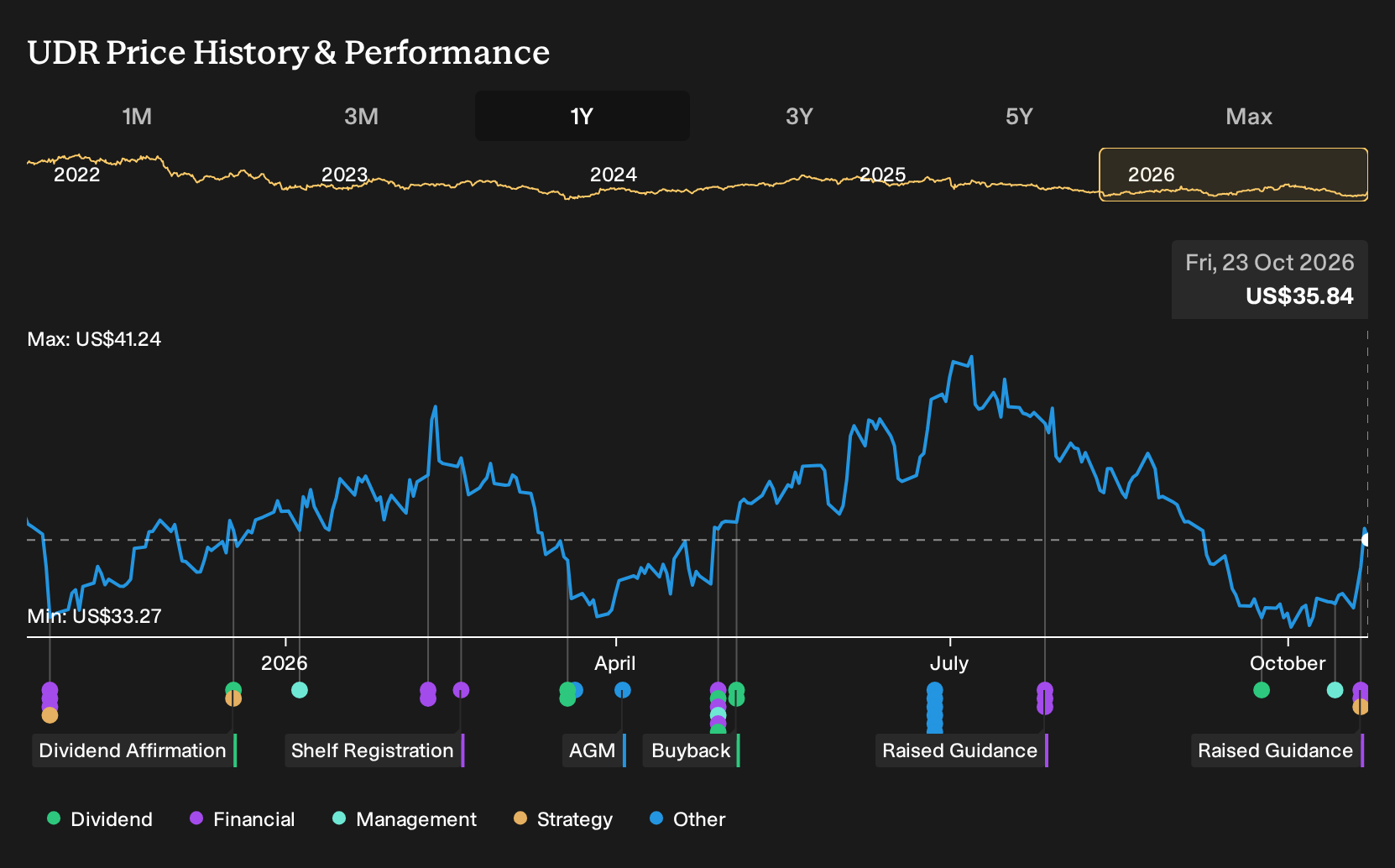
- UDR raised its 2026 guidance, with full year net income per diluted share now expected at US$1.58 to US$1.60 and Q3 net income per diluted share guided to US$0.67, alongside new Q4 guidance of US$0.13 to US$0.15.
- The planned joint venture with Apollo, involving 19 apartment communities valued at about US$2.0b where UDR retains a one third stake and operating control, points to a fee based and capital light way to scale its multifamily platform.
- This development raises the question of how UDR's sharply higher earnings guidance may reframe the existing investment narrative around data driven operations and capital recycling.
Scan how UDR's capital light model compares with other potential real estate picks by reviewing our hand picked list of solid balance sheet and fundamentals (24 results) for ideas beyond this one stock.
UDR Investment Narrative Recap
To own UDR, you need to be comfortable with a multifamily REIT that leans on data driven pricing, fee income and capital recycling rather than simple rent growth. The raised 2026 guidance puts more weight on execution of that model in the near term. The main upside swing factor remains how effectively UDR can translate its platform and portfolio moves into stable net operating income and cash flow.
The biggest immediate risk still sits in operational and external pressures. Sunbelt oversupply, regulatory actions in key coastal markets and interest expense coverage all matter more than one guidance update. If Sunbelt rent pressure or legal costs deepen, they could offset some of the earnings lift implied by the new numbers.
The planned joint venture with Apollo is the announcement that most directly ties into the updated guidance. It keeps UDR operating the properties, earning an asset management fee and retaining a one third interest with consolidation, while bringing in about US$1.34b of outside equity on a portfolio valued at roughly US$2.0b.
For you as a shareholder, that structure points to a more capital light path in which fee income, operating control and an option to repurchase Apollo’s stake sit alongside the core rental stream. Execution risk is real. UDR still has to manage 7,059 older apartment homes, deal with supply and regulation, and demonstrate that this joint venture helps rather than dilutes the key earnings catalysts already in place.
What The UDR Guidance Implies About Analyst Assumptions
UDR's new guidance lands on top of a consensus model that already incorporates modest top line growth and much thinner profit margins over time. Analysts are working with a forecast revenue growth rate of 1.0% a year over the next three years, current earnings of US$517.3 million and a consensus earnings estimate of US$183.2 million by 2029. That outlook points to an earnings decline of about US$334 million by the 2029 forecast year, even as the revenue line edges higher.
On those same assumptions, the valuation bridge rests on a 2029 revenue estimate of US$1.8b and earnings of US$183.2 million in that year. To make those numbers support current price targets, the stock would need to trade on a P/E of 80.8x compared with 21.1x today. This is well above the current multiple for the US residential REIT peer group. For you, the question is how comfortable you are with a scenario that pairs slow revenue growth with much lower margins but a meaningfully higher earnings multiple.
UDR's narrative projects forecast revenue of about US$1.8b and forecast earnings of US$183.2 million by 2029. This rests on revenue growing at 1.0% a year, with earnings declining by roughly US$334 million from current earnings of US$517.3 million over that period.
Uncover why UDR's fair value indicates a 13% potential upside to its current price that may not last much longer.
Exploring Other Perspectives
Only two fair value estimates from the Simply Wall St Community span roughly US$40 to US$56, so retail views on UDR already stretch across a wide price band even before the joint venture and guidance news. When you then consider Sunbelt supply risk, regulation, and the Apollo deal option, you get sharply different profit paths. Explore those contrasting viewpoints before deciding how UDR fits your portfolio.
Explore another UDR fair value estimate, including one that suggests as much as 57% upside from the current price.
The Verdict Is Yours
Don't just follow the ticker. Dig into the data and build a conviction that's truly your own.
- A great starting point for your UDR research is our analysis highlighting 3 key rewards and 3 important warning signs that could impact your investment decision.
- See our latest analysis for UDR. The report includes a comprehensive fundamental analysis summarized in a single visual, the Snowflake, making it easy to evaluate UDR's overall financial health at a glance.
Looking for more investment ideas beyond UDR?
Once you have a view on UDR, it can help to line it up against other opportunities that match your income needs, risk tolerance and balance sheet preferences using the Simply Wall St Screener.
- If you want income strength with less reliance on capital gains, focus on businesses targeting robust payouts and review 5 dividend fortresses that could complement a REIT like UDR in a diversified portfolio.
- For investors who put capital preservation and resilience first, concentrate on durability and stress tested metrics by scanning our 30 resilient stocks with low risk scores to see which tickers score well on stability.
- When you are hunting for quality at a reasonable price, start with fundamentals and valuation together and use the 21 high quality undiscovered gems to surface ideas that might not be on every watchlist yet.
Have feedback on this article? Concerned about the content? Get in touch with us directly. Alternatively, email editorial-team@simplywallst.com