


Learn Why The Bull Case For Coca Cola Stock Could Change Following KFC Fountain Deal
- KFC U.S. previously announced a new beverage partnership with The Coca-Cola Company, shifting roughly 3,600 U.S. outlets to Coca-Cola products starting in January 2027, with full rollout targeted by spring 2027.
- The KFC switch expands Coca-Cola's U.S. foodservice footprint, deepening exposure to bundle-friendly family meals and high-margin fountain volumes, which can be important for long-term cash generation.
- The next area of focus is how Coca-Cola's investment narrative could be reshaped by this large KFC fountain contract across U.S. restaurants.
Coca-Cola Investment Narrative Recap
To own Coca-Cola, you need to believe its portfolio of global beverage brands, from colas to value added dairy, can keep pulling in steady cash even as consumer tastes move toward lower sugar and new formats. The KFC U.S. fountain deal supports that view by adding another large foodservice outlet, but it mainly reinforces an existing strength rather than transforming the near term story.
Right now, the key near term swing factor is management’s ability to keep revenue and earnings progressing while divestitures such as refranchising Coca-Cola Beverages Africa create a modest drag. Health trends, including GLP 1 weight loss drugs and sugar regulation, remain the biggest operational risk if volumes in higher sugar drinks weaken faster than Coca-Cola can pivot toward zero sugar and other categories.
The most relevant recent announcement alongside the KFC agreement is the Board’s decision to declare a regular quarterly dividend of US$0.53 per share, payable on December 15, 2026. That payout, supported by annual earnings of US$14.3b on revenue of US$50.1b, signals that management still sees the cash profile as stable enough to fund ongoing shareholder returns.
For you as an investor, that dividend commitment sits next to the KFC contract as part of the same story: cash generation from a wide beverage system that includes both at home and away from home channels. The risk is that divestiture headwinds, health related volume pressure, or higher debt costs chip away at that cash engine faster than Coca-Cola’s work in emerging markets, value added dairy and AI driven marketing can compensate.
What Coca-Cola's KFC Deal Sits On Top Of
The KFC contract lands on an analyst story for Coca-Cola that is already built around slow but steady expansion rather than big swings. Forecasts point to revenue increasing by 2.1% a year over the next three years, paired with profit margins that are modeled to move from 28.6% today to 31.8% by around 2029. In that framework, a large U.S. fountain customer like KFC is another brick in the wall for away from home volumes, not the single pillar holding the future together.
On earnings, the consensus case sketches a climb from US$14.3b today to US$17.0b by 2029. That is about a US$2.7b gain, which is material for a mature consumer staples group and shapes how investors think about the KFC win. Extra fountain demand from KFC can help fill in part of that projected earnings bridge alongside margin expansion and category growth in areas such as value added dairy, but it sits inside a much wider system of outlets and channels.
The same analyst set ties those profit forecasts to a revenue line of US$53.4b in 2029. To line up with that view, you would need to accept a world where Coca-Cola earns US$17.0b that year and the shares trade on a P/E of 29.6x, compared with 25.7x today and 25.7x for the broader U.S. beverage peer group. KFC brings extra volume potential and brand visibility; yet the bigger swing factor for that multiple is whether the business broadly continues to convert its global reach and marketing spend into the higher margin mix implied by those numbers.
Coca-Cola's narrative projects US$53.4b revenue and US$17.0b earnings by 2029. This assumes 2.1% yearly revenue growth and an earnings increase of about US$2.7b from current earnings of US$14.3b.
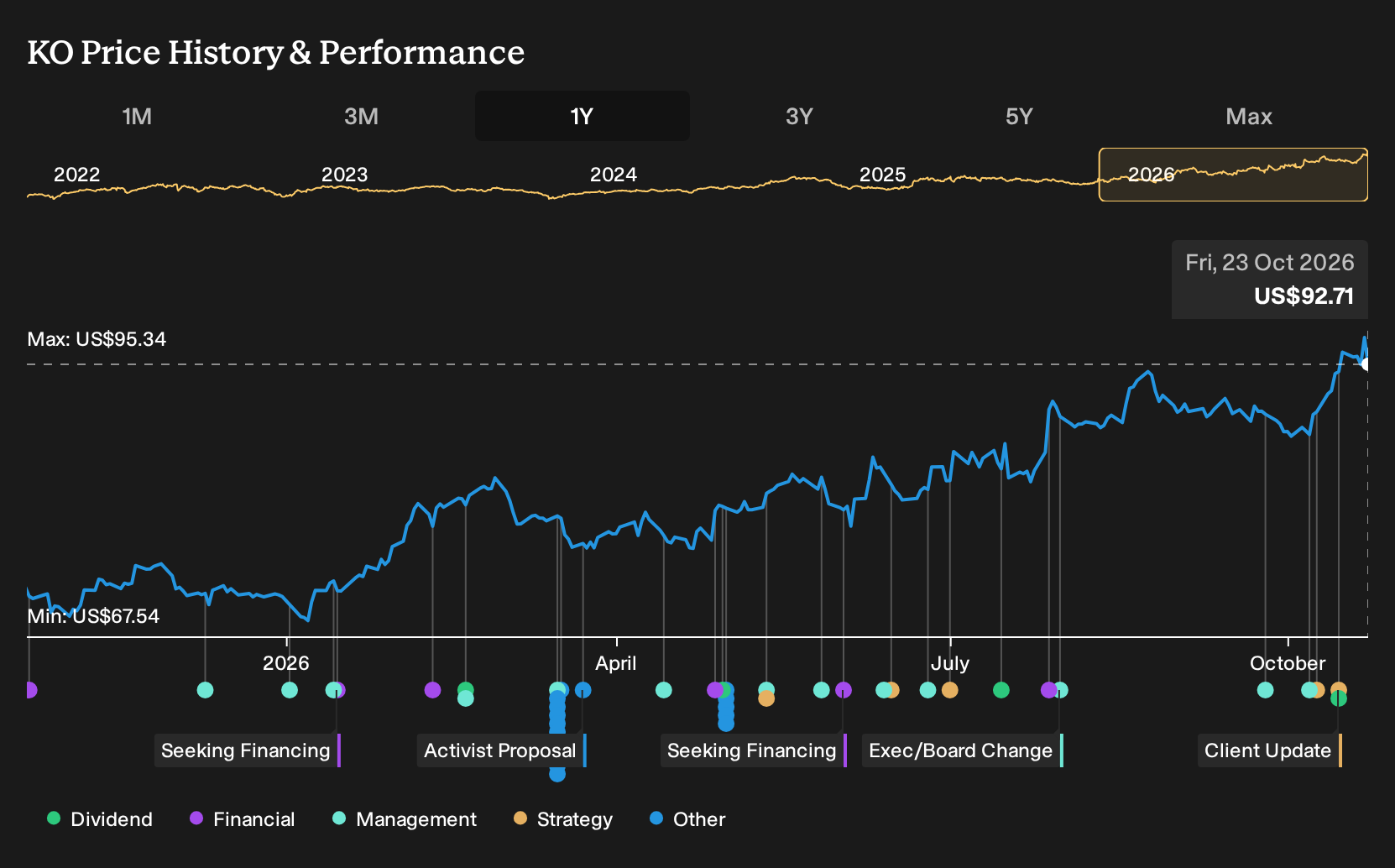
Analyst price targets make that tension visible. The consensus sits at US$94.65 per share, which is 9.5% above the current US$85.65 quote, with a wide band from US$75.00 to US$104.00. That spread reflects different views on whether the firm can actually deliver the forecast earnings profile and justify a higher P/E than both its current level and the industry average. For anyone watching the KFC agreement, the key question is how much that single relationship shifts earnings confidence inside that already wide range.
Uncover why Coca-Cola's fair value aligns with its current price.
Exploring Other Perspectives
Ten fair value estimates from the Simply Wall St Community span roughly US$66 to US$95 per share, so some contributors see Coca-Cola as cheap while others lean toward a rich valuation. Layer that spectrum over KFC’s new fountain contract, AI driven marketing efforts, and sugar related health risks, and you are looking at sharply different paths for future performance. Treat those community views as a menu, not a verdict, and explore several alternatives before fixing your own stance.
Explore 9 other Coca-Cola fair value estimates, including one that suggests it could be worth as much as $95.33.
Decide For Yourself
Don't just follow the ticker. Dig into the data and build a conviction that's truly your own.
- A great starting point for your Coca-Cola research is our analysis highlighting 4 key rewards and 2 important warning signs that could impact your investment decision.
- See our latest analysis for Coca-Cola. The report includes a comprehensive fundamental analysis summarized in a single visual, the Snowflake, making it easy to evaluate Coca-Cola's overall financial health at a glance.
Looking For More Ideas Beyond Coca-Cola?
If this look at Coca-Cola has sharpened your view on brands, cash flows, and dividends, you might want to scan a wider field of opportunities. The Simply Wall St Screener can help you quickly filter for stocks that fit different goals, whether you care most about income, resilience, or valuation support.
- For investors who want income to stay front and center, focus on companies built to keep paying out by reviewing a curated set of 5 dividend fortresses.
- If resilience matters more than excitement, concentrate on businesses with strong balance sheets and steady fundamentals by working through the list of solid balance sheet and fundamentals (25 results).
- When you are hunting for tomorrow's stories before the crowd gets there, scan a focused pool of 21 high quality undiscovered gems that combine quality metrics with low current attention.
Have feedback on this article? Concerned about the content? Get in touch with us directly. Alternatively, email editorial-team@simplywallst.com