


How Earnings Upgrades At HCI Group Stock Have Changed Its Investment Story
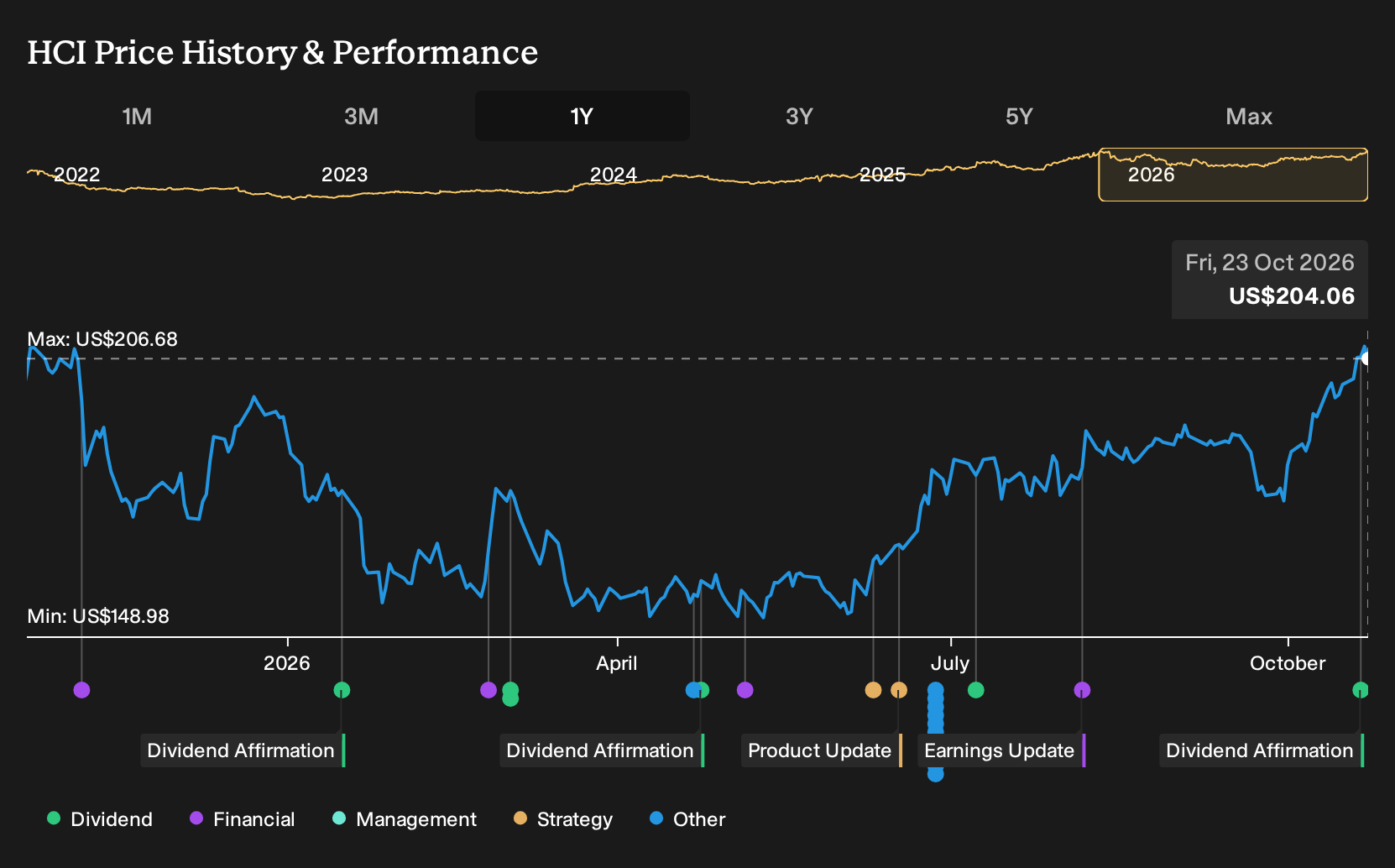
- HCI Group's board previously declared a regular quarterly cash dividend of US$0.40 per common share, payable on December 18, 2026, to shareholders of record on November 20, 2026.
- The reaffirmed dividend highlights management's ongoing capital return, alongside a business mix that spans homeowners insurance, reinsurance, technology, claims services, and real estate.
- Investors may now consider how HCI Group's investment narrative could be influenced by the affirmed US$0.40 quarterly dividend commitment to shareholders.
HCI Group Investment Narrative Recap
To own HCI Group, you need to be comfortable with a property insurer that still leans heavily on Florida exposure while trying to offset that through technology, reciprocal exchanges and reinsurance structures. The reaffirmed US$0.40 dividend is a signal about current capital priorities, but it does not materially change the near term focus on underwriting discipline and cost of risk.
The key near term swing factor remains catastrophe experience versus the 2026 to 2027 reinsurance program. Florida heavy concentration keeps weather events as the biggest operational risk, especially if future renewals become more expensive and push combined ratios and earnings under pressure.
The most relevant recent disclosure is HCI Group’s comment that Hurricane Isaias claims only affected one of its three reinsurance towers, with a US$15 million retention before reinsurance kicks in. That detail gives you a clearer view of how the risk transfer structure is absorbing shocks rather than the dividend decision alone.
For catalysts, that same reinsurance architecture, including Fortex Re and tokenized securities, ties directly into the story of lowering the cost of risk while keeping coverage intact. Execution on that front, together with underwriting supported by the Exzeo tech platform, sits opposite the Florida catastrophe threat when you weigh the trade off between earnings resilience and weather related volatility.
What The HCI Group Forecasts Really Assume
HCI Group's analyst model rests on a few clear building blocks that you can actually track over time instead of treating the stock as a black box. Revenue is projected to rise by 5.9% a year over the next 3 years, while profit margins are expected to move from 31.3% today to 18.2% by 2029. That mix points to higher top line but lower profitability on each dollar of premium, which matters more for an insurer that already leans on catastrophe exposed business.
Earnings today are put at US$297.8 million and the same analyst set expects that to be US$205.8 million by 2029, which is a decline of roughly US$92 million over the period. Analysts are effectively saying that even as HCI Group grows revenue and continues to work its technology and reinsurance angles, the profit pool tied to shareholders could still shrink. For an income focused holder watching that reaffirmed US$0.40 dividend, the tension between a steady cash return and lower projected profit is an important part of the story.
That earnings path feeds straight into the valuation math. The consensus assumes HCI Group trades on a P/E of 15.9x those 2029 earnings, compared with about 7.8x today and an industry level of roughly 10.7x. The same framework uses a discount rate in the range of 7.2% to 7.24%, so the future profit and multiple are both doing heavy lifting in the price target, not just the expected revenue line or the dividend check you collect along the way.
Analysts also bake in shrinking share count, with forecasts that the number of shares outstanding falls by about 4.02% per year for the next 3 years. If that happens, each remaining share would represent a larger slice of the earnings pie, even if the overall pie is smaller in dollar terms by 2029. For investors thinking about total return from HCI Group, this interplay between buybacks, dividend cash, and projected profit compression is what shapes the potential outcome rather than any single metric on its own.
HCI Group's narrative projects US$1.1b revenue and US$205.8 million earnings by 2029. This aligns with a 5.9% yearly revenue growth assumption and an earnings decline of about US$92 million from US$297.8 million today.
Uncover why HCI Group's fair value indicates an 18% potential upside to its current price that may not last much longer.
Exploring Other Perspectives
Three fair value views from the Simply Wall St Community span roughly US$241.67 to US$889.19 per share, which is a huge spread for HCI Group. That kind of gap signals retail investors are applying very different hurricane, reinsurance and Exzeo outcomes. Treat those opinions as a starting grid, and explore the full range yourself.
Explore 2 other HCI Group fair value estimates, including one that suggests it could be worth just $241.67.
Reach Your Own Conclusion
Don't just follow the ticker. Dig into the data and build a conviction that's truly your own.
- A great starting point for your HCI Group research is our analysis highlighting 3 key rewards and 1 important warning sign that could impact your investment decision.
- See our latest analysis for HCI Group. The report includes a comprehensive fundamental analysis summarized in a single visual, the Snowflake, making it easy to evaluate HCI Group's overall financial health at a glance.
Looking For More Investment Ideas Beyond HCI Group?
Once the HCI Group story is mapped out, it can help to set it alongside a wider watchlist so your dividend, value, and risk profile are not tied to a single insurer. The Simply Wall St Screener lets you filter for different return profiles and balance sheet setups, so you can compare HCI Group with a broader pool of listed businesses that fit your income and capital preservation goals.
- For investors focused on resilient balance sheets and steady fundamentals, start with a list of solid balance sheet and fundamentals (25 results) that can help you spot companies built to handle tougher conditions.
- If you want potential value upside with quality filters already applied, work through a curated 27 high quality undervalued stocks that aligns cash generation with reasonable pricing.
- Income seekers who liked HCI Group's dividend signal can extend that theme by reviewing a targeted 5 dividend fortresses aimed at yields supported by underlying financial strength.
Have feedback on this article? Concerned about the content? Get in touch with us directly. Alternatively, email editorial-team@simplywallst.com