


Does Global Money Platform Change The Bull Case For Mastercard (MA)?
- Mastercard recently launched its Global Money Platform with BVNK, combining multi currency fiat and stablecoin accounts, stablecoin-linked cards, and global payouts through a single API.
- The new stack lets banks, fintechs and enterprises consolidate treasury, payments and settlement flows, which can influence Mastercard’s mix of network and service revenue over time.
- The next area of interest will be how Mastercard’s Global Money Platform could reshape its investment narrative around services, digital assets and AI.
Scan Mastercard’s move into stablecoins against a wider opportunity set and see which other payment and fintech platforms are building similar rails through the 18 cryptocurrency and blockchain stocks.
Mastercard Investment Narrative Recap
To own Mastercard, you need to believe its global payments rails and value added services can keep compounding as cash use shrinks and digital money options broaden. The Global Money Platform fits that view by extending Mastercard into stablecoin flows and treasury use cases. The key near term swing factor remains execution on low double digit net revenue growth targets and service mix expansion that supports already high net margins.
The largest immediate risk does not change. Alternative domestic schemes and real time payment systems could still siphon volume and pressure pricing power, especially in markets like the UK. New crypto and stablecoin products may help Mastercard stay relevant if those rails scale, but they also invite extra regulatory and compliance scrutiny that could add cost if rules tighten.
The launch of the Stablecoin Security API is tightly linked to the Global Money Platform story. If Mastercard wants banks and fintechs to route more stablecoin activity through its infrastructure, they will likely focus on risk controls. This product leans on existing payment intelligence and blockchain analytics to score fiat to stablecoin flows inside the firm’s broader security stack.
For catalysts, investors are watching whether value added services that are already near 40% of net revenue keep climbing, since they are often higher margin and tied directly to the network. Stablecoin risk scoring, AI driven cyber tools and products like Mastercard Max all fall into that bucket. The execution test is whether these tools see real usage at scale rather than staying as press release headlines.
Mastercard Forecasts, Earnings Power And Valuation Setup
Analysts sketch a Mastercard trajectory that leans heavily on compounding revenue and growing profit pools, with the Global Money Platform and stablecoin tools sitting on top of that base. Consensus models call for revenue to rise by 12.5% a year over the next three years, while profit margins are expected to edge up from 46.3% today to 46.7% in the same window. On earnings, the group view points to US$23.3b of profit by 2029, compared with US$16.3b today, which implies an earnings increase of about US$7b on current figures. The same forecasts assume revenues reach US$49.9b and that the stock trades at a 28.8x P/E on those 2029 earnings, compared with 30.5x today.
Mastercard's narrative projects US$49.9b revenue and US$23.3b earnings by 2029. This setup assumes 12.5% yearly revenue growth and an earnings increase of about US$7b from the current US$16.3b base.
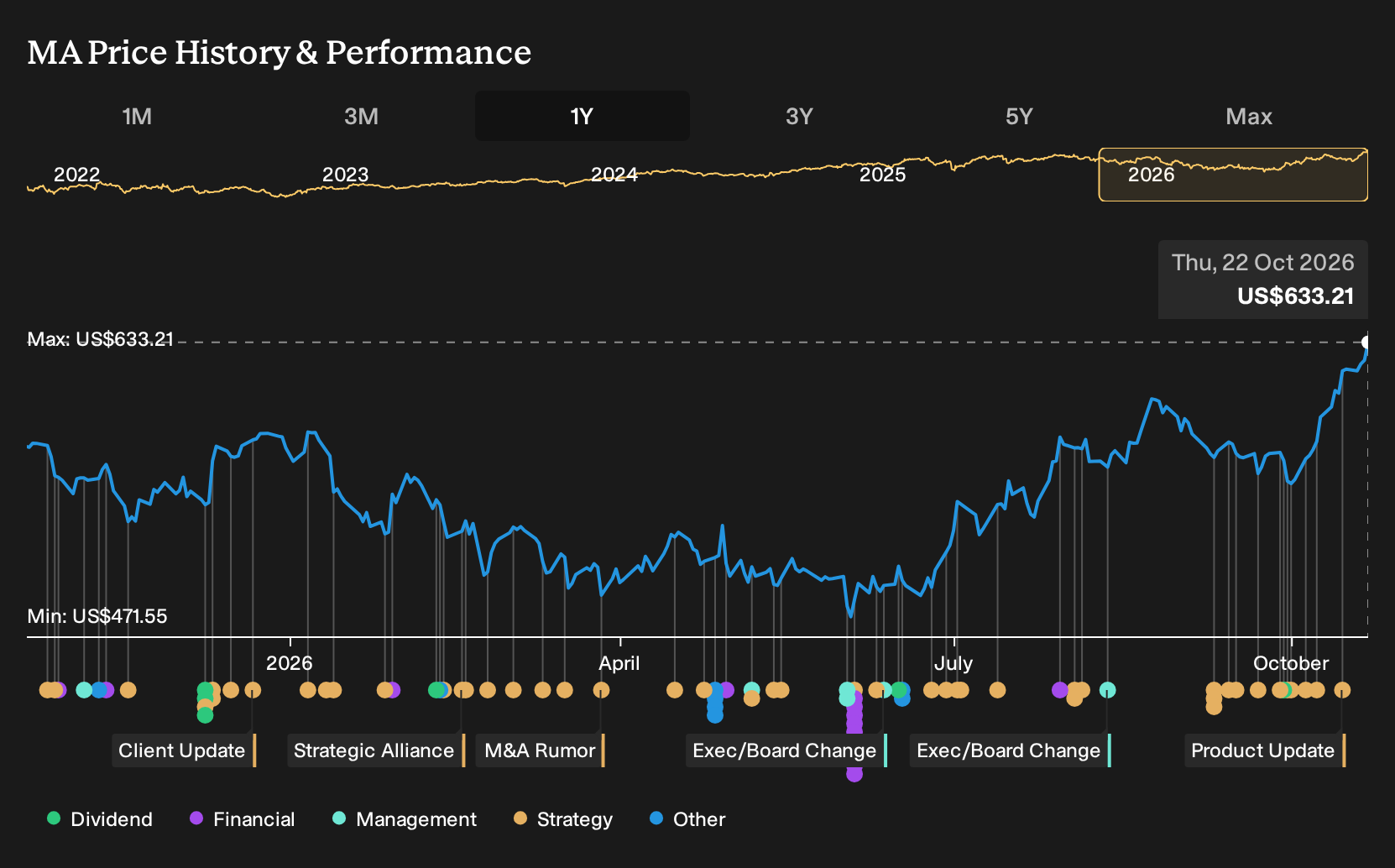
Those assumptions flow directly into the current price targets on Mastercard. The consensus target sits at US$666.71, with a spread that runs from US$550 on the cautious side to US$740 at the top end. To align with that view, an investor would need to be comfortable with the 2029 revenue and earnings profile above, and with the idea that a 28.8x P/E multiple on those earnings is justified, using a discount rate of roughly 7.4%. With the shares recently trading around US$565.24, the average target is about 15.2% higher. The gap between market price and the analyst case is meaningful enough that readers may wish to stress test the inputs against their own expectations for Mastercard's payments volume, service adoption and regulatory costs.
Uncover how Mastercard's fair value indicates a potential 5% upside to its current price before the market closes that gap.
Exploring Other Perspectives
Fair value signals from the Simply Wall St Community are all over the map, with 22 retail investors landing between US$520 and about US$902. Some see Mastercard as close to fully priced, while others pencil in far richer upside. Set that against risks around real time domestic rails and legal costs, then weigh how products like Global Money Platform, Mastercard Max and the Stablecoin Security API could influence where actual performance lands within that spectrum. Use those contrasting views as a prompt to explore several alternative scenarios before you anchor on your own fair value.
Explore 21 other Mastercard fair value estimates, including one that suggests as much as 42% upside from the current price!
Reach Your Own Conclusion
Disagree with existing narratives? Extraordinary investment returns rarely come from following the herd, so consider forming your own view based on thorough research.
- A great starting point for your Mastercard research is our analysis highlighting 3 key rewards and 2 important warning signs that could impact your investment decision.
- See our latest analysis for Mastercard. The report includes a comprehensive fundamental analysis summarized in a single visual, the Snowflake, making it easier to evaluate Mastercard's overall financial health at a glance.
Looking For More Investment Ideas Beyond Mastercard?
Once you have a view on Mastercard, it can help to widen the lens and compare it with other businesses that share similar quality traits or risk profiles. The Simply Wall St Screener lets you do that in a structured way instead of hopping between tickers at random.
- If capital preservation ranks high for you, start by reviewing a curated set of companies with steadier profiles through the 30 resilient stocks with low risk scores.
- If balance sheet strength is your anchor, benchmark Mastercard against a list of solid balance sheet and fundamentals (26 results) and see which businesses pair financial resilience with solid fundamentals.
- If you are hunting for underfollowed opportunities, widen your watchlist with a 20 high quality undiscovered gems that may not yet be widely discussed.
Have feedback on this article? Concerned about the content? Get in touch with us directly. Alternatively, email editorial-team@simplywallst.com