


Higher Dividend Might Change The Case For Investing In Life (TSE:8194)
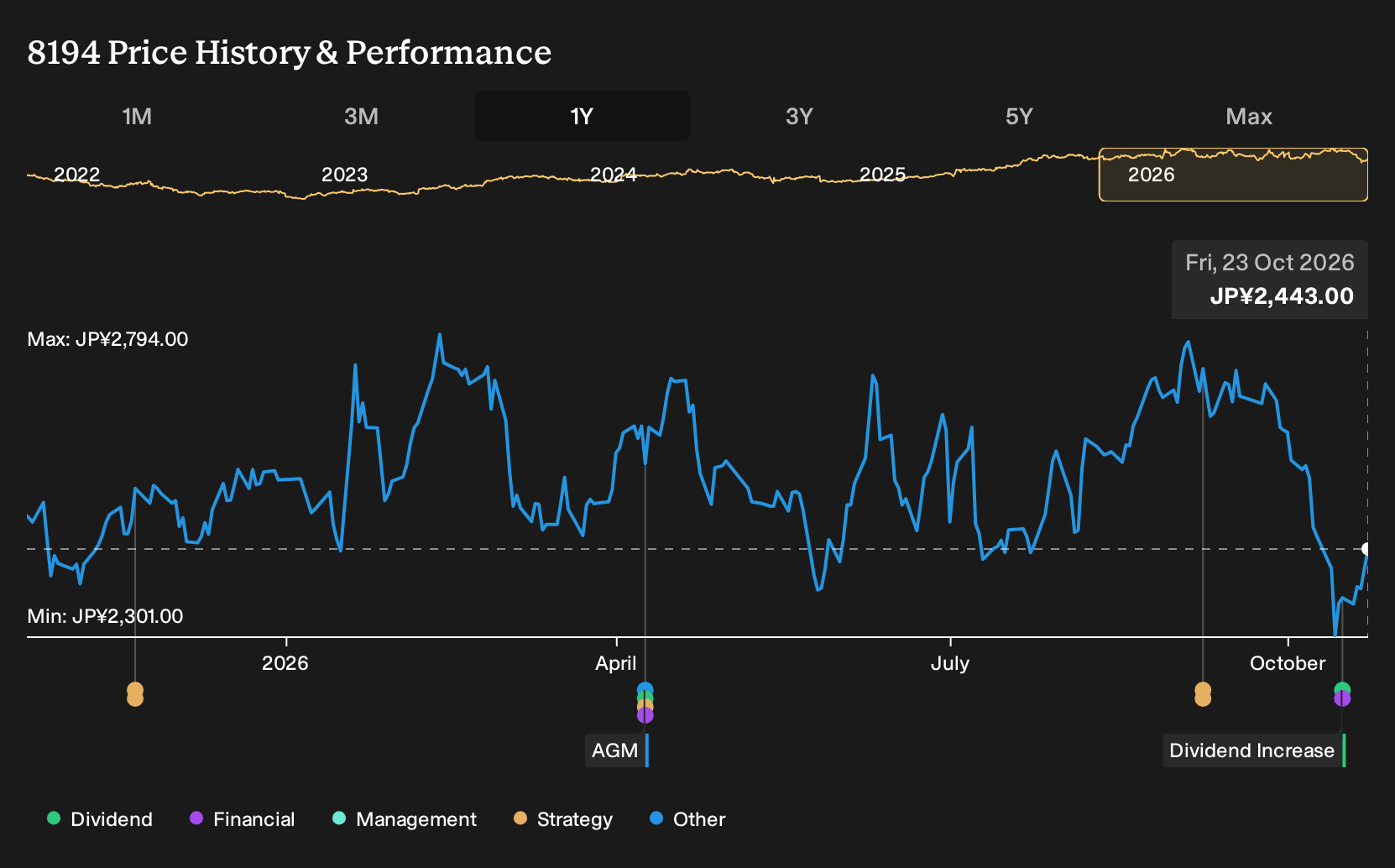
- Life Corporation announced an interim dividend for the second quarter of the fiscal year ending February 28, 2027 of ¥35.00 per share, compared with ¥32.50 per share for the same period a year earlier, with payment scheduled for November 2, 2026.
- The higher payout and the release of full year guidance, including expected operating revenue of ¥922,100 million and earnings per share of ¥219.6, indicate how Life Corporation is aligning its shareholder returns policy with its operating expectations.
- We will now look at how Life Corporation's higher interim dividend could influence the broader investment narrative around the business.
Compare Life Corporation's richer interim payout with other income ideas by screening for 29 dividend fortresses that aim to balance yield with resilience in their underlying businesses.
What Is Life's Investment Narrative?
To own Life, you need to be comfortable with a fairly steady, execution focused supermarket story in Japan. The business leans on domestic food and daily goods demand rather than high growth niches, and its guidance for operating revenue of ¥922,100 million and operating profit of ¥27,000 million underlines that scale. The higher interim dividend and projected earnings per share of ¥219.6 tie shareholder payouts directly to that operating plan, which matters more for near term sentiment than for the underlying store economics.
In the short term, the key questions are about pricing power, cost control and how capital is allocated in a relatively low margin, capital intensive retail model. Life offers some support on valuation, with a P/E of 11.7x compared with higher industry averages, but recent share performance has been mixed, including a roughly 9% decline over the past month. The richer dividend may ease concerns for income focused holders, although free cash flow coverage and the level of non cash earnings still sit in the background as real risks.
That said, before treating Life as a simple income plus value idea, it is worth pausing on ...
There's only one way to know the right time to buy, sell or hold Life. Head to Simply Wall St's company report for the latest analysis of Life's Fair Value.
Reach Your Own Conclusion
Disagree with this assessment? Extraordinary investment returns rarely come from following the herd, so go with your instincts.
- A great starting point for your Life research is our analysis highlighting 3 key rewards and 2 important warning signs that could impact your investment decision.
- See our latest analysis for Life. The report includes a comprehensive fundamental analysis summarized in a single visual, the Snowflake, making it easy to evaluate Life's overall financial health at a glance.
Looking For More Ideas Beyond Life?
If Life Corporation's dividend story caught your attention, it can be useful to line it up against a wider field of opportunities that share some of the qualities you care about, whether that is income, balance sheet strength, or potential mispricing.
- If you want potential mispricing plus quality in one place, scan through 15 high quality undervalued stocks that aim to pair reasonable valuations with robust fundamentals.
- If capital preservation is higher on your list, focus on resilience by reviewing 22 resilient stocks with low risk scores that may offer steadier profiles across a range of sectors.
- If you enjoy getting in early on quieter stories, broaden your watchlist with 72 high quality undiscovered gems that have solid financial underpinnings but limited current attention.
Have feedback on this article? Concerned about the content? Get in touch with us directly. Alternatively, email editorial-team@simplywallst.com