


Marten Transport (MRTN) Stock Dropped, What Is Driving Attention Now?
Why Marten Transport’s latest earnings matter for investors
Marten Transport (MRTN) just released third quarter and nine month results that missed analyst estimates, even though quarterly net income rose and a tighter freight market supported truckload pricing.
The update arrived as rising fuel and health insurance expenses weighed on margins, and weaker nine month earnings compared with the prior year led investors to reassess what they expect from the stock.
Marten Transport’s share price tells a mixed story. The stock is up 7.42% on a year to date share price basis and the 1 year total shareholder return is 17.14%, yet the 90 day share price return is down 24.54% as investors react to earnings that fell short of expectations and reassess how rising costs affect the risk profile at US$12.30 a share.
Scan how Marten Transport compares with other freight and logistics stocks facing similar cost pressures by reviewing our curated list of list of solid balance sheet and fundamentals (26 results).
Marten Transport still looks like a solid refrigerated hauler with a debt free balance sheet, yet the share price has slid hard over the last three months. Is that a fair reset, or an overly harsh mark down on US$12.30 a share?
Price-to-earnings of 79.4x: Is it justified?
Marten Transport trades at a P/E of 79.4x, which is high relative to many transport stocks and sits against a last close of $12.30. That starting point matters because it frames how much earnings strength the market is already baking into the current valuation.
The P/E ratio links what investors are paying today to the business’s current earnings power. For a refrigerated carrier like Marten Transport, this measure can reflect expectations around freight demand, operating efficiency, and the pace of any potential profit recovery from weaker margins.
Analysts flag that the shares are expensive versus both an estimated fair P/E of 38.2x and the wider US Transportation industry average of 32.4x. That is a wide gap and points to a valuation that assumes a much stronger profit profile than the recent 1.5% net margin and the earnings declines reported over the past year. If expectations reset closer to the fair P/E level, the valuation could move toward that lower multiple rather than staying at the current premium.
Explore the SWS fair ratio for Marten Transport.
Result: Price-to-earnings of 79.4x (OVERVALUED)
Still, the narrative around Marten Transport could shift quickly if cost inflation persists or if contract renewals reset pricing power lower in a weaker freight backdrop.
Find out about the key risks to this Marten Transport narrative.
Another view on Marten Transport’s value
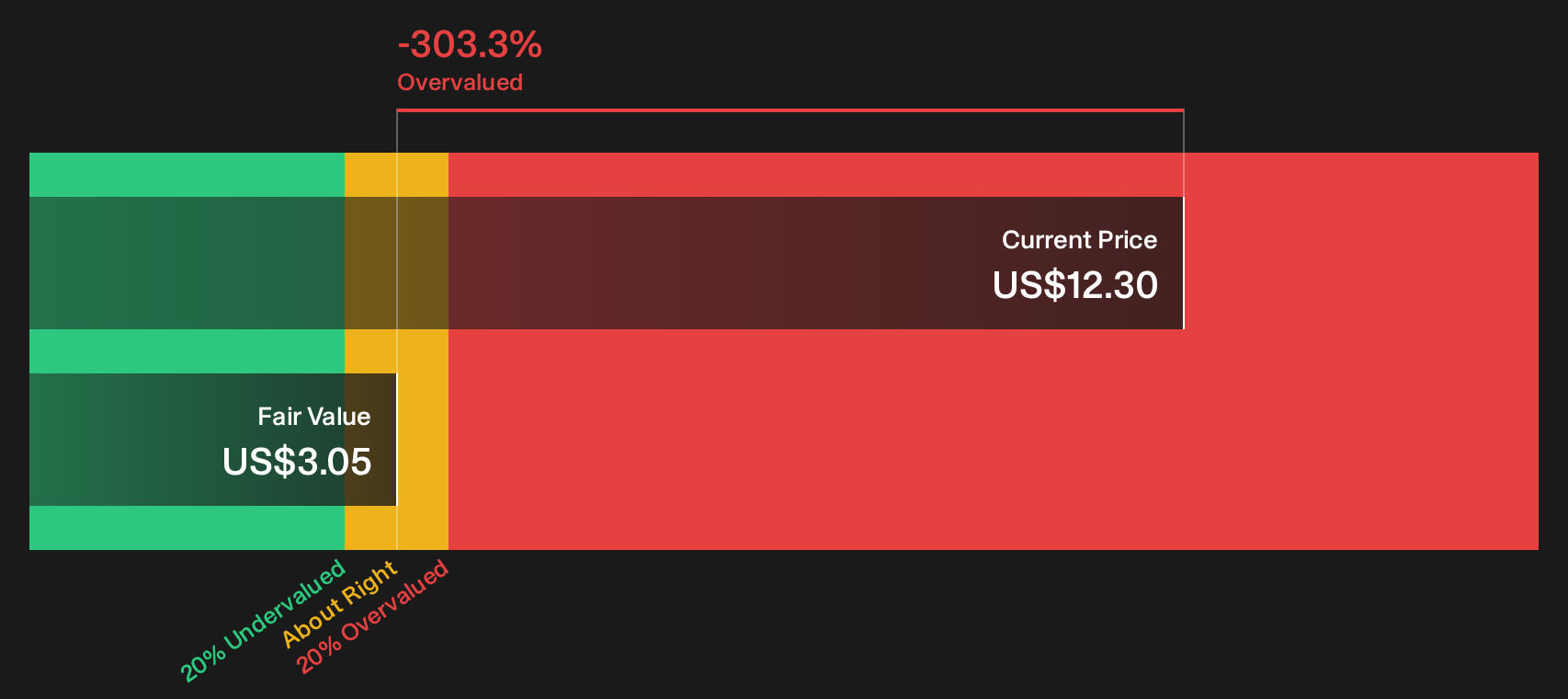
The P/E paints Marten Transport as expensive, yet the SWS DCF model goes further and values the stock at just $3.05 per share compared with the current $12.30 price. That points to a business that screens as heavily overvalued on future cash flows. Which signal do you trust more?
Look into how the SWS DCF model arrives at its fair value.
Simply Wall St performs a discounted cash flow (DCF) on every stock in the world every day (check out Marten Transport for example). We show the entire calculation in full. You can track the result in your watchlist or portfolio and be alerted when this changes, or use our stock screener to discover 29 high quality undervalued stocks. If you save a screener we even alert you when new companies match - so you never miss a potential opportunity.
Next Steps
Mixed messages or clear signal? If Marten Transport’s valuation and recent results feel unsettled, move quickly, review the underlying data, and weigh both risks and upsides for yourself by checking the 1 key reward and 3 important warning signs
Looking for more Marten Transport sized investment ideas?
If Marten Transport has sharpened your focus on valuation and risk, do not stop here. Broader ideas across sectors can help balance your portfolio and widen your opportunity set.
- Target resilient balance sheets and steadier fundamentals by scanning our 30 resilient stocks with low risk scores that may help you sleep better when markets move.
- Zero in on quality businesses that trade below their estimated worth by reviewing the 29 high quality undervalued stocks that could offer more compelling entry points.
- Hunt for potential standouts early by checking the 20 high quality undiscovered gems before wider attention affects valuations.
Have feedback on this article? Concerned about the content? Get in touch with us directly. Alternatively, email editorial-team@simplywallst.com