


Bernstein bucked the trend and sang multi-chip stocks: the market is too worried about the slowdown in memory ASP growth, preferring Seagate (STX.US) and optimistic about SanDisk (SNDK.US), etc.
The Zhitong Finance App learned that Bernstein released the latest research report to maintain a constructive view on memory and HDD as a whole, believing that the recent pullback has taken into account concerns about the slowdown in growth. In terms of US stocks, Seagate (STX.US) is still the first choice, and Western Digital (WDC.US) and SanDisk (SNDK.US) are also “outperforming the market.” Bernstein's predictions for the fiscal year 2027 for all three companies were about 12% higher than market consensus.
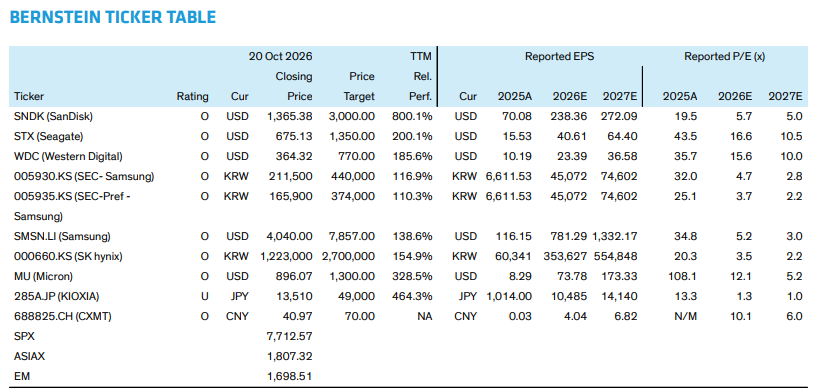
Memory and hard drive (HDD) stocks have declined significantly since their June peak and have outperformed the market over the past month. In the latest report, Bernstein positively responded to the most popular bearish argument at present - DRAM and NAND price increases are slowing down, which means that the cycle has reached or is close to the top, followed by a round of sharp decline. The conclusion is: I disagree, for three reasons.
The core pillar of the bearish argument is the deceleration of the month-on-month increase in average price (ASP). After DRAM and NAND experienced unprecedented month-on-month increases in the first half of the 2026 calendar year, price increases in the third and fourth quarters are bound to slow significantly. This made investors see fewer “surprises” in profit revisions, and based on an erroneous interpretation of history, they judge that this is a sign of peaking or approaching the top, followed by a sharp decline.
Bernstein refuted each one and gave three reasons.
Reason 1: The double-digit month-on-month increase is still an extreme value in history
By any historical standard, a 15% to 20% month-on-month increase is an extreme pricing environment. According to the report's estimates, when the average price growth rate of the NAND industry was at this level, it was about 90—95 in the past 15 years; the 10% to 15% growth rate predicted for DRAM in the fourth quarter was 76-89. According to Bernstein, an increase above 90% of the historical sample conveys strong demand rather than weak demand.
At a specific pace, TrendForce's estimates and forecasts show that NAND flash contract prices will rise 85% to 90% in the first quarter, 55% to 60% in the second quarter, 18% to 23% in the third quarter, and 15% to 20% in the fourth quarter; regular DRAM contract prices will rise 93% to 98% in the first quarter, 58% to 63% in the second quarter, 13% to 18% in the third quarter, and 10% to 15% in the fourth quarter. In other words, the deceleration is compared to the unprecedented jump in the first half of the year, and the absolute pricing capacity is still extremely strong.
The report also acknowledged that part of the slowdown in growth is due to consumer price tolerance reaching its limit: mobile phone brands have collectively raised retail prices since the first half of 2026 to hedge high memory costs, and some manufacturers have become more conservative in their production plans; there is limited room for manufacturers to continue to pass on costs to consumers. However, Bernstein believes that once memory prices return to a more normal level, suppressed demand is expected to be made up, and high-end models with AI features will also provide a solid demand base for high-end models in the market.
Another heavy buffer against SanDisk is the customer structure: the company's share of the data center, the fastest-growing terminal market, is rapidly expanding, and the share of consumer and edge side has declined markedly — SanDisk's data center bits account for a share of total shipments, rising from 12% in the fourth quarter of FY2025 to 38% in the fourth quarter of FY2026.
Reason 2: Judging from the absolute amount, the increase is still at an all-time high
The 15% to 20% month-on-month increase was not only a “strong price environment”; arithmetic at a high base also meant that it was extremely profitable for the memory industry as a whole.
First, the absolute stride has hardly slowed down. The NAND contract price has increased more than fivefold over the past year; on this basis, the increase of 18% to 23% in the third quarter is about 5 cents per GB, and then 15% to 20% in the fourth quarter, which is about 5 cents. In cents per GB, this absolute increase in the fourth quarter is still at the 95th quartile of the past 15 years, the highest level in history until 2026 — the rate of increase has declined, but the absolute price contribution of each quarter is still at an all-time peak.
Second, compared to unit cost, this step is in the 95-97 quantile, which indicates considerable profitability. At the industry level, the predicted absolute ASP increases for the third quarter and fourth quarter are equivalent to 97% and 104% of the unit cost, respectively, both higher than the 95th quartile of the past 15 years. Since the unit cost does not change with the price in the short term, almost all incremental ASP will go directly to gross profit. DRAM shows the same dynamic. Bernstein's phrase is: The current operating leverage of the entire memory industry is at a level not seen in more than a decade.
Reason 3: The price cap of long-term agreements is diluting apparent increases
Most global memory vendors already have a significant percentage of their sales locked in long-term agreements (LTAs) covering 2028. More than half of SanDisk's FY2027 and about two-thirds of FY2028 has been sold to eight data centers and edge customers through a new business model (NBM) with lower and upper price limits; Micron has secured more than one-third of its revenue through Supply Assurance Agreements (SCA) until 2030; Kioxia aims to cover half of sales by 2028.
The point is: the part of the market read “weakening demand” is exactly the purpose of this type of contract design — to convert the spot price into a long-term contract price rather than a real slowdown in demand.
Bernstein uses sensitivity measurements to explain this mechanism: Assuming that the market price has reached the upper price limit of each contract, a 30% increase in market price can only be realized as an actual average price increase of 18% under the 40% LTA penetration rate; if the penetration rate rises to 50% and 60%, then it falls to 15% and 12%, respectively. In other words, as the industry switches more and more bits to the agreed price, even if the underlying demand does not change, the apparent price growth rate will slow down mechanically.
Statements at the company level support this understanding: Micron revealed during a conference call for the third quarter of FY2026 that the price cap of its largest agreements is close to the market price for the second quarter of the 2026 calendar year; TrendForce also indicated that LTAs with US cloud customers are limiting the increase in server DRAM prices.
What needs to be clarified is that Bernstein himself is wary of this type of contract: the report indicates that the deposit or financial guarantee is still small compared to the contract amount, so it has doubts about the enforceability of LTA; however, it also admits that this generation of LTA is indeed more protective than before.
The three meanings of SanDisk
Notably, the above three industry-level changes are particularly beneficial to SanDisk because its LTA coverage rate is higher than the industry average, its product structure is skewed towards data centers, and it is a pure NAND target, which is rare among global memory vendors.
First, Bernstein's prediction of SanDisk's actual average price has taken into account LTA's drag: the month-on-month increases for the first quarter and the second quarter of fiscal year 2027 are expected to be 9% and 9.5%, respectively. Both are still close to SanDisk's own 89th quartile over the past 15 years; the absolute step of about 3 cents/GB is higher than its 90th quartile. In other words, even after deducting LTA dilution, SanDisk's actual average price increase is still at an all-time high in absolute cents.
Second, operating leverage determines that the increase will be directly converted into profit: the ratio of the absolute ASP increase of F1Q27 and F2Q27 to the unit cost is in the 94th to 96th quartile over the past 15 years. Bernstein acknowledged that as gross margin expansion approaches the ceiling, SanDisk's EPS growth rate will drop from more than 60% in the previous quarter to less than 20%. This change in growth pattern itself explains part of the recent decline in valuation; however, the dollar contribution brought about by pricing is still at an all-time high. Since then, the absolute increase is more important than the apparent percentage increase.
Third, LTA is downside protection rather than growth resistance. The lower price limit can anchor the downside near the current level — Bernstein estimates that, on average, 53% of SanDisk's shipments in the 2027-2030 fiscal year were below the LTA, with an implied average lower price of $0.26/GB, with only 19% downside compared to the most recent quarter's mixed average price. The customer's willingness to pay is also a signal: data center customers promised a $16.5 billion deposit and guarantee for SanDisk's minimum LTA revenue of $93.9 billion (coverage rate of 17.6%); Micron's side is $32 billion equivalent to $100 billion (coverage rate 32%; 35% of its revenue will be covered by SCA until 2030, and management targets about 50% later). Customers are willing to lock in the price floor for three to five years at a level close to or slightly below the current price and place a high cash coverage rate for this, indicating that they do not expect a price cliff in 2027 or 2028 under the benchmark scenario. Micron and other suppliers also mentioned that the price of the new agreement is higher and the term has been extended to 2031.
In terms of valuation, Bernstein believes that SanDisk's multiples should reflect a more structured profit bottom. Historically, at the top of the cycle, memory stocks were usually traded at the low to high single-digit forward multiples (reflecting the market's assumption that peak profits are unsustainable); SanDisk's current price-earnings ratio of 5.2 times based on FY2028 earnings is at the lower end of the top range of this historical cycle, indicating that the market is about to shift in the betting cycle. However, the report argues that this round should be given a multiple higher than this range. The reason is that being close to the lower limit of the current price has greatly weakened the assumption that “profit bottom is very low” and lengthens the sustainability of the high point of the cycle.
HDD doesn't have this problem at all
While memory stocks are plagued by a “slowdown in growth,” the hard drive stock has no problem — in fact, HDD prices are likely to accelerate further from here on. Bernstein's judgment is that even if there are doubts about the above arguments, HDD is at an earlier stage in the upward cycle compared to memory. The average price per EB of near-line HDDs increased by only 13.6% year over year (NAND and DRAM prices rose about 400% year over year), so it has more room to “go higher and longer” and is likely to accelerate from the previous two quarters.