


AI computing power ushered in a super strong needle! Meta (META.US) announced a major commitment of US$825 billion. Will the AI infrastructure boom continue to dominate the market?
The Zhitong Finance App learned that Facebook and Instagram parent company Meta Platforms Inc. (META.US) said that the tech giant has agreed to spend about 825 billion US dollars on various leases and contracts in the future, many of which are closely linked to the huge AI computing power resources and certain energy type infrastructure required for the global AI smart frenzy led by Muse.
According to information, after the October 21 earnings report was released, it once rose by about 5% after the market. By the pre-market trading session of the US stock market on the 22nd, the tech giant's stock price had turned down about 3% before the market. In addition to the huge upfront investment pressure of nearly trillion US dollars associated with AI infrastructure shown in the latest statement, the market is also facing the impact of New Mexico's $25 billion fine ruling, and the company plans to appeal. At the same time, at least 13 Wall Street financial giants announced increases in their Meta price targets after the earnings report, which is enough to show that the company's growth prospects are recognized even as AI capital expenditure requirements grow larger. Looking at the valuation mechanism, this round of recent reversals in post-market and pre-market stock prices reflects — the market first expands trading revenue and strong growth expectations associated with Muse, then re-evaluates how much capital and how long these increases require to form a sustainable free cash flow.
The amount of operating leases and financial leases not yet included in Meta's balance sheet is $355.7 billion, the company said in a document submitted on Thursday. This includes the construction of huge AI data centers, which will begin one after another from the rest of this year to 2036, the leasing process, and infrastructure leasing linked to energy sources such as nuclear energy.
As of September 30, the company had an additional $454.5 billion in irrevocable short- and long-term contracts. Many of these involve third-party cloud computing power, data center energy agreements, or the Reality Labs division's consumer hardware products.
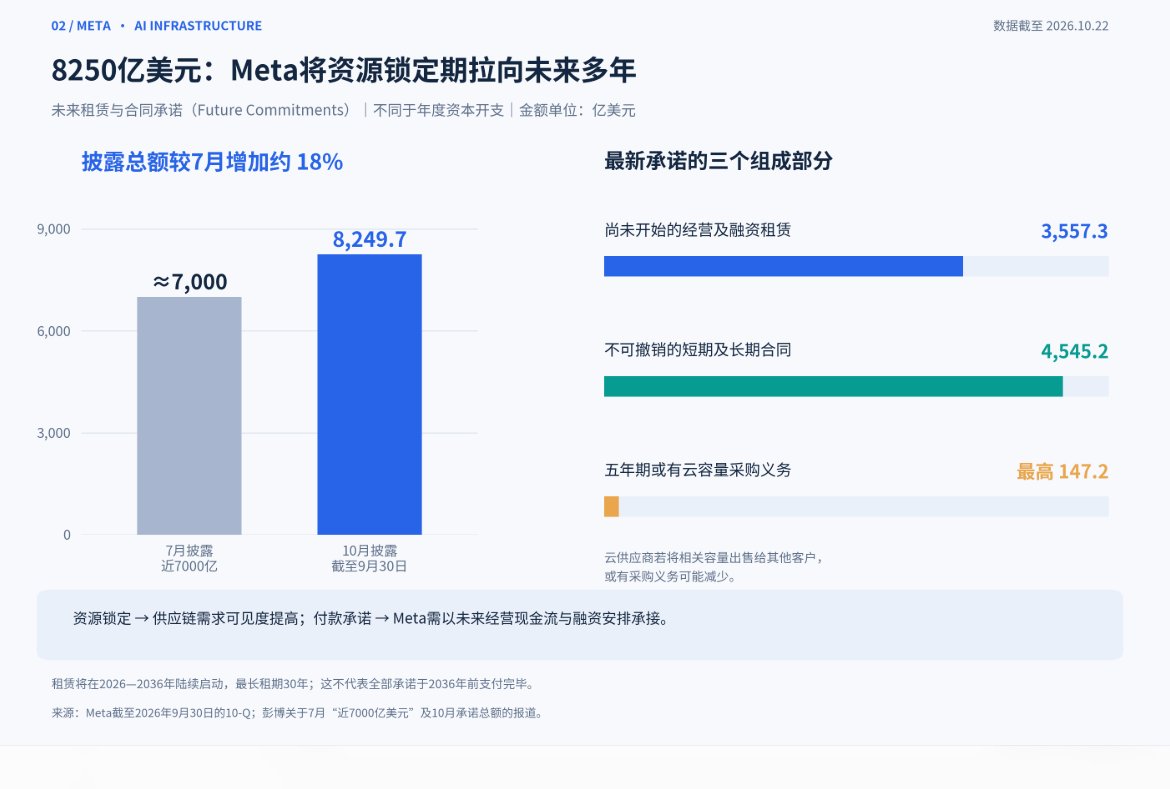
Meta also said that the company is obligated to purchase up to $14.7 billion of cloud computing capacity within five years, although this amount may be reduced if cloud service providers sell the relevant capacity to other customers.
When announcing quarterly results on Wednesday, the social media giant raised its capital expenditure plan for this year and announced the establishment of a new class of non-voting shares, which may be used to pay for acquisitions and other expenses in the future.
By contrast, previously in July of this year, Meta disclosed future spending promises close to $700 billion.
Meta is under pressure from cash flow, and the AI infrastructure supercycle is receiving stronger financial support
Meta's stock price is under pressure and the computing power industry chain is supported by demand, so it can be established at the same time. The multi-year spending commitment of 825 billion US dollars can be said to have strengthened the market's focus on Meta's capital occupation and commercialization return cycle; however, from the perspective of the entire AI computing power infrastructure industry, this also means that a tech giant with a huge advertising business is locking in future computing power and infrastructure resources ahead of schedule.
Wall Street financial giant J.P. Morgan's latest judgment provides an important supplementary logic to this: according to the agency's statistics, listed technology companies still have about 400 billion US dollars in industry financing surpluses this year, indicating that some companies' free cash flow (Free Cash Flow) is under pressure, which is not enough to deduce that the entire AI capital expenditure cycle has lost financial support.
The core contradiction of Neocloud (Neocloud) is that construction payments occur first, computing power revenue is then paid out, and rising financing costs therefore squeeze project returns. According to J.P. Morgan estimates, this type of enterprise has a cash flow of about 30 billion US dollars this year, corresponding to about 80 billion US dollars in capital and R&D investment. The latter accounts for only about 4.4% of industry-related investment. As a result, tighter financing may change who will build first, what kind of financing method is used, and when the project is delivered. Equity financing, project financing, and construction of hyperscale cloud vendors (hyperscalers) with stronger balance sheets may all be adjustment paths; other cash-rich technology companies can also free up more investment capital by reducing repurchases. According to J.P. Morgan strategists, these latest series of adjustments provide room for continued computing power construction.
This also explains why Meta and supply chain valuations may be divided: Meta shareholders need to wait for Muse subscriptions, transaction fees, corporate services, and advertising revenue to cover additional investment, while chip, network, memory, and packaging vendors can gradually confirm revenue as equipment is delivered. Combined with Meta's existing collaboration between Nvidia, AMD, and Broadcom, as well as capacity expansion and deployment acceleration driven by the Berlin GTC, its long-term commitment provides a more clear basis for demand in the supply chain. The key change in investment can be described as capital that may further differentiate between “operators that bear the risk of infrastructure investment and commercialization” and “suppliers that obtain orders and profits based on product competitiveness.”
At the transaction level, J.P. Morgan Chase pointed out that semiconductors account for about 13% of the market value of the MSCI Global Stock Index, yet contribute about 21% of venture capital; high concentration and high volatility can easily trigger value at risk (VaR) constraints and amplify passive position reduction. As positions fall from September highs, this part of the selling pressure is expected to ease. At the same time, for the AI computing power industry chain, it also means that when the release of position pressure meets the long-term demand promises of giants such as Meta, the computing power sector obtains the conditions for re-trade order growth and profit fulfillment — pressure on Meta's cash flow does not necessarily become a profit inflection point for the entire supply chain.
Behind the $825 billion promise: demand for computing power is locked in for longer, and cash returns are waiting longer
It should be noted that Meta's capital expenditure this year is expected to increase by about 87% to 101% year on year, with a median increase of about 94%, nearly doubling; $825 billion is leasing and contract commitments spanning many years and cannot be directly treated as annual capital expenditure.
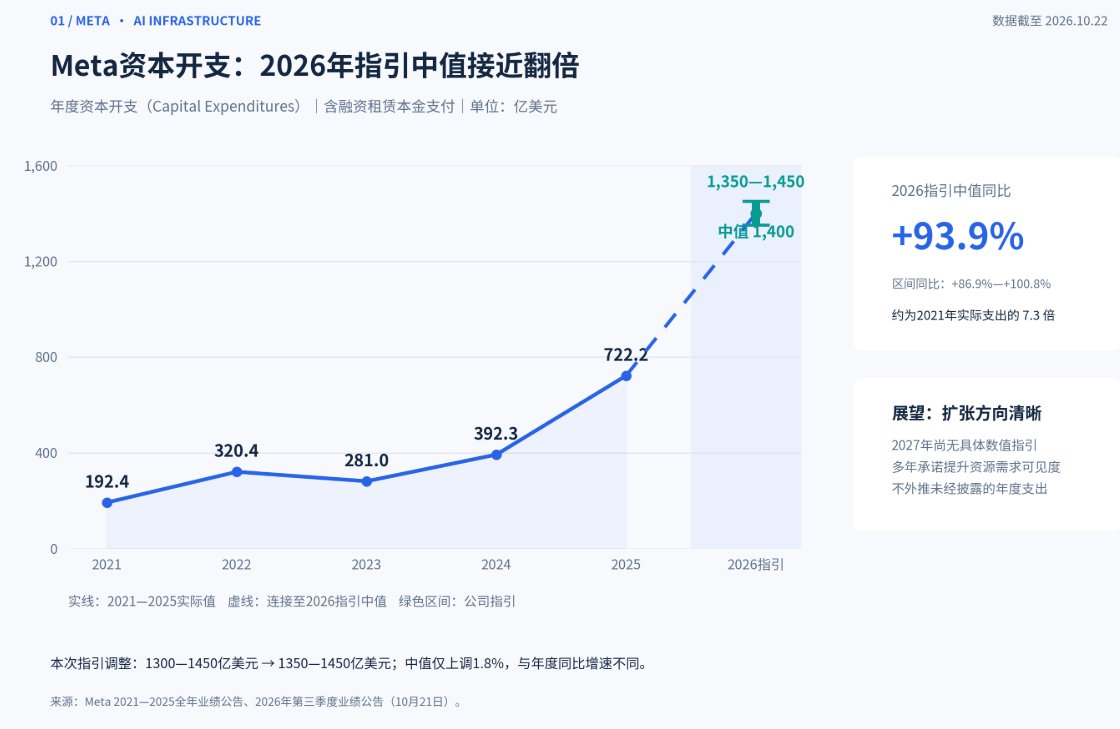
The company recently adjusted its 2026 capital expenditure guidelines from US$130 billion to US$145 billion to US$135 billion to US$145 billion. Compared with actual expenditure of US$72.22 billion in 2025, the expansion is significant. However, this time, only the lower limit was raised; the upper limit remained the same, and the median guideline value increased by only about 1.8%. What is really triggering a market re-examination is the time gap between the continuous accumulation of long-term payment responsibilities and AI commercialization returns.
Future spending commitments are about 18% higher than the nearly $700 billion disclosed in July. These commitments cover data center leases, third-party cloud computing power, energy supply, and consumer hardware, including both investment expenses and purchases required for future operations. For investors, the investment meaning behind this dynamic is that Meta is using multi-year contracts to lock in resources ahead of time, while also reducing the room for future spending adjustments as demand changes. Some of these leases will start one after another between 2026 and 2036, for a maximum period of 30 years, so this total amount reflects the size of long-term operating commitments.
The financial report showed a clear “strong revenue and pressure on cash flow” structure: revenue for the third quarter was US$64.601 billion, up 26% year on year; ad impressions and average prices increased by 10% and 14% respectively; revenue guidance for the fourth quarter was US$73 billion to US$76 billion. Third-quarter earnings per share were $3.83, or $7.40 after excluding the impact of $9.89 billion in legal settlement fees. However, operating cash flow for the same period was US$32.79 billion, lower than capital expenditure of US$34.91 billion, and free cash flow turned negative to US$2.12 billion. Business growth has been realized, and infrastructure investments are taking up more direct cash.
Muse expansion affects computing power orders: from smart entrances to AI chips, memory, and 3D advanced packaging
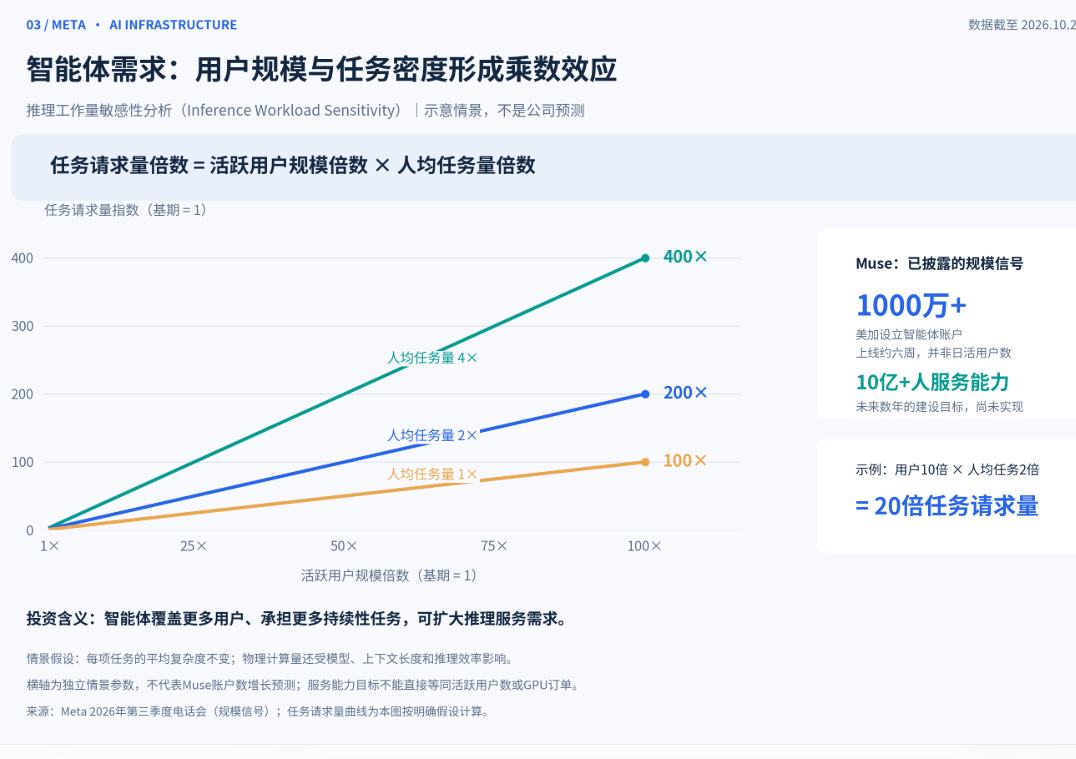
Muse has provided an initial verification of application requirements. Management revealed that about six weeks after launch, more than 10 million people in the US and Canadian markets set up the Muse personal smart device, and about a quarter of them use it on any given day; shopping covered more than 25% of weekly active users, with an average purchase amount of more than 200 US dollars. Muse Wonder is further improving product quality, engagement, and retention. The company is simultaneously expanding the code, voice, and open weighting models, and plans to bring Muse into Meta smart glasses in November, and the Muse Charm device will soon be launched. These positive developments all mean that Meta is expanding the smart device from a standalone application to a service portal connecting shopping, work, and everyday devices.
The commercialization path includes advanced models and additional usage subscriptions, enterprise services, and future charging merchants to facilitate transactions; Meta Enterprise Platform expands inference revenue and shares the fixed costs of model training through model APIs, muse codes, and enterprise agents. Management plans to build the capacity to serve more than 1 billion people and aim to increase computational cost efficiency by more than 10 times over the next year, but at the same time, it is expected that user expansion will continue to increase total service costs. According to Wall Street giants such as J.P. Morgan Chase, which are optimistic about the prospects of an AI super-bull market, a decrease in unit task costs and an increase in total demand for computing power can occur at the same time — depending on the growth rate of the number of users, frequency of tasks, and task complexity.
For core suppliers of chip, network infrastructure, and data center optical interconnection systems, Meta's expansion has a clear foundation of cooperation: Nvidia and Meta have cooperated for many years covering millions of Blackwell, Rubin GPUs and CPUs, networks and high-speed optical interconnect product lines; AMD has collaborated on a maximum scale of 6 gigawatt GPU deployment; and Broadcom has participated in the development of multiple generations of Meta self-developed training and inference accelerator MTIA. As a result, new demand will flow simultaneously to general-purpose GPUs, custom chips, and interconnect networks, and each vendor's actual revenue growth will depend on platform shares and delivery arrangements.
The beneficial mechanisms of DRAM memory and NAND/SSD data center storage components also have their own focus: SK Hynix has supplied server DRAM and enterprise-grade SSDs to Meta and is promoting HBM technology collaboration; Micron is participating in platform upgrades through HBM4, memory modules, and enterprise-grade SSDs for Vera Rubin. For Seagate and Western Digital, the two supermechanical hard disk dominators that monopolize HDDs, the core transmission path is: the expansion of the smart device business produces more enterprise data, work results, and historical records worth preserving, and long-term storage capacity that continues to grow even after screening, compression, and deduplication will drive demand for high-capacity HDDs. This demand transmission is judged by industry mechanisms, and the $825 billion disclosure itself did not give the two companies' additional order amounts.
The supply side of AI computing power resources is also cooperating with the expansion. The DSX POD released by GTC Berlin has been pre-integrated and validated at the factory to reduce the on-site deployment time for completed power, cooling, and network preparation sites from about six months to as fast as 14 days, and is scheduled to be delivered in early 2027; it helps shorten the waiting time between equipment arrival and computing power being put into operation. Nvidia is also promoting the expansion of production of substrates, advanced packaging, testing, and optical engines. Among them, the Korean intermediate-layer wafer production capacity in collaboration with Amkor is scheduled to increase by more than 300% by the end of 2028. This provides a basis for demand transmission and expansion of production for TSMC's 3D advanced manufacturing and packaging and Amkor's package testing.
Recent financial reports provide further evidence of demand fulfillment — the “king of global chip foundry” TSMC's third-quarter US dollar revenue increased 41.2% year over year to 46.72 billion US dollars; lithography giant Asmack (ASML)'s quarterly revenue reached 11.662 billion euros, and indicated that customers have begun discussions on equipment requirements from 2029 to 2030; SpaceX's super intelligence division's revenue reached 7.56 billion US dollars, and operating profit corrected to 431 million US dollars.
SpaceX's strong earnings report and outlook also provided demand-side support for Nvidia's Berlin GTC's computing power expansion narrative. The company's third-quarter revenue increased 161% year over year to 14.58 billion US dollars, of which super intelligence (SI) business revenue increased by about 830% year over year to 7.56 billion US dollars, and achieved operating profit of 431 million US dollars, indicating that AI business expansion is gradually being transformed into revenue and operating results. Musk further stated that it is expected that the online computing power capacity will reach 2.5-3 gigawatts by the end of the year, and he is confident that another 10 gigawatts will be added in 2027. Next year's deployment will mainly use the Nvidia Vera Rubin platform.
This expansion plan echoes the DSX POD shown by GTC to accelerate on-site deployment and expand production capacity in key supply chains: customers need faster access to computing power that can be put into operation, and Nvidia is focusing on shortening the distance between hardware delivery and computing power service revenue generation. As far as the market is concerned, the realisation of AI business revenue is mutually confirmed by the next-generation computing power procurement plan, providing more specific support for Nvidia, HBM and data center high speed optical interconnection, power supply and liquid cooling industry chains, and adding fundamental catalysts to the “AI bull market narrative”.
From a comprehensive perspective, the long-term commitment of Facebook and Instagram's parent company Meta can be described as a significant medium- to long-term demand benefit for the computing power industry chain; however, the impact of the same round of investment on the valuation of different companies is not the same: suppliers can confirm revenue during the delivery process, while Meta needs to convert purchased computing power into sufficient profits and cash returns through advertising, subscriptions, transaction fees, and corporate services.