


Dear Nvidia Stock Fans, Mark Your Calendars for October 20
Nvidia (NVDA), the bellwether of the AI trade, will hold its GTC Berlin AI Conference today. CEO Jensen Huang is scheduled to speak, and the market will not only be looking to gain insights into the chip giant's plans for Europe, but also his take on other contentious topics affecting the AI infrastructure buildout, such as the memory shortage, capex spending, and energy needs.
After a stellar run over the better part of the last three years, Nvidia's share price performance has been somewhat muted this year, with the stock up 15%. Yet, this has been enough to outperform the S&P 500 ($SPX). A key component of this was the largest-ever increase in its share buyback program by an additional $150 billion.
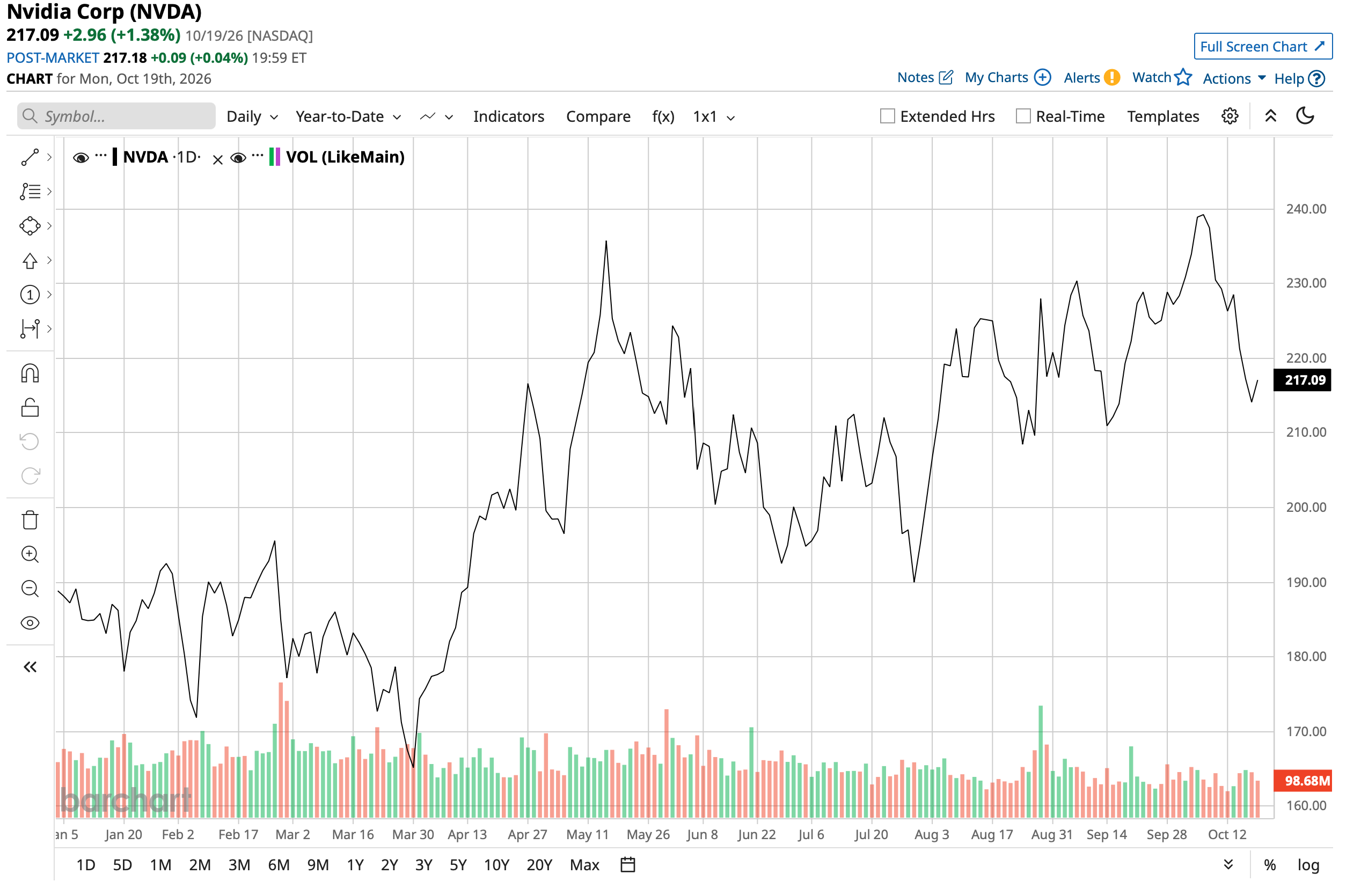
Notwithstanding all this, the company's growth has remained robust, and Huang has been as bullish as ever about the demand for the company's chips, despite intensifying competition from custom silicon developed by the hyperscalers, all of which are in turn some of the largest customers of the company. However, as China remains mostly out of bounds, the conference in Berlin could be an ideal opportunity for Huang to deepen its relationships in Europe.
Looking Across the Pond
Nvidia's long-standing relationship with Europe has evolved significantly over the past two and a half decades. From selling GPUs, the company wants to be a key player in the development of the region's AI infrastructure and industrial ecosystem. Reportedly, Nvidia has committed nearly $10 billion to Europe's technology ecosystem, with heavy investments in France and Germany and a $250 million commitment over five years for AI safety and security research in the UK.
Overall, Nvidia has 35 AI and high-performance computing supercomputers in development across Europe in June 2026, spanning 23 countries and supporting more than three million researchers. The company said its technology powered more than 90% of Europe's AI factory buildout, with 800 AI exaflops deployed or announced since the previous year.
Now, although the conference's workshop day is on Oct. 20, Huang's keynote address will be on Oct. 21. Here, market participants and the wider AI world are looking to hear more from Huang about the Vera Rubin platforms, the company's latest rack-scale system. Then, in terms of agentic AI, Nvidia's published programme specifically highlights AI agents that can plan, use tools, and carry out extended tasks. The agenda also includes industrial AI, robotics, autonomous vehicles, and digital twins. The presence of executives from Mercedes-Benz, Siemens Healthineers (SIEGY), and Agile Robots in the keynote program signals a strong industrial focus. Concrete evidence of customer deployments, clarity on production timelines, and the pace of commercial adoption will be in focus here.
Finally, the agenda also features Deutsche Telekom (DTEGY), Mistral AI, and Nebius (NBIS), among other European technology and infrastructure players. This creates an opportunity for announcements about new capacity, cloud partnerships, financing, or customer commitments.
Nvidia Is Operating From a Position of Financial Strength
Nvidia's European strategy may get some more clarity at the conference, but the strength of its financial position cannot be clearer.
Turning to the second quarter of fiscal 2027, Nvidia reported revenue of $96.2 billion, a 106% rise from the year-earlier period, and came in ahead of consensus estimates. Data center revenue advanced 117% year over year to $89 billion. For the third quarter of fiscal 2027, the company guided for total revenue of $108 billion plus or minus 2%.
Earnings per share climbed 120% year-over-year (YoY) to $2.22, beating the consensus estimate of $2.09 and extending Nvidia’s streak of consecutive earnings beats to nine quarters.
Gross margins expanded to 75% from 72.4% in the prior year period. The company’s projected gross margin range of 73.5% to 74.5% for the third quarter of 2027 drew some criticism from observers searching for potential soft spots in the investment case. Even so, Nvidia shares advanced after the second-quarter results, ending a four-quarter sequence in which the stock fell immediately after earnings announcements.
One important point raised during the second-quarter earnings call was the plan by Amazon (AMZN) Web Services, a leading cloud provider, to deploy 2 million Nvidia graphics processing units starting in the current quarter and running through the second quarter of fiscal 2029. This announcement helps ease concerns that large hyperscalers could develop their own chips or application-specific integrated circuits and lessen their dependence on Nvidia products.
Net cash from operating activities in the second quarter rose to $24.1 billion from $15.4 billion in the year-ago period. The total included $7.8 billion in gains from equity investments in companies such as OpenAI, SpaceX (SPCX), CoreWeave (CRWV), and Nebius. At the same time, accounts receivable increased by a sizable $22.3 billion during the quarter, a development that has fueled ongoing discussion about possible circular financing dynamics.
Nvidia ended the quarter with $22.4 billion in cash, well above its short-term debt balance of $1 billion.
Amid these results, NVDA shares continue to trade at reasonable levels, trading at a slight premium over the sector medians. Its forward P/E, P/S, and P/CF are 22.99, 12.56, and 24.73, compared to the sector medians of 21.01, 3.20, and 19.70, respectively.
Analyst Opinion on NVDA Stock
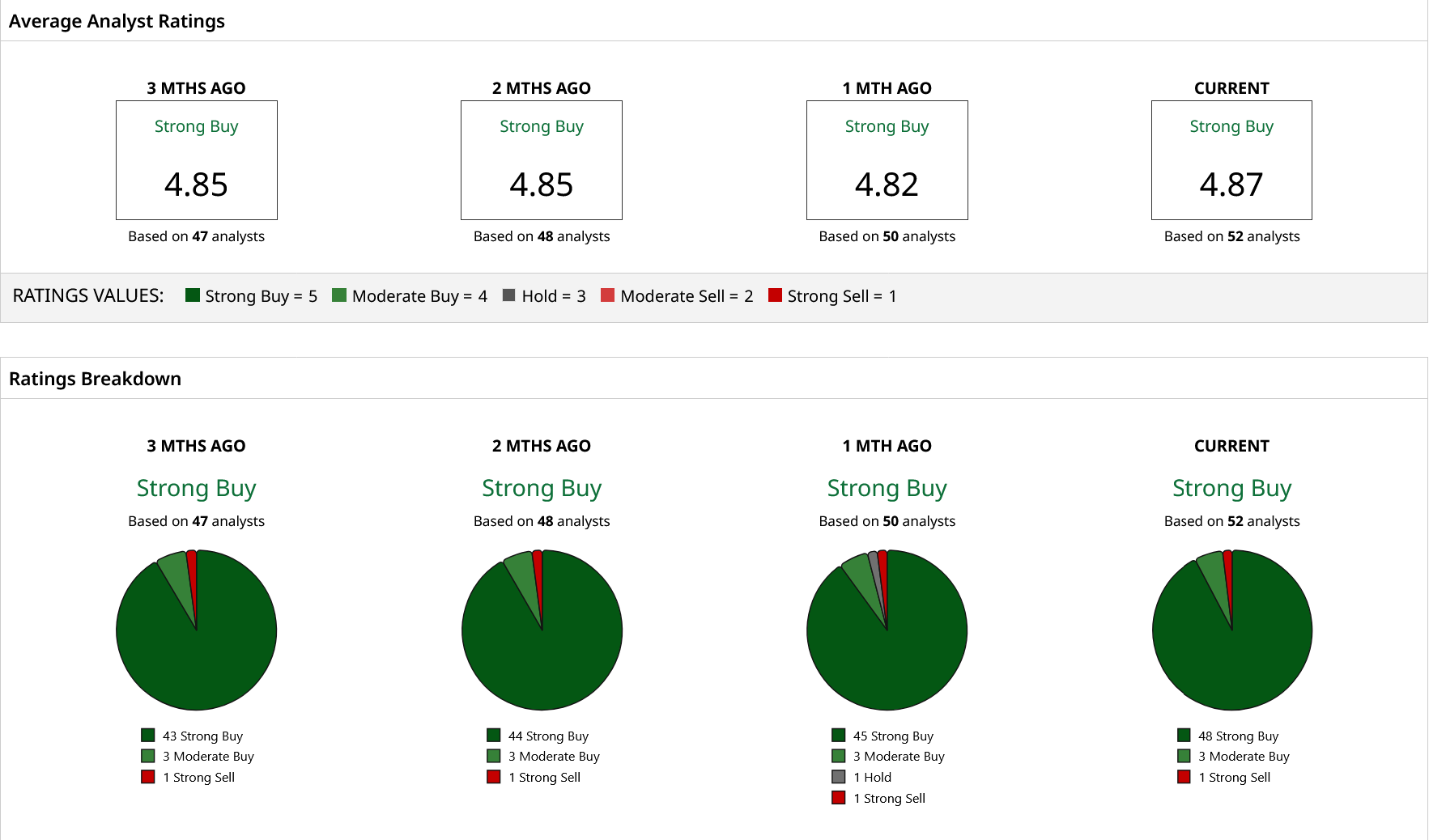
Considering all this, analysts remain optimistic about NVDA stock and have earmarked for it an overall consensus rating of “Strong Buy.” The mean target price of $328.75 indicates a potential upside of 51% from current levels. Out of 52 analysts covering NVDA, 48 have a “Strong Buy” rating, three have a “Moderate Buy” rating, and one has a “Strong Sell” rating.
On the date of publication, Pathikrit Bose had a position in: NVDA . All information and data in this article is solely for informational purposes. For more information please view the Barchart Disclosure Policy here.