


Does Asset Sale Plan Change The Bull Case For Gibraltar Industries (ROCK)?
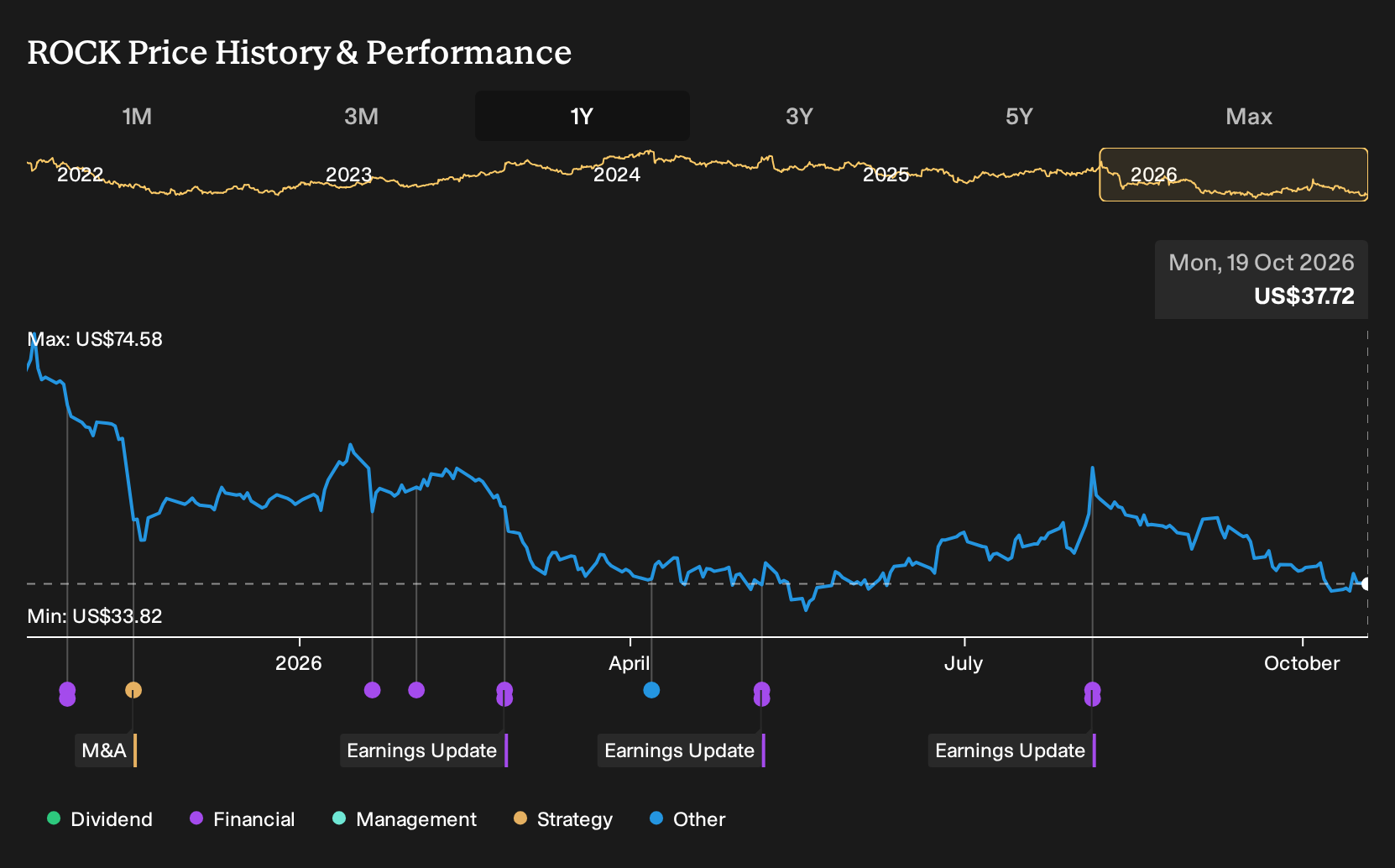
- Gibraltar Industries has reshaped its portfolio in recent years, integrating the acquired Omnimax business while planning to sell the D.S. Brown infrastructure unit to concentrate more on building products and structures.
- This refocus tightens management attention and capital around a narrower set of construction exposed activities, which could affect how durable Gibraltar Industries' earnings mix appears to investors.
- We will now look at how Gibraltar Industries' investment narrative may be influenced by the Omnimax integration and D.S. Brown divestiture.
Scan beyond Gibraltar Industries and compare how other construction exposed businesses are repositioning their portfolios by reviewing our curated list of 42 power grid technology and infrastructure stocks.
Gibraltar Industries Investment Narrative Recap
To own Gibraltar Industries, you need to believe the tighter focus on building products, Agtech and infrastructure can translate into steadier profitability despite a weak U.S. residential roofing backdrop and a sharp share price pullback. The near term swing factor is whether Omnimax integration keeps lifting the Residential margin profile while the business reshapes around fewer, more construction exposed segments.
The biggest current risk is that soft roofing demand and a heavier Residential mix squeeze pricing and volumes at the same time that debt remains a constraint. If free cash flow or planned divestitures disappoint, higher interest costs and thinner margins could matter more to results than any portfolio tidy up.
The planned sale of the D.S. Brown infrastructure unit is the announcement that ties most directly to this portfolio reset. That transaction would tilt Gibraltar Industries even further toward building products and structures, on top of the earlier exit from Renewables, and reinforces the idea that management wants a cleaner, more concentrated earnings base.
For you, the key question is whether a simpler mix, together with Omnimax synergies and working capital initiatives, can offset the risk of being more tethered to construction cycles while carrying about US$1.2b of net debt and 3.9x net leverage. Execution on cost savings, deleveraging and the trims and flashings supply agreement will likely shape how quickly that thesis is tested.
What The Current Forecasts Assume For Gibraltar Industries
On current analyst assumptions, Gibraltar Industries is modeled as a much larger, more profitable business by the late 2020s, with the Omnimax integration and portfolio reshaping already baked into the numbers. Those forecasts matter because they anchor many of the debates around leverage, the D.S. Brown sale and how concentrated the earnings stream could become in construction linked categories.
Forecasts in the latest report point to revenue expanding by 15.7% per year over the next few years, which is a brisk clip for a building products focused group that is still managing a heavy roofing exposure. Earnings today are put at US$60.3 million, with consensus pointing to US$223.4 million by 2029. That implies a value increase of about US$163 million if those projections play out.
On that 2029 view, analysts are also assuming that profit margins move from 4.2% today to 10.0%, as Omnimax synergies, mix choices and cost work feed into the income statement. At the share level, that equates to forecast earnings per share of US$5.60 by 2029, alongside a modest 0.48% annual increase in the share count over the next 3 years. This means much of the uplift is expected to come from profitability rather than financial engineering.
The valuation framework in the report builds these ingredients into a single story. To line up with the consensus price target, you would need to be comfortable with Gibraltar Industries reaching about US$2.2b of revenue and US$223.4 million of earnings in 2029 and then trading on a P/E multiple of 14x those earnings, compared with 19.8x today and the same 19.8x quoted for the wider US building peer group.
That 14x assumption effectively embeds a lower multiple than both the current stock and the sector snapshot. This signals that the model does not rely on a rerating. Instead, it leans on margin expansion and top line growth to do the heavy lifting, while the discount rate of roughly 11.4% to 11.38% is used to translate those future cash flows and profits back into today’s value terms.
Gibraltar Industries' forecasts imply about US$2.2b of revenue and US$223.4 million of earnings by 2029, which ties to an assumed 15.7% yearly revenue growth rate and an earnings increase of roughly US$163 million from the current US$60.3 million level.
Uncover why Gibraltar Industries' fair value indicates a 100% potential upside to its current price, which could narrow quickly.
Exploring Other Perspectives
One alternate angle on Gibraltar Industries leans heavily on execution risk around the systems integration push. The lowest analysts were already cautious before this news, even while modeling about US$2.4b of 2029 revenue and US$242.9 million of earnings. That mix of higher earnings but a 9.4x P/E shows how sharply opinions can differ. Treat this news as a prompt to compare several viewpoints, not to accept any single story as fixed.
Explore 2 other Gibraltar Industries fair value estimates, including one that suggests it could be worth just $75.25!
Form Your Own Verdict
Disagree with existing narratives? Extraordinary investment returns rarely come from following the herd, so go with your instincts.
- A great starting point for your Gibraltar Industries research is our analysis highlighting 2 key rewards and 3 important warning signs that could impact your investment decision.
- See our latest analysis for Gibraltar Industries. The report includes a comprehensive fundamental analysis summarized in a single visual, the Snowflake, making it easy to evaluate Gibraltar Industries' overall financial health at a glance.
Looking For More Investment Ideas Beyond Gibraltar Industries?
If the Gibraltar Industries story has sharpened your thinking, use that same lens to scan for other opportunities that match your risk tolerance, time horizon and preferred business profiles using the Simply Wall St Screener.
- If you want financial quality at a discount, start by reviewing a curated set of 35 high quality undervalued stocks that combine strong fundamentals with relatively low valuations.
- For investors who care most about resilience, focus on a 32 resilient stocks with low risk scores that score well on balance sheet strength and earnings stability.
- If you prefer strong finances and durable business models, filter for companies in our list of solid balance sheet and fundamentals (25 results) to see which ones fit your framework.
This article by Simply Wall St is general in nature. We provide commentary based on historical data and analyst forecasts only using an unbiased methodology and our articles are not intended to be financial advice. It does not constitute a recommendation to buy or sell any stock, and does not take account of your objectives, or your financial situation. We aim to bring you long-term focused analysis driven by fundamental data. Note that our analysis may not factor in the latest price-sensitive company announcements or qualitative material. Simply Wall St has no position in any stocks mentioned.
Have feedback on this article? Concerned about the content? Get in touch with us directly. Alternatively, email editorial-team@simplywallst.com