


Wells Fargo: This earnings season is “one of the weakest EPS seasons in history”, and most companies' performance falls short of expectations
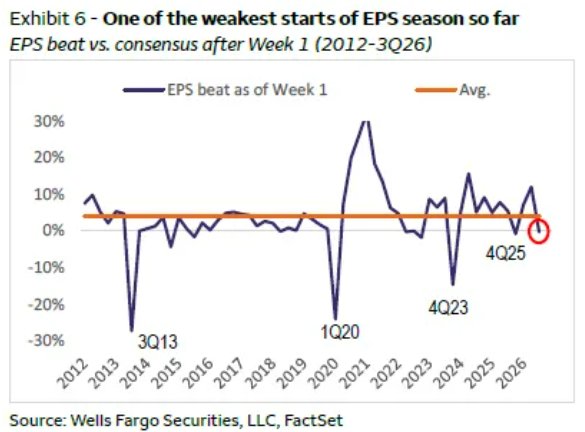
The Zhitong Finance App learned that Wells Fargo said that the current US earnings season had a bad start. A team of analysts led by Ohsung Kwon, the bank's chief stock strategist, wrote in a report to clients that the third-quarter earnings season began only about a week ago, and the earnings per share of companies that have announced results are 0.3% lower than analysts' general expectations.
This is significantly lower than investors' previous expectations: data dating back to 2012 shows that corporate profits generally exceeded expectations by an average of 4% during the earnings season. Furthermore, only 48% of companies surpassed expectations, compared to 61% in previous years.
Analysts said there are currently no signs of a “fundamental rift” and companies are “still generally optimistic” about demand. But they pointed out that early data meant this was “one of the weakest starts to the EPS season in history.”
Over the past few years, continued strong corporate profits have supported stock prices. So far, however, mixed results have failed to provide much of a boost. The performance of large Wall Street banks has been divided, and their stocks have recorded the longest consecutive weekly decline since the 2008 financial crisis.
Bank of America strategists Savita Subramanian and Victoria Roloff believe that the performance was “overall steady but lacking in surprise.” In the first week of this earnings season, about 40% of the S&P 500 constituent banks exceeded expectations in terms of both profit and revenue, compared to 100% for the same group in the previous quarter.
“Banks continue to send positive signals in terms of credit and consumers, but concerns about capital market activity peaking persist,” Subramanian and Roloff wrote in a report released Monday.
Banks weren't the only ones to disappoint the market. Due to high aviation fuel prices, Delta's third-quarter profit fell short of expectations and lowered its full-year profit guidance.
The lackluster market reaction is also noteworthy, due to energy shocks caused by the Iran war, rising interest rates, and overshadowed prospects by the US congressional election order early next month.
According to Bank of America data, companies whose profits and revenue both exceeded expectations were lower than usual in stock prices the next day. Overall, individual stocks fluctuated an average of 3.4% the day after the earnings report was released, compared to 5.3% in the previous quarter.
“Although we expect steady results, under macro headwinds, companies gave reassuring guidance on the outlook, which could be a greater driver of stock price performance this quarter,” Subramanian and Roloff wrote.