


Microsoft’s New AI Model Adds to Its Bull Case, but Investors Should Wait for a Pullback
Microsoft (MSFT) just introduced a new artificial intelligence (AI) model that could help companies get work done quicker and at a lower cost of $0.042 per million input tokens, with responses costing nothing. Called Microsoft-Decision-1, the model focuses on tasks such as “routing, classification, prioritization, verification, and workflow control, making it easier to incorporate decision intelligence into existing applications, agents, and workflows in a secure, trusted environment." It’s also fast, performing such tasks quicker than larger AI models in testing, including being 35 times faster than GPT-6 Sol.
It's Also Less Expensive
The lower cost of $0.042 could attract more customers, making AI far more affordable for a company to use millions of times a day. For example, think of a company using it to sort customer requests, flag problems, or decide which tasks need attention first. Each decision might cost very little, making it easier to justify using the technology across the business. Others charge between 10 cents and $1. According to OpenRouter.ai, Microsoft’s Decision 1 input price is 58% less than Google Gemini 2.5 Flash-Lite, and 58% less than Anthropic Claude Haiku 5.5.
In short, if Microsoft can make AI tools far more useful, affordable, and fast, other companies may find more reasons to use its technology. By simply reducing a company’s overhead with lower fees, those companies could make more projects worth pursuing.
An AI assistant often has to do more than answer a question. To complete a task, it may need to retrieve information, check a result, and decide what happens next. If those decisions take too long, the whole process slows down. A faster decision model could help reduce those delays. That could make AI applications smoother and help employees finish work sooner. Better results could give customers a stronger reason to pay for AI tools. The important question is whether the technology makes the workday easier. And if it can help save time, control costs, and get work done well, the model could strengthen its AI business.
What Do Analysts Say About MSFT Stock?
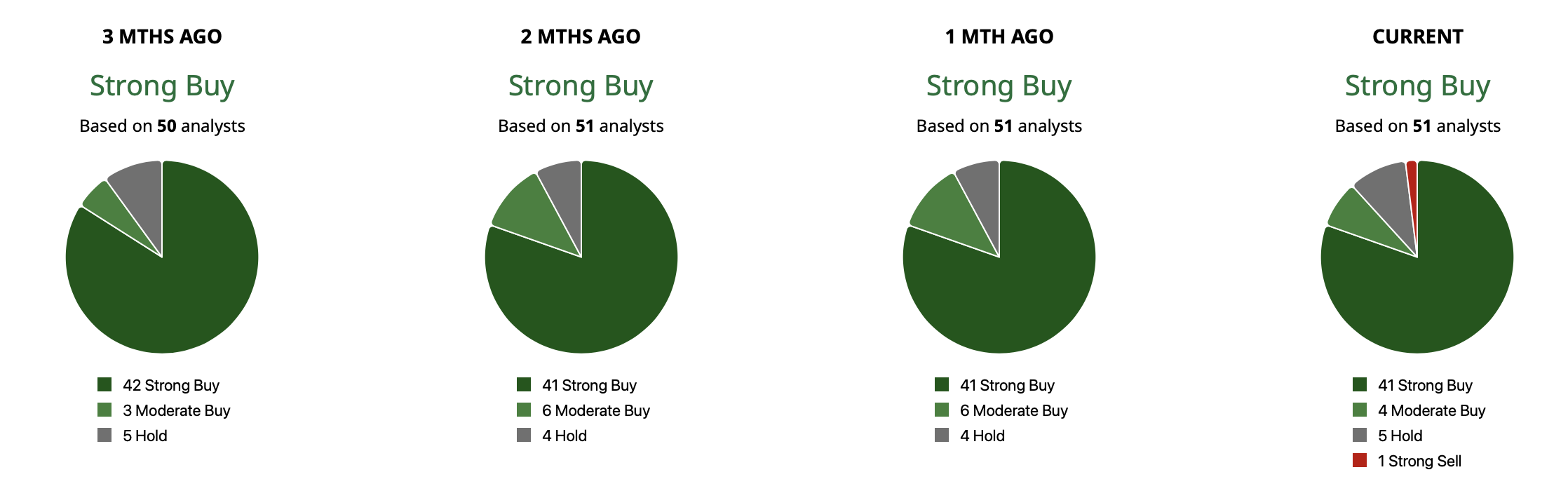
Overall, Microsoft has a consensus “Strong Buy” rating on Wall Street. Of the 51 analysts covering MSFT stock, 41 have a “Strong Buy” rating, four have a “Moderate Buy” rating, five have a “Hold” rating, and one has a “Strong Sell” rating. The mean target price of $590.88 implies a potential upside of 12% from current levels. Meanwhile, its high-end price target of $725 implies a potential upside of 37%.
Most recently, analysts at UBS raised their price target on Microsoft to $675 from $525, citing Azure and Microsoft 365 growth, with a buy rating. Citi analysts raised their price target to $636 from $600 with a buy rating, noting that the tech giant is one of the best-positioned AI vendors. TD Cowen analysts raised their price target to $625 from $540 with a buy rating. The firm cited the potential for a beat on Azure numbers. And Mizuho analysts raised its price target to $600 from $510, with an outperform rating. Goldman Sachs is also bullish ahead of earnings later this month, expecting Azure cloud revenue growth to reach about 46% to 47%. The firm has a buy rating and a $640 price target.
Analysts at Jefferies also raised their price target on MSFT to $650 from $575, with analyst Brent Thill noting that Microsoft could do better than expected with earnings. Demand for its AI services is so strong that the company is struggling to keep up. Customers are also expected to spend more on Microsoft 365 as they add its Copilot AI tools.
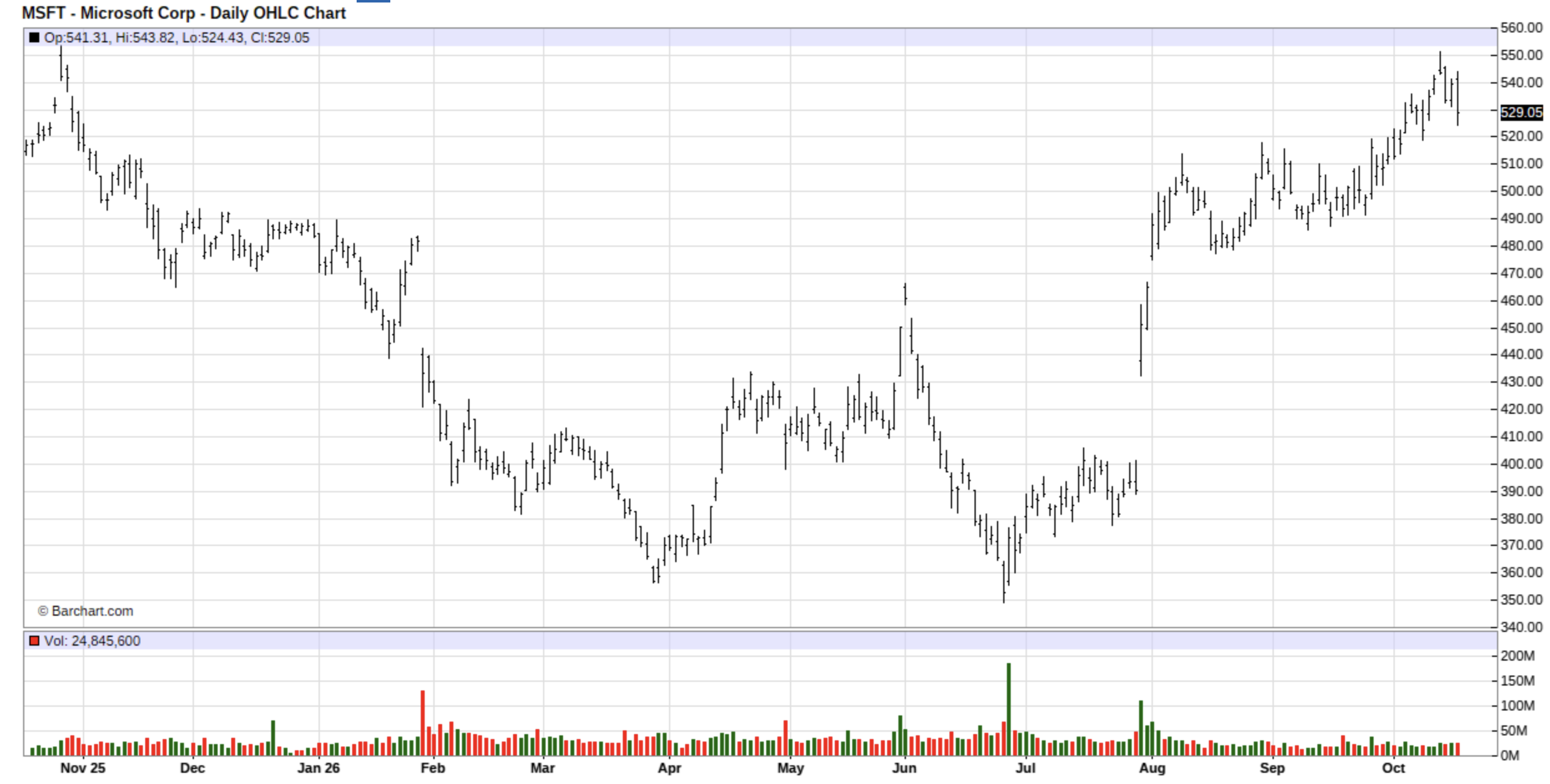
However, as bullish as those analysts may be heading into earnings later this month, I’d wait to buy on a pullback. At the moment, MSFT stock is struggling at triple-top resistance with overextensions on relative strength, MACD, and Williams’ %R. If it fails to break above $551, it could potentially retest support at around $490, worst-case scenario.
On the date of publication, Ian Cooper did not have (either directly or indirectly) positions in any of the securities mentioned in this article. All information and data in this article is solely for informational purposes. For more information please view the Barchart Disclosure Policy here.