


How a Possible Dead-Cat Bounce May Trigger a 135% Options Payout for Baidu (BIDU) Stock
From the looks of things, Baidu (BIDU) is a name to avoid and for good reason. It’s one of the tech-related names that fully deserves its 100% Strong Sell rating by the Barchart Technical Opinion indicator. Tumbling nearly 11% in the trailing month will do that to you. Plus, BIDU stock happens to be one of the worst one-month percentage losers among large-capitalization securities.
Still, Baidu offers what extreme contrarians love: a relevant business that’s suffered a massive haircut. Primarily, the idea is that BIDU stock could be a possible mean-reversion candidate. With so much negativity baked into the share price, more bad news of increasing scope may be necessary to justify its descent. Theoretically, upside resistance may be limited — meaning good news could have a disproportionate impact.
There's a technical argument to consider as well. Right now, Baidu stock is rapidly approaching the $80 level, which may be a psychologically significant support level. In addition, BIDU has dropped to around this point in late 2022 and early 2025. To be fair, I’m not sure if that necessarily offers significance, although many technicians will argue that this level represents established support.
Whatever the case may be, we’re approaching a historical reference marker. At the exact same time, BIDU stock is structured in an extremely bearish state. Historically, we know through historical data that when such states materialize, a transition often occurs to a bullish state.
We’re not necessarily betting on the state itself but the anticipated transition. As such, a debit-based vertical spread may be an ideal strategy here.
Looking for a November Swing for BIDU Stock
Specifically, I’m interested in the 80/85 bull call spread expiring Nov. 20. Here, the speculator will pay a net debit of $213 in the hopes that Baidu stock will rise and trigger the $85 second-leg strike on expiration. If it does, the maximum profit would be $287, a payout of 134.74%.
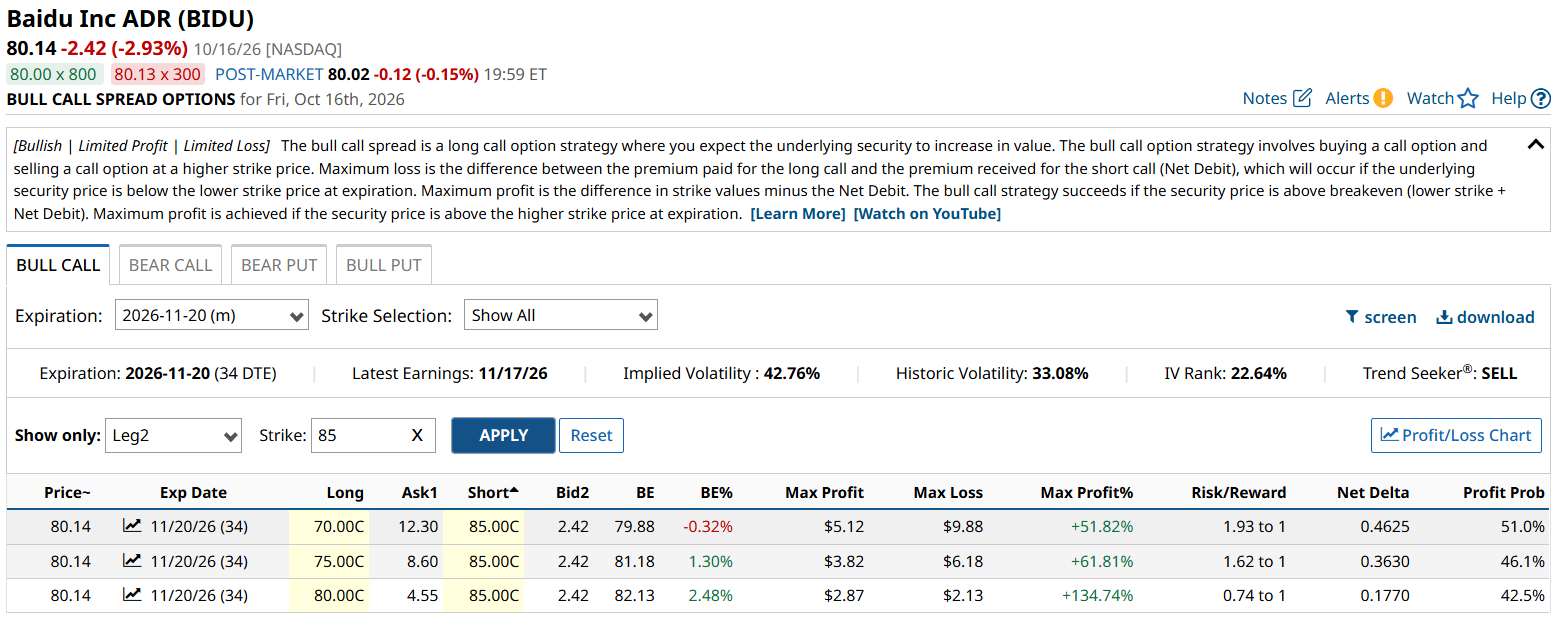
What’s intriguing about this idea off the top is the balance between the payout and probabilistic risk. Using standard risk-management practices, this BIDU stock options spread is attractive because of its favorable payout asymmetry: you have a chance to generate more in profit than you would be putting at risk.
Secondly, the probabilities aren’t bad for a trade of this nature. For example, the breakeven price sits at $82.13, which is 2.48% above the current spot price. Also, Black-Scholes’ probability distribution curve places the odds of Baidu stock hitting the full-profit target at 30.84%.
However, with these parameters, the trade isn’t mathematically ideal, resulting in an expected value (EV) of $23.47 below zero. That translates into an expected return on capital (ROC) of -27.61%. Basically, if you’re feeling lucky, BIDU stock might be worth a go. But identical trades across multiple parallel universes would statistically result in a net loss.
What if we can change one of the parameters? Then the November 80/85 bull spread would take a fascinating turn.
Shifting the Probabilistic Assumption of Baidu Stock
Obviously, one of the straightforward mechanisms (if it were possible) is to simply boost the payout associated with the aforementioned spread. If the maximum reward were, say, 500%, it would basically be a no-brainer. However, Wall Street isn’t in the business of handing out free gifts to retail traders. If you want such an extreme payout, you need to take extreme risks.
So, the only practical solution is to change the probability associated with the trade. Right now, the chance that BIDU stock will trigger the $85 strike on expiration is around 31%. However, this probability must rise to a minimum of 42.6% for the $85 bull spread to reach parity on EV.
Fortunately, there’s a potential case for this ratio to be 50%.
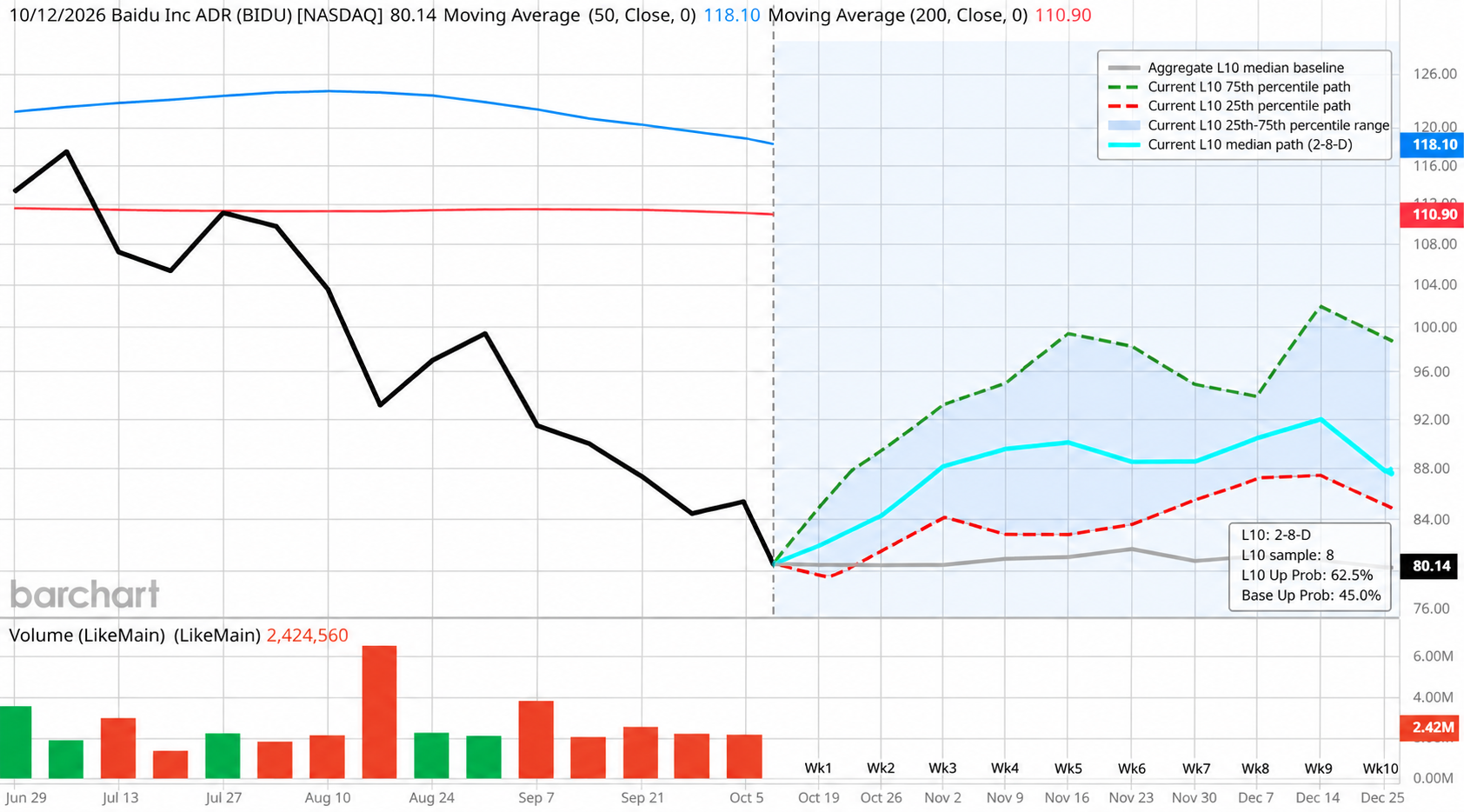
Earlier, I said that Baidu stock was structured in an extremely bearish state; more to the point, in the last 10 weeks (two months), BIDU has only managed to print two net positive weekly candlesticks. This particular sequence has only materialized eight times on a rolling basis in the past five years.
When Baidu stock has done so, a dead-cat bounce tends to be the typical response — enough so that there is a 50%, to possibly up to a 62.5% chance, that BIDU triggers the equivalent of the $85 strike on Nov. 20.
Of course, the premise of bullishness rests on an inductive observation — with a very limited sample size. But if you’re willing to take that risk, BIDU stock could present a tempting proposition.
On the date of publication, Josh Enomoto did not have (either directly or indirectly) positions in any of the securities mentioned in this article. All information and data in this article is solely for informational purposes. For more information please view the Barchart Disclosure Policy here.