


Procter & Gamble (PG) Could Be 19% Below Fair Value As Earnings Week Nears
Procter & Gamble (PG) heads into a busy earnings week with investors watching how upcoming results square with recent product launches, fresh dividend declarations, and a new shelf registration for additional debt financing flexibility.
Recent news flow around product upgrades, fresh dividend declarations and new debt shelf capacity has landed alongside a clear upswing in Procter & Gamble’s trading performance. A 30-day share price return of 8.85% and a year-to-date share price gain of 12.38% point to building momentum, while the 5-year total shareholder return of 27.85% reflects a steadier long-run compounding profile as investors weigh brand strength against input cost and consumer demand risks.
Compare how Procter & Gamble stacks up against other resilient consumer-focused businesses by scanning our hand picked 32 resilient stocks with low risk scores with similar defensive profiles and lower risk scores.
After an 8.9% move in 30 days and fresh news on dividends and debt capacity, Procter & Gamble now forces a choice. Is it worth paying up today, or does patience for a cheaper entry make more sense as the valuation picture unfolds?
Most Popular Narrative: 48% Overvalued
Against the last close at $159.35, the most followed valuation narrative for Procter & Gamble points to a fair value of $107.52, which frames the recent share price strength as rich rather than cheap.
From what we have seen a possible reduction of its exposure to the Beauty segment (with a decreasing operating margin) and an increase of exposure to the Grooming business segment (with an increasing operating margin) would be a logic step in improving the overall operating margins for the company. However, from what is presented in front of us, this does not seem to be the current or projected situation.
See why 34 investors see Procter & Gamble as 48% overvalued.
According to andre_santos, the narrative anchors on a discount rate of 8.32% and lands on a weighted fair value estimate of $107.52, which is roughly 48% below the current share price. That gap is driven by cautious assumptions on mid single digit revenue growth, mostly flat margins, and dividend growth that tracks broader economic expansion rather than a step change in profitability.
The same narrative highlights Procter & Gamble’s high return on invested capital and long record of steady cash returns, yet still concludes the stock price embeds a premium to those fundamentals. In other words, the business quality scorecard looks strong, but the author judges the valuation to leave limited room for disappointment on earnings, capital allocation, or competitive pressure.
Result: Fair Value of $107.52 (OVERVALUED)
Still, pricing power facing fiercer competition or a shift in segment mix toward lower margin Beauty could challenge the Procter & Gamble overvaluation thesis.
Find out about the key risks to this Procter & Gamble narrative.
Another View: Procter & Gamble Through Our DCF Lens
Procter & Gamble looks very different when run through our DCF model. On this approach, the stock trading at $159.35 sits about 19.1% below an estimated future cash flow value of $196.96, which presents PG as undervalued rather than expensive.
That split between an overvaluation narrative at a $107.52 fair value and an underpricing signal from the SWS DCF framework leaves investors with a blunt question: Which set of assumptions about growth, margins, and required return feels more realistic for Procter & Gamble over the long haul?
If you want to understand how much of that gap comes from different inputs on growth, margins, and discount rates, it is worth unpacking the SWS DCF model in detail. Start with its fair value estimate and methodology, then compare those building blocks with andre_santos' work to see where your own comfort level sits. Look into how the SWS DCF model arrives at its fair value.
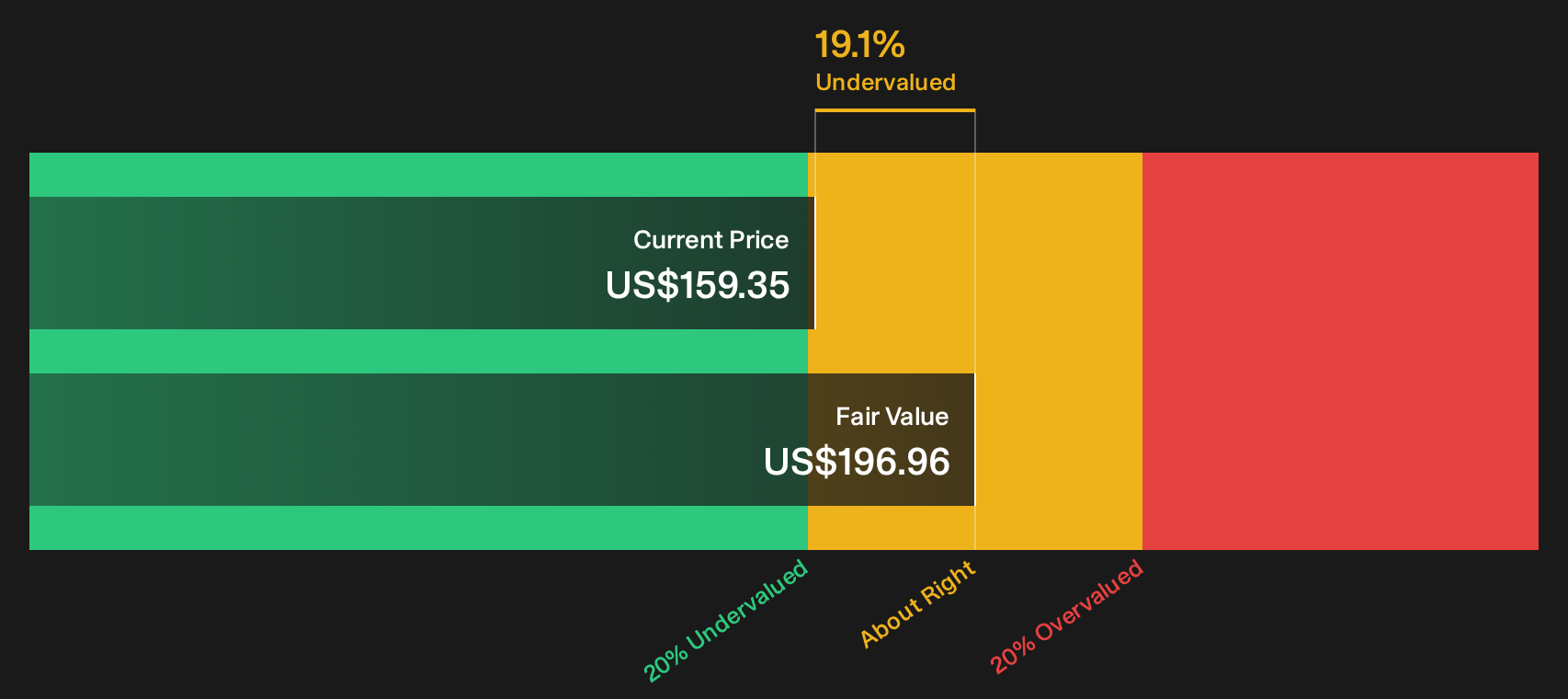
Simply Wall St performs a discounted cash flow (DCF) on every stock in the world every day (check out Procter & Gamble for example). We show the entire calculation in full. You can track the result in your watchlist or portfolio and be alerted when this changes, or use our stock screener to discover 33 high quality undervalued stocks. If you save a screener we even alert you when new companies match - so you never miss a potential opportunity.
Next Steps
Conflicting signals on Procter & Gamble valuation make this a live debate, so review the full risk and reward scorecard before you decide. Start by weighing the 4 key rewards and 2 important warning signs
Looking for more investment ideas beyond Procter & Gamble?
Do not stop with Procter & Gamble. Apply the same disciplined approach across other opportunities so your portfolio is not overly tied to a single story or sector.
- Target resilient opportunities backed by strong finances by scanning a curated list of solid balance sheet and fundamentals (25 results) that can help anchor your portfolio.
- Hunt for potential mispricings by reviewing a focused 33 high quality undervalued stocks that may surface ideas with quality fundamentals at compressed valuations.
- Strengthen your income stream by evaluating a hand picked 8 dividend fortresses that concentrates on companies offering higher yields with robust profiles.
This article by Simply Wall St is general in nature. We provide commentary based on historical data and analyst forecasts only using an unbiased methodology and our articles are not intended to be financial advice. It does not constitute a recommendation to buy or sell any stock, and does not take account of your objectives, or your financial situation. We aim to bring you long-term focused analysis driven by fundamental data. Note that our analysis may not factor in the latest price-sensitive company announcements or qualitative material. Simply Wall St has no position in any stocks mentioned.
Have feedback on this article? Concerned about the content? Get in touch with us directly. Alternatively, email editorial-team@simplywallst.com