


3 U.S. Utility Stocks Riding Nuclear Power And Data Center Demand
Nuclear power is quietly moving from legacy asset to front-page story as uprates, refurbishments and long-term tech power deals reshape who supplies reliable, carbon-free electricity in the U.S. That shift could rewire how investors think about utilities and nuclear-linked businesses, and missing the right exposure may mean missing a fresh source of potential returns. This article walks through three U.S. Nuclear Power Utilities screener stocks most exposed to the latest news and explains why they may merit a closer look now.
The stocks highlighted below are just a sample, and the full screen surfaced 8 more U.S. nuclear-linked utilities with equally compelling stories that are not covered in this article. To identify and analyze the highest-conviction ideas first, head straight into the U.S. Nuclear Power Utilities screener.
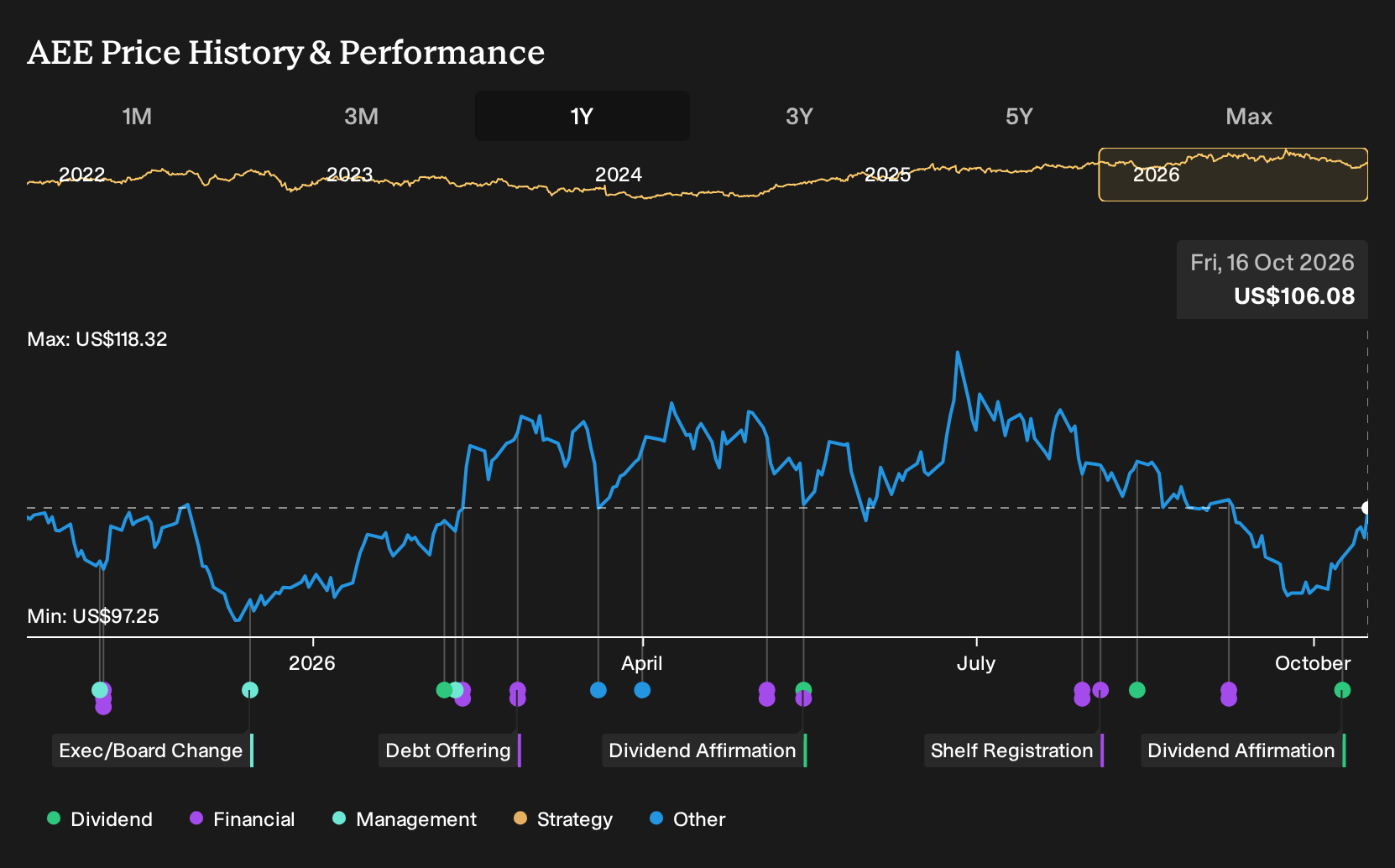
Ameren (AEE)
Ameren is a regulated utility that matters for this nuclear-focused screen because its mix of coal, gas, renewables and an operating nuclear plant ties future grid planning directly to long-lived, carbon-free baseload capacity.
Ameren Corporation runs a regulated power and gas network across Missouri and Illinois, with Ameren Missouri generating about US$4.6b of revenue and Ameren Illinois Electric Distribution and Natural Gas adding roughly US$2.5b and US$1.0b respectively. This supports a business valued around US$29.4b in market cap.
"Rapid growth in large data center and hyperscaler demand in Ameren Missouri's territory, reflected in 2.8 gigawatts of signed electric service agreements, 3.4 gigawatts of construction agreements and a further 4 gigawatts of projects with completed interconnection studies, is expected to translate into higher electricity sales and a larger regulated revenue base as contracted load ramps through 2029 and beyond, supporting earnings."
What happens to that outlook if a single pressure point in its long-range build and funding plan shifts more than investors currently assume?
If that pressure point matters to you, read the full narrative for Ameren to see how Ameren's nuclear load, capex plan and funding options could be decoupling from consensus expectations.
Public Service Enterprise Group (PEG)
Public Service Enterprise Group brings the nuclear theme front and center for this screen, pairing a large regulated utility with an owned fleet of reactors that already supply carbon free baseload power. That mix makes what comes next especially important for long term demand and earnings visibility.
Public Service Enterprise Group runs electric and gas networks plus nuclear generation, with about US$10.1b of revenue from PSE&G and US$3.7b from PSEG Power & Other, all in the U.S., and an equity value near US$35.6b.
"Growing demand for electricity from large loads such as data centers and other economic development projects in the PJM region continues to reshuffle load forecasts, and Public Service Enterprise Group is pursuing bilateral arrangements through PJM’s Reliability Backstop Procurement process that could translate these inquiries into contracted generation and transmission revenue and a larger rate base over time."
The real swing factor is how one regulatory and contracting outcome shapes the gap between that potential and the earnings path investors are pricing in.
That swing factor is exactly what you need to pin down, and the full narrative for Public Service Enterprise Group shows how Public Service Enterprise Group’s earnings story could be quietly decoupling from expectations.

FirstEnergy (FE)
FirstEnergy links into the U.S. Nuclear Power Utilities theme through its mix of generation sources, including nuclear, and a heavy focus on the transmission and distribution networks that move baseload power to customers. The Integrated segment brings in about US$6.2b, Distribution US$7.6b and Stand-Alone Transmission roughly US$2.0b, all within the United States, supporting a business valued around US$26.7b.
FirstEnergy provides a different angle on the nuclear story, with a regulated grid and mixed-generation fleet that can participate in cleaner baseload trends even when the nuclear piece is less visible on the surface.
"Surging demand from data centers, AI, and high growth sectors remains a central theme for FirstEnergy, with forecasted data center load of roughly 25 GW by Q2 2026 and 6.4 GW already contracted. This supports further investment in transmission and distribution assets and can influence long term revenue and earnings."
What really shapes the payoff is how one crucial assumption about future grid investment recovery and customer affordability ultimately resolves.
That hinge point is where things get interesting, and the full narrative for FirstEnergy shows how FirstEnergy’s grid build, regulation and earnings risk could be quietly decoupling in investors’ favor.

Seeking Alternatives Before The Crowd?
New themes are emerging while older stories lose momentum, and the most attractive entries are often taken quickly. Review these fresh stock ideas that may be under the radar for now if you are looking to act early.
- Look for companies with strong cash generation that may still be overlooked by scanning a curated 33 high quality undervalued stocks before valuations potentially move higher.
- Explore opportunities linked to AI infrastructure demand by reviewing a hand picked group of 55 AI infrastructure stocks while some attention remains focused elsewhere.
- Identify potential income-oriented companies with steady payouts through a focused set of 8 dividend fortresses while those yields remain available.
This article by Simply Wall St is general in nature. We provide commentary based on historical data and analyst forecasts only using an unbiased methodology and our articles are not intended to be financial advice. It does not constitute a recommendation to buy or sell any stock, and does not take account of your objectives, or your financial situation. We aim to bring you long-term focused analysis driven by fundamental data. Note that our analysis may not factor in the latest price-sensitive company announcements or qualitative material. Simply Wall St has no position in any stocks mentioned.
Have feedback on this article? Concerned about the content? Get in touch with us directly. Alternatively, email editorial-team@simplywallst.com