


U.S. Copper Stockpiles Have Surged: Could the 2025 Price Collapse Repeat?
Copper's Rally Takes a Breather
Copper futures have rallied strongly over the past year, hit record highs, and settled into a sideways trading pattern over the last several months. December copper closed Friday, October 16, at approximately $6.57 per pound.
While the recent price action has been relatively quiet, something interesting has been happening behind the scenes. The United States has accumulated an enormous amount of copper, and the reason may surprise some traders.
Could this growing stockpile hurt copper prices? To answer that question, we need to look at what happened in 2025.
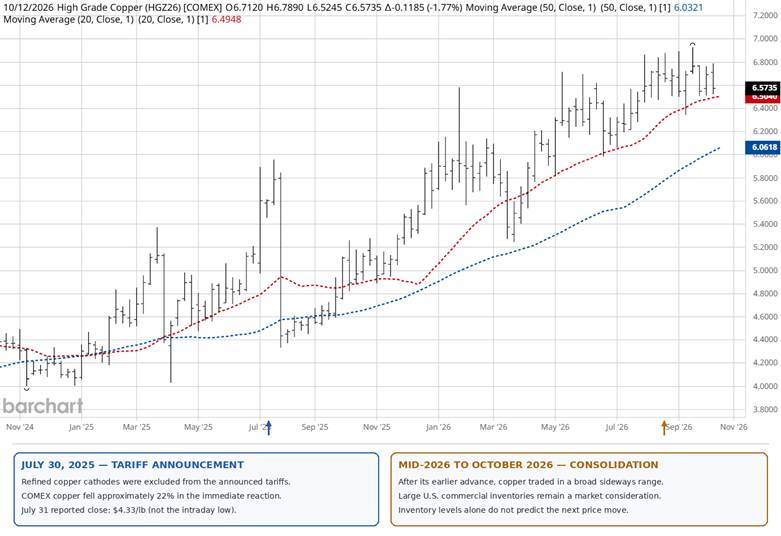
Chart Source: Barchart
Why Is So Much Copper Coming to America?
According to a Reuters report on October 14, U.S. copper inventories have grown to more than 1.6 million metric tons, including metal held in exchange warehouses and other commercial storage facilities.
Much of this copper arrived because traders anticipated U.S. import tariffs. With copper trading at a premium on the COMEX compared with international markets, importing metal into the United States became an attractive business opportunity.
This wasn't necessarily copper being purchased for immediate industrial use. Instead, traders were responding to price differences and potential changes in trade policy.
As a result, the United States has accumulated substantial copper inventories while supplies available in other parts of the world have become relatively tight. Much like crude oil, where Brent and West Texas Intermediate (WTI) prices can differ, copper prices on the COMEX and London Metal Exchange can also vary. Transportation costs, regional demand, and trade policies can create price differences that encourage traders to move supplies from one market to another.
How Does America Compare With China?
China is the world's largest copper consumer and has long accumulated strategic metal reserves.
However, China's government reserve holdings are not publicly disclosed, making a direct comparison difficult.
We can compare exchange inventories. On October 9, copper inventories monitored by the Shanghai Futures Exchange stood at approximately 58,744 metric tons. By mid-October, COMEX inventories in the United States exceeded 700,000 metric tons.
That's roughly 12 times as much copper in COMEX warehouses as in Shanghai exchange warehouses.
However, these figures don't include China's government reserves or all privately held copper. They illustrate how unusually large U.S. exchange inventories have become.
Remember What Happened in July 2025?
Last year, copper traders experienced a dramatic lesson in how quickly government policy can change market expectations.
During the first half of 2025, copper prices rallied as traders anticipated tariffs on imported copper. The expectation encouraged large shipments into the United States and pushed COMEX prices well above international prices.
Then, on July 30, President Trump announced a 50% tariff on certain copper products but unexpectedly excluded refined copper.
The reaction was immediate.
COMEX copper futures plunged, with prices falling about 22% as the market reacted to the announcement. The premium over London copper prices quickly disappeared.
It wasn't a sudden collapse in worldwide copper consumption. Traders were adjusting to an unexpected tariff policy change.
The weekly copper chart shown earlier illustrates that sharp decline and the recovery that followed.
Could History Repeat Itself?
Today's situation resembles 2025, but key differences remain.
The United States already holds substantial copper inventories, and traders still face uncertainty about possible additional tariffs in 2027 and 2028.
However, the current COMEX premium over international copper prices is much smaller than it was before the July 2025 collapse.
That distinction matters.
A large stockpile alone doesn't guarantee falling prices. Copper demand, mining disruptions, global inventories, and future tariff decisions will all influence what happens next.
For now, copper has been trading sideways after its earlier rally. Whether that consolidation leads to another advance or a deeper correction remains to be seen.
Assets to Trade the Copper Market
Traders interested in the copper market have several options through CME Group.
- Standard Copper Futures (HG): Each contract represents 25,000 pounds of copper, with a minimum price movement of $0.0005 per pound, equal to $12.50 per contract.
- Micro Copper Futures (QL on Barchart; MHG on CME): At 2,500 pounds, the Micro Copper contract is one-tenth the size of the standard contract. Each minimum price movement of $0.0005 per pound equals $1.25 per contract. The smaller contract size allows traders to manage their copper exposure in smaller increments.
- Options on Copper Futures: Copper options provide another way to participate in the market. Traders can use calls or puts to express a directional opinion or manage risk. Options strategies involve different risk levels depending on whether traders buy or sell contracts.
In Closing...
America's unusually large copper stockpile presents an interesting situation for futures traders. While large inventories might normally suggest a bearish outlook, much of this copper accumulated in response to trade policy rather than weakening industrial demand. The July 2025 price collapse reminds us how quickly those policies can change and how sharply prices can react. With copper trading sideways after a strong rally, traders may want to watch U.S. inventories, the price gap between COMEX and London copper, and upcoming tariff decisions. History doesn't always repeat itself, but it can still offer valuable lessons.
On the date of publication, Don Dawson did not have (either directly or indirectly) positions in any of the securities mentioned in this article. All information and data in this article is solely for informational purposes. For more information please view the Barchart Disclosure Policy here.