


How Investors Are Reacting To Enel (BIT:ENEL) Consumer Relief Push
- Enel has rolled out consumer relief measures, including €40 petrol vouchers, a 20% discount on electric vehicle charging with Q8 and an extended fixed-price electricity tariff, to help households and businesses manage higher fuel and power costs.
- The package ties Enel's retail offering more closely to everyday spending, which could influence customer retention, brand perception and long term demand for its broader energy services.
- We will look at how Enel's fixed price electricity extension shapes the investment narrative investors have been using to frame the company.
Scan for other utilities that are leaning into customer relief and energy transition by reviewing the curated 42 power grid technology and infrastructure stocks alongside Enel's latest consumer offers.
Enel Investment Narrative Recap
To own Enel, you need to be comfortable with a utility that leans heavily on regulated grids and large CapEx while carrying debt that is not well covered by operating cash flow. In the short term, the key swing factor is how effectively Enel executes its €53b investment plan without eroding returns or further stressing the balance sheet.
The main risk still sits in regulation and concessions, especially in Italy and Brazil, where changes could affect earnings or trigger impairments. The new consumer relief offers, including petrol vouchers and a fixed price tariff extension, appear incremental for the near term investment story rather than a material shift.
The recent extension of the fixed price electricity tariff is the most relevant move here. It tightens the link between Enel's retail arm and its integrated generation model, where most production already goes directly to end customers instead of trading, which is a small slice of EBITDA. That structure is intended to reduce exposure to commodity swings.
For catalysts, the focus remains on whether Enel can continue to grow regulated grid earnings, deliver on renewable and storage projects, and manage regulatory issues in Italy and São Paulo. The customer relief package fits into that picture as a consumer-facing execution detail, while the bigger questions still relate to regulation, leverage and CapEx returns.
Enel's Analyst Assumptions In Context
Analysts who cover Enel are effectively saying that the current retail relief package, including the fixed price electricity extension, sits on top of a much bigger earnings story. Their working model assumes that revenue grows at 3.4% a year over the next three years, with profit margins rising from 5.4% today to 8.9% by 2029. That combination matters for you because it links Enel's retail pricing and consumer offers back to the long range plan for regulated grids, renewables and the debt load behind them.
On earnings, the consensus view looks for profit to move from €4.3b today to €7.9b by 2029, with some analysts modelling as much as €9.0b. That implies an increase of about €3.6b in earnings against the current base, which is a big jump in absolute euro terms even before thinking about any share count reduction. The key question for anyone looking at Enel is whether the mix of regulated grid returns, renewable projects and retail initiatives such as fixed tariffs can support that sort of shift without putting extra strain on the balance sheet.
Valuation assumptions are equally important for understanding how the relief package fits into the bigger picture. To reach the current analyst targets, Enel would need to trade on a P/E of 15.9x on those 2029 earnings, compared with 20.3x today and against a GB Electric Utilities industry level of 18.7x. That means the scenario behind the petrol vouchers and tariff offers is not about a richer multiple but about Enel earning into a lower valuation multiple over time while still making the numbers work.
Capital allocation also plays into the narrative investors are using. Analysts build in a discount rate of 8.69% to bring future cash flows back to today and assume the number of shares outstanding declines by about 1.51% per year over the next three years. For you, that combination of buybacks, capex and regulated returns is what ties Enel's day to day customer offers to the longer term investment case.
Enel's narrative projects €88.0b revenue and €7.9b earnings by 2029. This requires 3.4% yearly revenue growth and about €3.6b earnings increase from €4.3b today.
Discover why Enel's fair value indicates a 12% potential upside to its current price that may not last much longer.
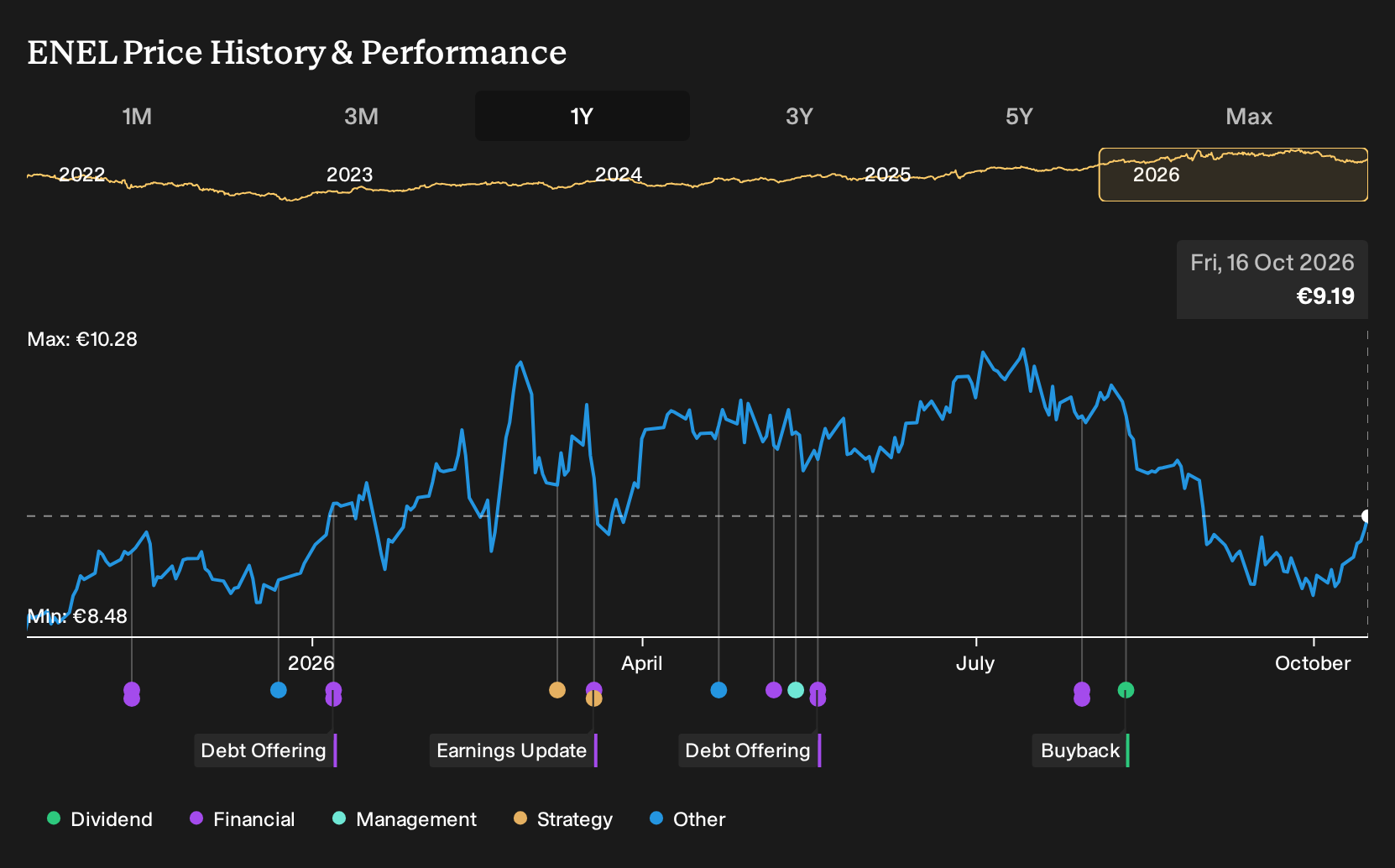
Exploring Other Perspectives
Two fair value estimates from the Simply Wall St Community span a wide band from €10.27 to €32.84, which already shows how far private investors can disagree on Enel. You also need to weigh that enthusiasm against unresolved regulatory risk in Italy and Brazil. Use these contrasting views to test your own thesis.
Explore another Enel fair value estimate, including one that suggests it could be worth just €10.27.
Decide For Yourself
Disagree with existing narratives? Extraordinary investment returns rarely come from following the herd, so go with your instincts.
- A great starting point for your Enel research is our analysis highlighting 2 key rewards and 3 important warning signs that could impact your investment decision.
- See our latest analysis for Enel. The report includes a comprehensive fundamental analysis summarized in a single visual, the Snowflake, making it easy to evaluate Enel's overall financial health at a glance.
Looking for more investment ideas beyond Enel?
Once you have a view on Enel, it often helps to compare it with other opportunities that share similar qualities or offer a different risk profile. The Simply Wall St Screener can surface a mix of resilient balance sheets, income options and potential mispricings so you can build a watchlist that fits your own style.
- For investors who care most about capital strength and staying power, start by scanning a list of solid balance sheet and fundamentals (204 results) that can handle tougher conditions without relying on aggressive financing.
- If you want income on top of potential price moves, look at a 216 dividend fortresses that focuses on higher yielding payouts backed by underlying fundamentals.
- To hunt for opportunities that the market may not be fully pricing, review a 614 high quality undiscovered gems that combine quality metrics with relatively low investor attention.
This article by Simply Wall St is general in nature. We provide commentary based on historical data and analyst forecasts only using an unbiased methodology and our articles are not intended to be financial advice. It does not constitute a recommendation to buy or sell any stock, and does not take account of your objectives, or your financial situation. We aim to bring you long-term focused analysis driven by fundamental data. Note that our analysis may not factor in the latest price-sensitive company announcements or qualitative material. Simply Wall St has no position in any stocks mentioned.
Have feedback on this article? Concerned about the content? Get in touch with us directly. Alternatively, email editorial-team@simplywallst.com