


Wayfair (W) Could Be 13% Undervalued After £4.8 Million UK Fine
Wayfair (W) is back in focus after the UK Competition and Markets Authority fined the online retailer £4.8 million for misleading flash sale promotions, putting its discount tactics and customer trust under closer investor scrutiny.
The regulatory hit lands after a strong run in Wayfair’s stock, with a 90-day share price return of 22.24% and a 1-year total shareholder return of 30.34%, even though the latest move saw the share price fall 4.15% to US$107.28. Recent headlines have ranged from this UK fine to a deeper Klarna partnership that widens flexible payment options across the Wayfair brands. This keeps both growth potential and customer sentiment in sharp focus for investors assessing whether momentum is building or fading.
Broaden your watchlist beyond Wayfair by scanning a hand-picked 33 high quality undervalued stocks that pair disciplined pricing power with stronger balance sheets and fewer regulatory headaches.
Wayfair now trades at US$107.28 with analysts clustered around US$122.69 and one valuation model implying a far steeper discount. Is that gap mispricing or a fair reflection of regulatory and earnings risk?
Most Popular Narrative: 13% Undervalued
Wayfair’s most followed narrative lines up a fair value of $123.34 against the last close at $107.28. This frames the stock as materially discounted while still wrestling with profitability and capital intensity.
Wayfair's proprietary logistics network, CastleGate, is expected to provide a meaningful growth unlock by improving efficiency and customer experience. This can positively impact revenue growth through higher conversion rates and potentially improved net margins.
The company's strategic decision to invest heavily in technology and logistics might not yield immediate returns and poses a risk if the expected efficiencies and competitive advantages take longer to materialize. This could affect earnings and free cash flow in the near term.
See why 15 investors see Wayfair as 13% undervalued.
Result: Fair Value of $123.34 (UNDERVALUED)
Still, the narrative can crack if heavy advertising and technology spending fail to lift earnings, or if weak housing demand keeps big ticket furniture purchases subdued.
Find out about the key risks to this Wayfair narrative.
Another View: What Multiples Say About Wayfair
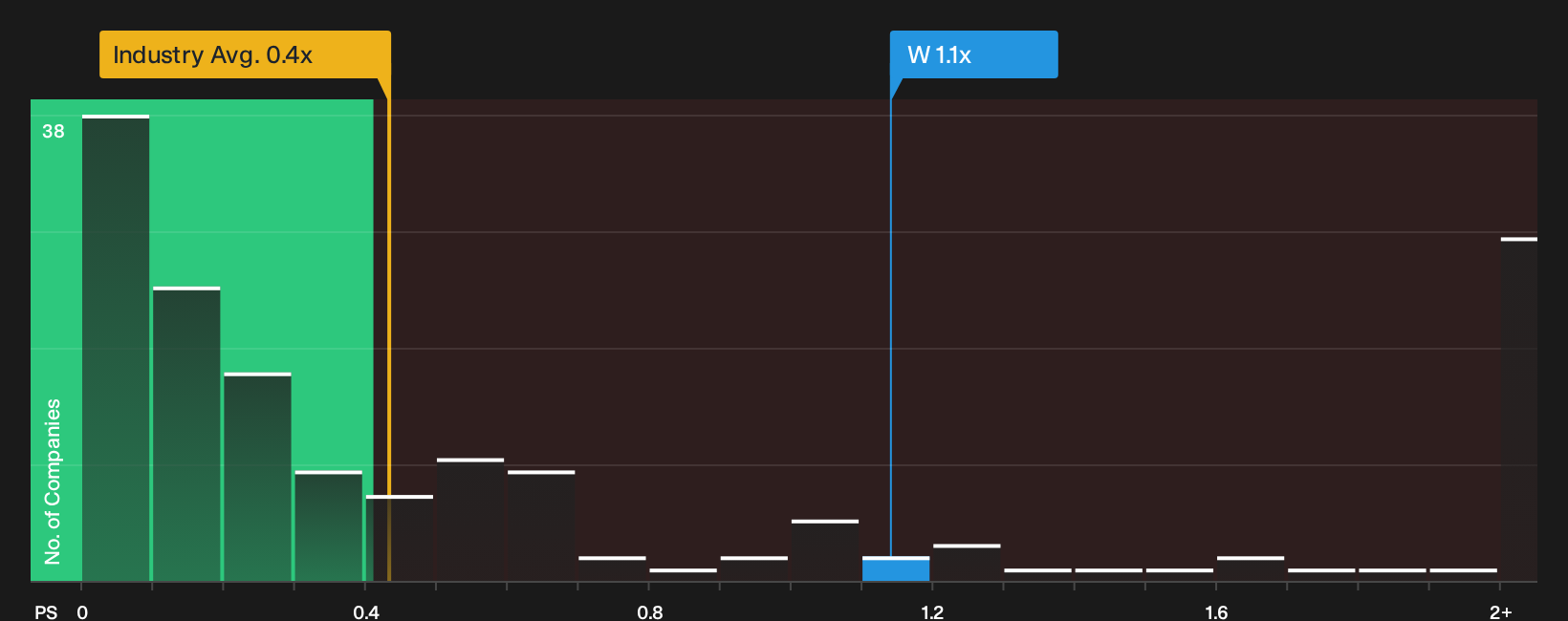
There is a very different message coming from Wayfair’s pricing on sales. The stock trades on a P/S ratio of 1.1x, while the US Specialty Retail industry averages 0.4x and the fair ratio is estimated at 0.8x. That points to a rich sales multiple even with a DCF narrative pointing to value. Which signal do you trust when growth is not especially fast and profits are still negative?
To pressure test that gap between price and fundamentals, it helps to step through a fuller breakdown of the valuation math and peer comparisons, then decide which assumptions feel realistic for you, not just for analysts. See what the numbers say about this price — find out in our valuation breakdown.
Next Steps
Mixed signals like these rarely stay unresolved for long. Pull up the numbers yourself, weigh the trade off between concerns and upside, and ground your view in the 2 key rewards and 3 important warning signs.
Looking for more investment ideas beyond Wayfair?
If you only stop at Wayfair, you risk missing other setups where price, quality and balance sheet strength line up in a cleaner way for your portfolio.
- Target durable compounding by reviewing a 8 dividend fortresses that may appeal if you want income to work alongside potential capital gains.
- Hunt for mispriced quality through a curated 20 high quality undiscovered gems that highlights businesses with solid fundamentals that many investors still overlook.
- Prioritise resilience by scanning a 32 resilient stocks with low risk scores that filters for companies with steadier risk profiles to anchor the more volatile parts of your holdings.
This article by Simply Wall St is general in nature. We provide commentary based on historical data and analyst forecasts only using an unbiased methodology and our articles are not intended to be financial advice. It does not constitute a recommendation to buy or sell any stock, and does not take account of your objectives, or your financial situation. We aim to bring you long-term focused analysis driven by fundamental data. Note that our analysis may not factor in the latest price-sensitive company announcements or qualitative material. Simply Wall St has no position in any stocks mentioned.
Have feedback on this article? Concerned about the content? Get in touch with us directly. Alternatively, email editorial-team@simplywallst.com