


Should Strong September Traffic Require Action From SIA Stock Investors?
- Singapore Airlines reported September 2026 operating figures that showed 3,508,600 passengers carried and 102.2 million kg of cargo and mail, with passenger and cargo load factors remaining in the mid 80% and high 50% range respectively, compared with the same month a year earlier.
- The mix of higher passenger and cargo volumes, alongside largely steady load factors, points to network demand that remains broad based rather than reliant on a single route or segment.
- We will now see how Singapore Airlines' investment narrative could be influenced by September's higher passenger volumes and cargo throughput.
Singapore Airlines Investment Narrative Recap
To own Singapore Airlines, you need to believe the group can keep filling a young, premium focused fleet while holding the line on unit economics. September’s traffic shows healthy passenger volumes and firmer cargo load factors, which supports that demand story, even though the passenger load factor stayed broadly unchanged.
The key short term swing factor is still how well Singapore Airlines manages yields and non fuel costs as capacity creeps higher. The main risk is that rising expenses and competitive pricing pressure squeeze margins further, especially with profit margins already lower than a year ago. September’s figures do not materially change that risk balance.
The September 2026 operating update is the clearest recent data point to focus on. Passenger traffic and revenue passenger kilometres moved higher year on year, while passenger load factor stayed near 87%. At the same time, cargo and mail carried, cargo tonne kilometres and the cargo load factor all improved, pointing to better aircraft utilisation.
For catalysts, this matters because the current equity story leans on disciplined capacity growth, premium investment and digital tools to offset yield and cost pressure. The risk side of that equation, including weaker margins and an unstable dividend record, is still present. Sustained traffic and cargo throughput give Singapore Airlines room to keep executing on that plan, but do not remove those execution challenges.
What The Consensus Implies For Singapore Airlines
Analysts sketch a picture of Singapore Airlines where modest top line expansion and slightly better margins do most of the heavy lifting rather than dramatic traffic gains. Revenue is assumed to rise by 3.7% a year over the next three years, with profit margins moving from 5.8% today to 6.6% by around 2029.
On earnings, the group is expected to lift net profit from SGD 1.2b today to SGD 1.5b by the 2029 forecast horizon. This gain of roughly SGD 300m would need to come through a mix of pricing discipline, cost control and fleet efficiency rather than sheer volume growth. Forecasts also bake in roughly 0.84% annual growth in the share count, so any improvement in earnings per share depends on that profit pool expanding fast enough to offset incremental dilution.
For these assumptions to line up with current analyst targets, the stock would need to trade on a P/E of 18.8x those 2029 earnings, compared with about 17.5x today and a similar multiple for the wider Singapore airlines peer group. That suggests investors are being asked to pay a slightly richer valuation for Singapore Airlines in exchange for its premium positioning, balance sheet strength and the potential benefits from a younger, fuel efficient fleet.
Singapore Airlines' narrative projects SGD 22.9b revenue and SGD 1.5b earnings by 2029. This requires 3.7% yearly revenue growth and an earnings increase of about SGD 300m from SGD 1.2b.
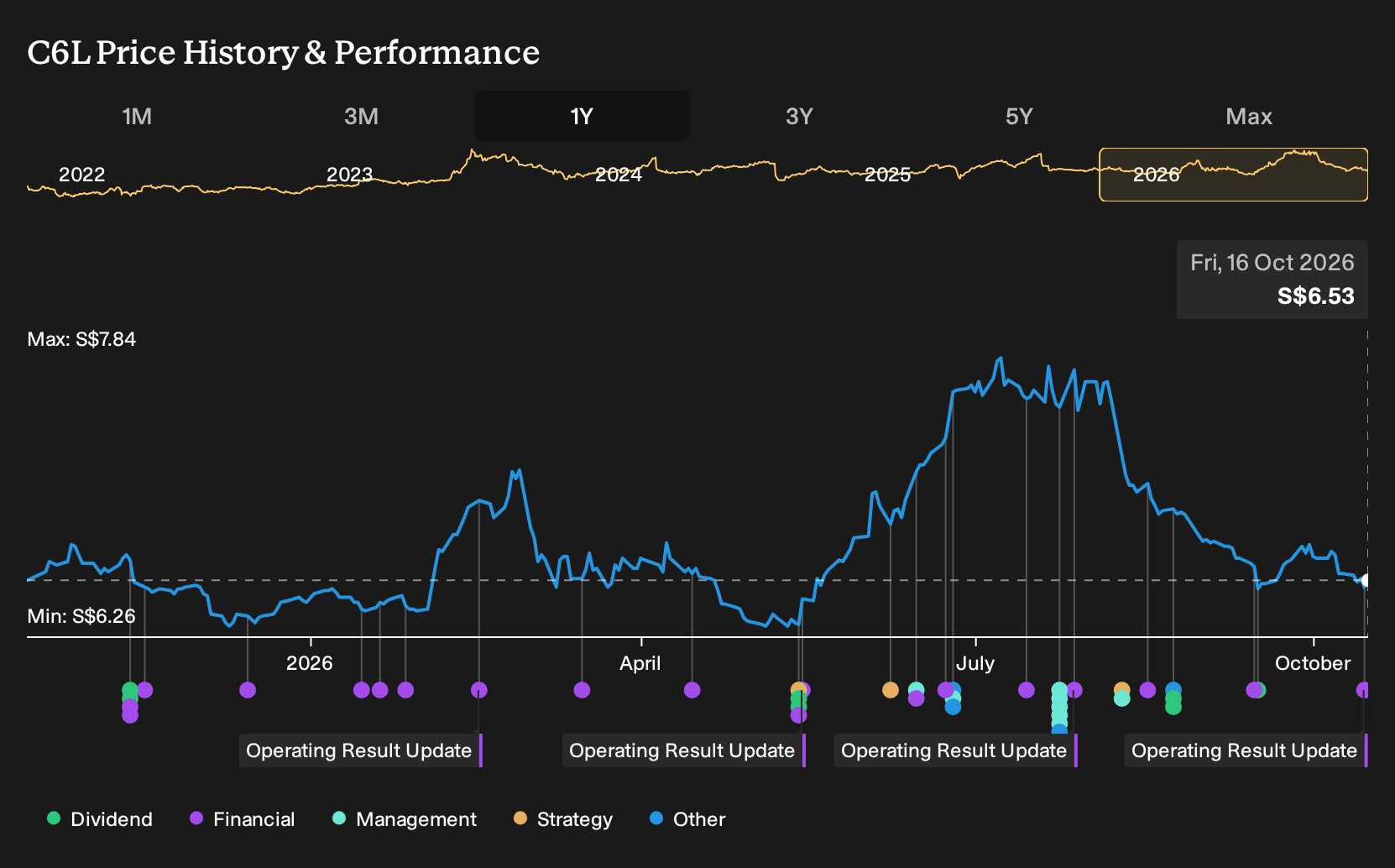
Analyst price targets cluster around SGD 7.02 per share, only 6.4% above the recent SGD 6.57 share price. This signals expectations that the stock is roughly fairly priced on these consensus inputs rather than primed for a sharp rerating. For you as an investor, the key question is whether the combination of mid single digit revenue growth, slightly higher margins and a firmer P/E multiple feels realistic given what the September traffic data says about demand and how you view the competitive and cost backdrop for the airline over the next few years.
Uncover why Singapore Airlines' fair value indicates an 8% potential upside to its current price that may not last much longer.
Exploring Other Perspectives
Six fair value estimates from the Simply Wall St Community span a wide gap, from about SGD 2.41 to SGD 7.02 per share, so some retail investors see Singapore Airlines as deeply mispriced while others cluster near current targets. Set that against rising non fuel costs and digital and fleet investments. You should expect opinions to differ and explore several of these viewpoints before assigning your own valuation anchor.
Explore 5 other Singapore Airlines fair value estimates, including one that suggests as much as 8% upside from the current price.
The Verdict Is Yours
Don't just follow the ticker. Dig into the data and build a conviction that's truly your own.
- A great starting point for your Singapore Airlines research is our analysis highlighting 1 key reward and 2 important warning signs that could impact your investment decision.
- See our latest analysis for Singapore Airlines. The report includes a comprehensive fundamental analysis summarized in a single visual, the Snowflake, making it easy to evaluate Singapore Airlines' overall financial health at a glance.
Looking For More Investment Ideas Beyond Singapore Airlines?
If Singapore Airlines helps frame what you want from an airline investment, use that same lens to scan the wider market. The Simply Wall St Screener lets you filter for the combination of quality, valuation and balance sheet strength that fits your own checklist rather than someone else's.
- For investors who want to focus on quality at a reasonable price, start with a curated set of 616 high quality undiscovered gems that pair solid fundamentals with relatively low visibility.
- If resilience matters most to you, concentrate on stability and defense by working through a 233 resilient stocks with low risk scores that scores well on balance sheet and risk metrics.
- Income focused investors can anchor their watchlist around 216 dividend fortresses and see which companies currently combine higher yields with durability.
This article by Simply Wall St is general in nature. We provide commentary based on historical data and analyst forecasts only using an unbiased methodology and our articles are not intended to be financial advice. It does not constitute a recommendation to buy or sell any stock, and does not take account of your objectives, or your financial situation. We aim to bring you long-term focused analysis driven by fundamental data. Note that our analysis may not factor in the latest price-sensitive company announcements or qualitative material. Simply Wall St has no position in any stocks mentioned.
Have feedback on this article? Concerned about the content? Get in touch with us directly. Alternatively, email editorial-team@simplywallst.com