


3 Financial Stocks Tied To The U.S. Treasury Market’s Growing Interest Cost Pressure
Soaring federal interest costs and a US$40b debt pile turning ever more expensive have pushed the Treasury market back into the spotlight, and with it the banks and brokers that help keep it running. This stress can punish some tickers yet open doors for others as volatility reshapes where capital flows. This article profiles 3 stocks exposed to that story and explains why their Treasury market role might matter for your portfolio.
The stocks profiled below are only a small sample of this Treasury plumbing theme. The full screen identified 16 more listed intermediaries with similarly detailed stories that are not covered here.
To go directly to the wider opportunity set, use the U.S. Treasury Market Intermediaries and Primary Dealers screener to identify, filter, and analyze the U.S. Treasury players that best fit your own risk and return checklist.
Jefferies Financial Group (JEF)
Jefferies Financial Group is a full-service investment bank and capital markets firm that helps underwrite, trade, and distribute U.S. Treasuries and other fixed income securities, directly tying it to this Treasury intermediary theme. It generated about US$7.8b from Investment Banking and Capital Markets and US$681m from Asset Management, and has a market value of roughly US$10.3b.
Jefferies provides focused exposure to the infrastructure of the Treasury market, with a large Investment Banking and Capital Markets arm that is closely linked to issuance and trading volumes in U.S. government debt. The appeal is that this fixed income engine can be positioned to participate in periods of heavy Treasury refinancing while one less-visible pressure quietly influences how much of that activity ultimately contributes to the bottom line.
To see how that pressure filters through Jefferies Financial Group’s actual earnings power, review the DCF valuation analysis for Jefferies Financial Group and judge whether the Treasury engine looks fully appreciated yet.
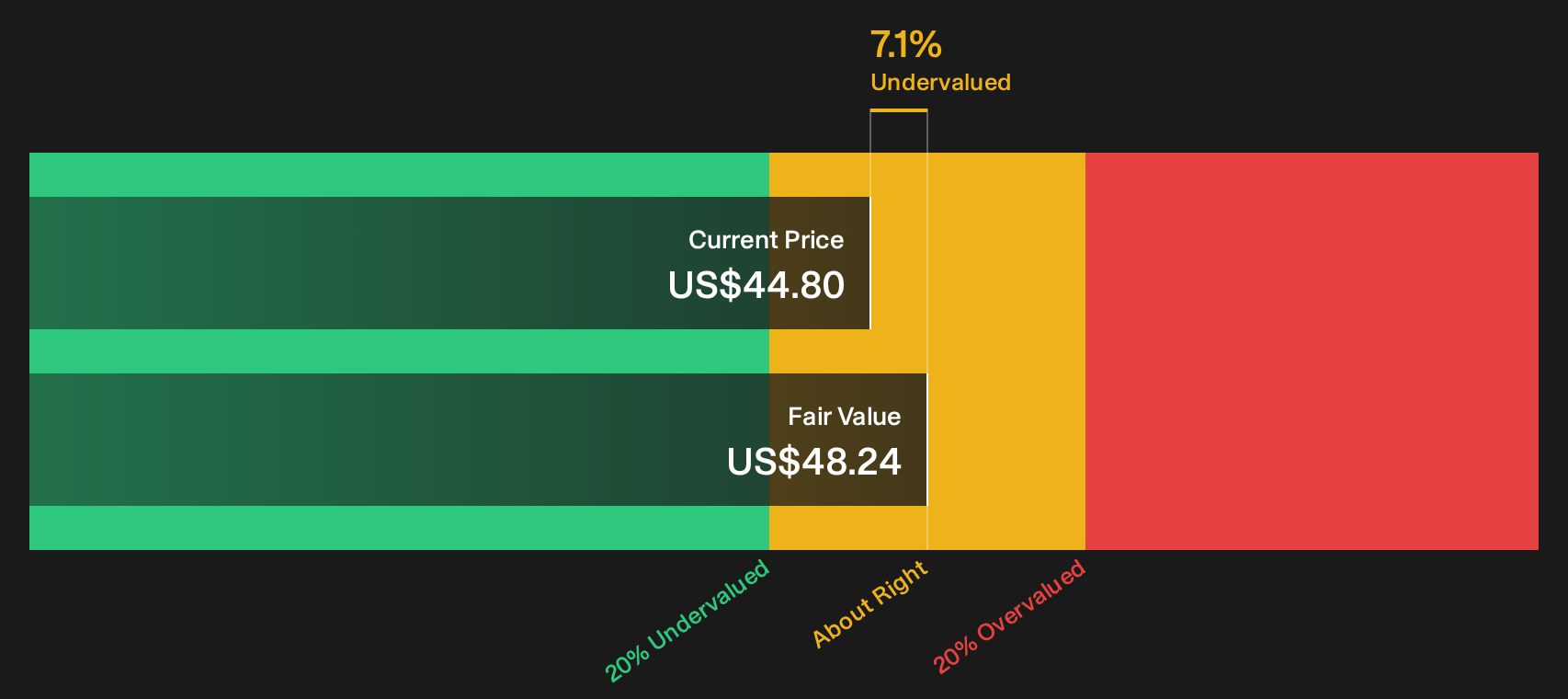
KeyCorp (KEY)
KeyCorp is a Cleveland based regional bank tied into the Treasury theme through its capital markets and government securities activities, yet most of its story still comes from plain vanilla banking relationships and fee income that rise and fall with deposit, lending, and client activity.
KeyCorp earns about US$3.6b from its Consumer Bank and US$3.9b from its Commercial Bank, with small negative adjustments in other lines, all within the United States, and it carries a market value near US$21.3b.
For investors watching how higher federal borrowing costs ripple through funding markets, KeyCorp offers a way to track that pressure through a traditional lender that also touches capital markets and fixed income flows.
"The anticipated shift from net interest income headwinds to tailwinds is now supported by over US$9b of low yielding fixed rate assets expected to reprice in the back half of 2026 and about US$30b through year end 2027. Management ties this to an outlook for net interest margin to move from 2.89% toward at least 3.25% and potentially lift revenue and earnings."
What happens if one unseen pressure on those repricing assumptions bends margins in the opposite direction will matter a lot for KeyCorp holders.
That hinge point is exactly where the interest rate story gets interesting for KeyCorp, so read the full narrative for KeyCorp to see how repricing could accelerate or stall.

Piper Sandler Companies (PIPR)
Piper Sandler Companies is an investment bank and institutional securities firm closely tied to Treasury and broader fixed income trading, generating about US$2.1b from brokerage activities in the U.S., with the stock valued around US$4.3b.
Piper Sandler Companies sits squarely in the Treasury intermediation story, since its institutional brokerage and advisory work operates where volatile government bond markets, balance sheet repositioning, and bank deal flow all intersect.
"Rising consolidation among US banks and related balance sheet restructurings are creating more complex M&A and fixed income assignments. This can support advisory and trading revenues as Piper Sandler advises on both bank deals and associated balance sheet repositioning."
What happens if one unseen pressure on that restructuring and trading pipeline shifts client appetite for complex fixed income work could matter a lot for margins.
If that pressure point on client demand has your attention, read the full narrative for Piper Sandler Companies to see how Piper Sandler Companies could turn volatility into accelerating fee power.

Seeking Alternatives Before The Crowd?
Fresh ideas move first. Breakout trends, new momentum, and dropping mispricings usually get caught early while they still fly under the radar for now.
- Spot potential breakout income plays by scanning the 8 dividend fortresses that could keep paying investors while others chase short term stories.
- Track fast moving sector shifts with the 41 power grid technology and infrastructure stocks and see which infrastructure operators might benefit if energy systems keep evolving quickly.
- Target earlier stage upside potential through the curated 14 elite penny stocks with strong financials that screens for stronger balance sheets instead of pure speculation.
This article by Simply Wall St is general in nature. We provide commentary based on historical data and analyst forecasts only using an unbiased methodology and our articles are not intended to be financial advice. It does not constitute a recommendation to buy or sell any stock, and does not take account of your objectives, or your financial situation. We aim to bring you long-term focused analysis driven by fundamental data. Note that our analysis may not factor in the latest price-sensitive company announcements or qualitative material. Simply Wall St has no position in any stocks mentioned.
Have feedback on this article? Concerned about the content? Get in touch with us directly. Alternatively, email editorial-team@simplywallst.com