


Learn Why The Bull Case For UDR Stock Could Change Following CIO Appointment
- UDR, Inc. reported that Scott McCallum, a former Blackstone real estate executive with multifamily expertise, will join as Executive Vice President and Chief Investment Officer on November 5, 2026, reporting to CEO Tom Toomey.
- The hire ends a year long CIO vacancy and brings in a leader with experience sourcing and evaluating multifamily deals, which directly connects to UDR’s focus on data driven capital recycling and portfolio repositioning.
- The next section will examine how UDR’s investment narrative could evolve as Scott McCallum assumes the CIO role.
Scan how UDR’s leadership shake-up compares with other real estate opportunities by lining up its profile against a hand picked list of solid balance sheet and fundamentals (25 results).
UDR Investment Narrative Recap
To own UDR, you need to believe the apartment REIT can keep turning its Orion analytics, capital recycling and resident retention into steady cash generation, even as earnings are forecast to decline over the next three years. In the near term, the key swing factor is how effectively it redeploys roughly US$650 million of asset sale proceeds and manages Sunbelt softness without letting same store revenue stall.
The biggest risk still lies in operational pressure points. Persistent supply in key Sunbelt markets, legal and regulatory scrutiny around pricing tools, and interest costs that are not well covered by earnings all challenge the story. Scott McCallum’s arrival does not remove these issues, but it may help execution if capital deployment tightens.
The most relevant upcoming event is UDR’s third quarter 2026 earnings release on November 2 and the public webcast on November 3. That update provides a clear checkpoint on how management views leasing trends, Sunbelt pricing, legal costs and balance sheet flexibility heading into McCallum’s November 5 start date as CIO.
For catalysts, that call also matters because it is where investors can hear how UDR plans to combine its existing Orion analytics and capital recycling program with a CIO who has multifamily deal experience from Blackstone, which manages over US$1.3b in assets. Any detail on acquisition criteria, redevelopment priorities or share repurchases will feed directly into views on risk, execution and the timing of capital rotation.
How Scott McCallum Could Shift UDR’s Risk‑Reward Profile
UDR’s investment story already leans heavily on hard numbers. Analysts are modeling revenue growth of 1.0% a year, shrinking margins and a sizable earnings reset. Bringing Scott McCallum into the Chief Investment Officer seat places a real estate dealmaker into that existing framework rather than rewriting it overnight.
The forecasts are blunt. Earnings today are about US$517.3 million, and consensus points to US$183.2 million by 2029, which is a decline of roughly US$334 million. Revenue is projected at US$1.8 billion in that same 2029 window, built on modest 1.0% annual top line growth and profit margins that are expected to compress from 29.3% to 10.1%.
UDR's narrative projects US$1.8 billion revenue and US$183.2 million earnings by 2029. This lines up with a 1.0% yearly revenue growth rate and an earnings decline of about US$334 million from current earnings of US$517.3 million.
The wide gap between current and forecast profitability sets the bar for McCallum’s impact. The role is less about pursuing aggressive growth and more about trying to make each dollar of capital work harder inside a fairly flat revenue outlook. That is where his multifamily experience from Blackstone, which has historically focused on granular property level underwriting and disciplined exit strategies, could matter for UDR’s portfolio mix and timing.
Capital allocation sits at the center of this discussion. Analysts expect roughly US$650 million of asset sale proceeds to be recycled into share repurchases and future acquisitions, while the remaining US$380 million debt and preferred equity portfolio runs off toward zero after 2027. A CIO with a background in sourcing and vetting multifamily deals could influence how quickly that capital is put back to work and what kind of risk profile UDR accepts for new projects.
Think in terms of trade offs rather than fixes. Selling older properties at mid 5% cap rates and buying back shares at an implied mid 6% cap rate creates one kind of earnings outcome. Redirecting more of that pool into redevelopment or new communities in supply constrained submarkets could produce a different cash flow pattern. McCallum’s track record in multifamily transactions may shape which of those paths UDR leans into as the current plan unfolds.
Risk still comes from the same places. Sunbelt softness, legal scrutiny of pricing tools and a forecast P/E that would need to climb from 21.1x today to 80.8x on 2029 earnings leave little room for missteps if the analyst targets are to hold. A CIO with deeper transactional experience might help tighten underwriting standards on new investments or divestitures, but cannot change the legal backdrop in markets like San Diego, Boston or New York City.
The disagreement across analyst forecasts underlines why execution under new leadership matters for you as a shareholder. Consensus earnings sit at US$183.2 million by 2029, yet the more bearish estimates fall to US$83.5 million. That spread effectively measures how differently people think UDR will manage Sunbelt exposure, capital recycling and balance sheet strength once McCallum is in the chair and Orion analytics are integrated into every deal review.
For investors watching UDR, the CIO handover functions as a lens rather than a single event. As third quarter 2026 results and the November webcast arrive, the focus will land on how Tom Toomey frames McCallum’s remit and how quickly that shows up in concrete levers such as acquisition criteria, target cap rates, redevelopment hurdle returns and the split between buybacks and new projects. Those are the practical details that will determine whether today’s cautious earnings path and rich implied 2029 P/E still feel acceptable to hold in a portfolio.
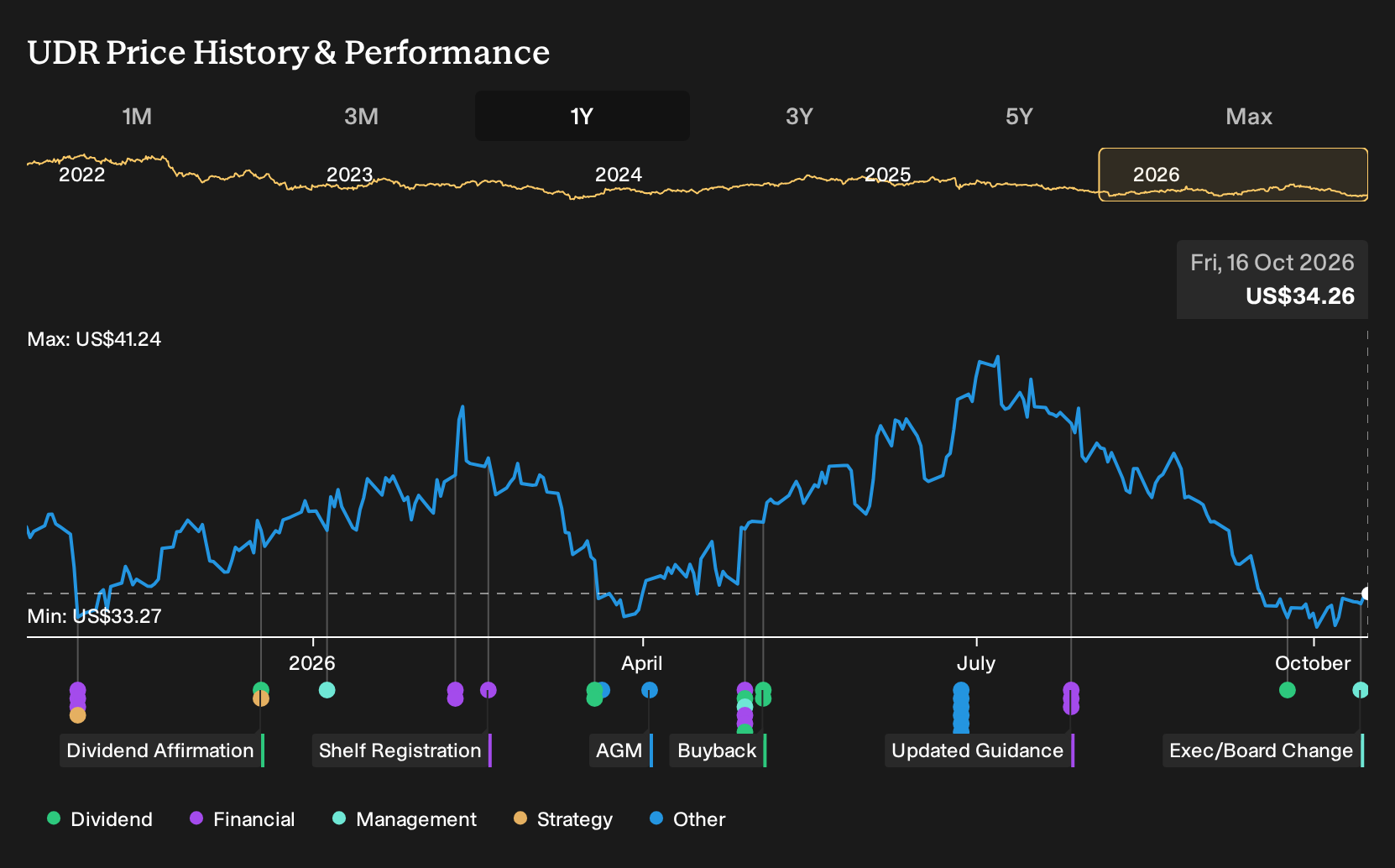
Uncover why UDR's fair value indicates an 18% potential upside to its current price that could narrow quickly.
Exploring Other Perspectives
The Simply Wall St Community only has two fair value estimates for UDR so far, ranging from about US$40.45 to US$55.91 per share. That wide band already shows how far opinions can spread. When you also consider Sunbelt supply risk, regulatory cases around pricing tools, and the upcoming November earnings call, there is even more room for diverging views. Use those contrasting perspectives as a prompt to explore multiple angles before deciding how UDR fits your portfolio.
Explore another UDR fair value estimate, including one that suggests it could be worth just $40.45.
Reach Your Own Conclusion
Disagree with existing narratives? Extraordinary investment returns rarely come from following the herd, so go with your instincts.
- A great starting point for your UDR research is our analysis highlighting 3 key rewards and 3 important warning signs that could impact your investment decision.
- See our latest analysis for UDR. The report includes a comprehensive fundamental analysis summarized in a single visual, the Snowflake, making it easy to evaluate UDR's overall financial health at a glance.
Looking for more UDR investment ideas?
If the UDR story has sharpened your view on risk, income and balance sheet strength, broaden your watchlist by lining it up against other opportunities using the Simply Wall St Screener.
- For investors who want potential upside with support from fundamentals, scan a curated 20 high quality undiscovered gems that might not yet be widely followed.
- If capital preservation matters most, compare UDR against a 32 resilient stocks with low risk scores that score well on resilience and financial risk metrics.
- Income focused readers can weigh UDR’s profile against a hand picked 8 dividend fortresses that combine higher yields with fundamental strength.
This article by Simply Wall St is general in nature. We provide commentary based on historical data and analyst forecasts only using an unbiased methodology and our articles are not intended to be financial advice. It does not constitute a recommendation to buy or sell any stock, and does not take account of your objectives, or your financial situation. We aim to bring you long-term focused analysis driven by fundamental data. Note that our analysis may not factor in the latest price-sensitive company announcements or qualitative material. Simply Wall St has no position in any stocks mentioned.
Have feedback on this article? Concerned about the content? Get in touch with us directly. Alternatively, email editorial-team@simplywallst.com