


Did Price Transparency Rules Just Shift CarMax (KMX) Stock Narrative?
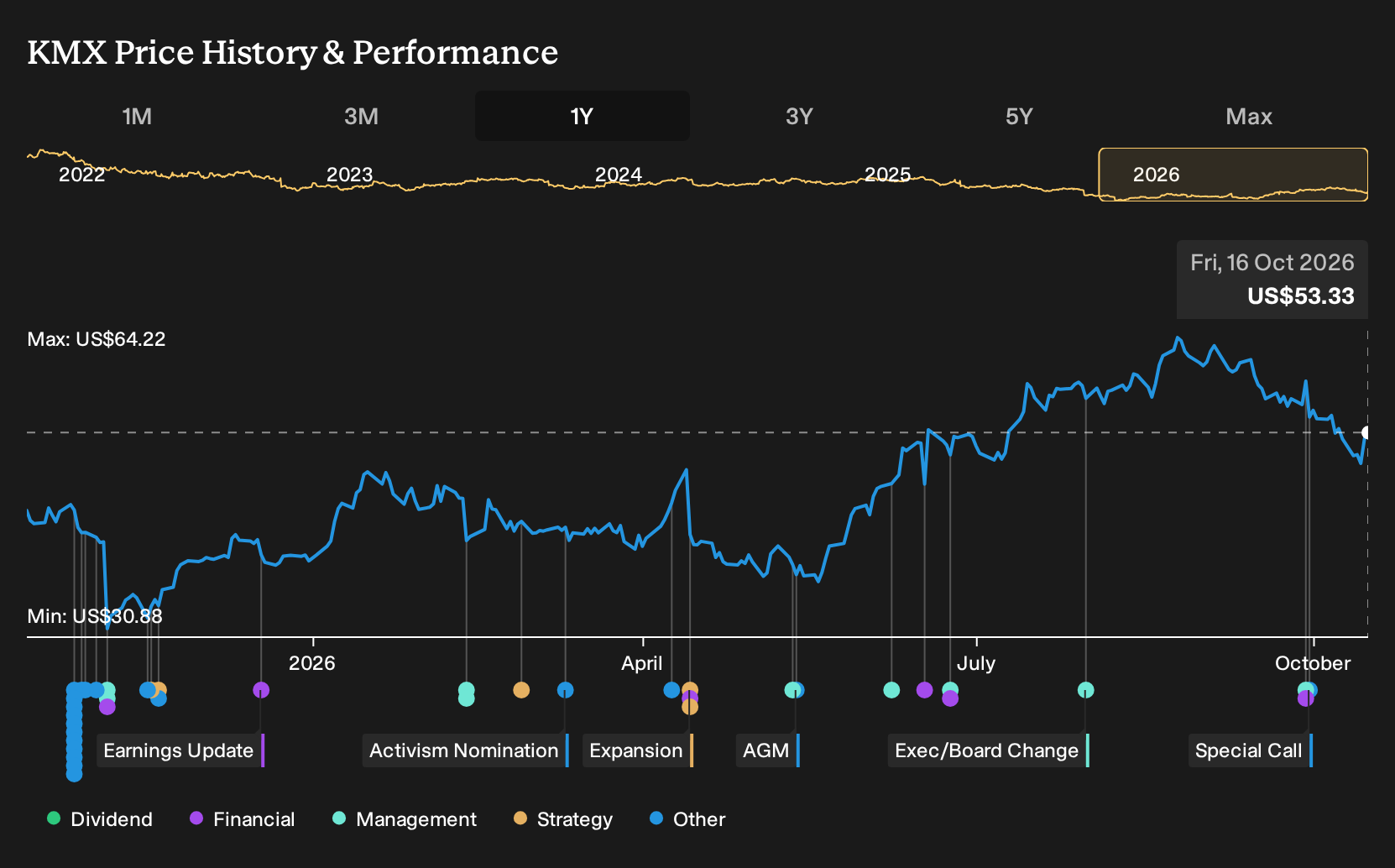
- CarMax has attracted renewed attention after earnings estimates were revised higher and recent quarters showed stronger revenue, profit performance and market share gains, supported by its Shift into GEAR cost and pricing program.
- The retailer’s sharpened price competitiveness following Federal Trade Commission price transparency rules, coupled with cost initiatives and digital execution efforts, is emerging as a key driver of its operating story beyond analyst upgrades.
- We will look at how CarMax's investment narrative intersects with its improved price competitiveness and cost program momentum described in the latest news.
Scan how CarMax's premium P/E and price transparency story compares with other retailers by reviewing our hand picked 33 high quality undervalued stocks, which combine stronger balance sheets with disciplined cash flows.
CarMax Investment Narrative Recap
To own CarMax, you need to believe the business can turn stronger unit volumes, sharper upfront pricing and omnichannel execution into healthier per unit economics over time. The near term swing factor is whether the Shift into GEAR cost work and digital upgrades keep supporting revenue and profit performance without eroding customer experience or used vehicle gross profit per unit.
The main risk right now is that pressure on both retail and wholesale margins persists while CarMax leans further into full spectrum lending and carries debt that is not well covered by operating cash flow. The recent premium P/E and upbeat earnings narrative do not materially change that execution test.
The recent focus on Federal Trade Commission price transparency and CarMax being described as its most price competitive in years ties directly into that thesis. More vehicles showing as great deals on third party sites can support unit volumes, especially when combined with omnichannel sales and AI supported customer journeys that aim to improve conversion.
Those same developments raise the bar on execution. Sharper pricing backed by US$200m of targeted SG&A savings by FY27, expansion in Tier 2 lending and higher loss reserves all need to work together. If wholesale and retail GPUs or loan loss provisioning move the wrong way, the current premium valuation could be hard for investors to justify.
CarMax's current analyst narrative points to revenues of US$29.7b and earnings of US$811.7m by 2029, with earnings today at US$292.4m. This implies an earnings increase of about US$519m and a move in profit margins from 1.0% to 2.7%, even as revenue is assumed to remain fairly flat over the next three years.
Uncover why CarMax's fair value indicates a 17% potential upside to its current price that could narrow quickly.
Exploring Other Perspectives
One alternate view puts loan loss provisioning at the center of the CarMax story. Before this latest transparency driven news, the most cautious analysts were penciling in 2029 earnings of about US$502.6m on roughly US$28.8b of revenue. That is far below the consensus and shows how wide opinions run, so treat this update as a chance to reassess both paths.
Explore 5 other CarMax fair value estimates, including one that suggests as much as 58% downside from the current price!
The Verdict Is Yours
Don't just follow the ticker; dig into the data and build a conviction that's truly your own.
- A great starting point for your CarMax research is our analysis highlighting 1 key reward and 3 important warning signs that could impact your investment decision.
- See our latest analysis for CarMax. The report includes a comprehensive fundamental analysis summarized in a single visual, the Snowflake, making it easy to evaluate CarMax's overall financial health at a glance.
Looking for more ideas beyond CarMax?
Once you have a view on CarMax, it can help to widen the lens and compare it with other companies that have different balance sheets, income profiles and risk levels. The Simply Wall St Screener gives you a way to line up these opportunities quickly using the same consistent framework.
- If you want potential growth with tighter risk controls, start by scanning a group of more defensively positioned businesses through our 32 resilient stocks with low risk scores.
- For investors who care most about financial resilience, you can filter for companies with sturdy capital structures using the list of solid balance sheet and fundamentals (25 results).
- Those looking off the beaten path can cast a wider net across smaller, underfollowed opportunities by reviewing the 20 high quality undiscovered gems.
This article by Simply Wall St is general in nature. We provide commentary based on historical data and analyst forecasts only using an unbiased methodology and our articles are not intended to be financial advice. It does not constitute a recommendation to buy or sell any stock, and does not take account of your objectives, or your financial situation. We aim to bring you long-term focused analysis driven by fundamental data. Note that our analysis may not factor in the latest price-sensitive company announcements or qualitative material. Simply Wall St has no position in any stocks mentioned.
Have feedback on this article? Concerned about the content? Get in touch with us directly. Alternatively, email editorial-team@simplywallst.com