


Why Micron Is Betting $35 Billion on Its Own Stock
If you’re a Micron Technology (MU) shareholder, you’re already having a pretty good year. Micron is one of the best-performing stocks in all of the S&P 500 ($SPX) right now and is up over 200% year-to-date (YTD), as the company’s growing role in artificial intelligence is drawing more interest in the memory chipmaker.
And now investors have another reason to be excited—Micron's board of directors authorized a whopping $35.16 billion share repurchase program. The new authorization, approved Oct. 8, gives Micron the ability to buy back its stock beginning Dec. 9 and expands an existing program that had approximately $2.16 billion remaining.
That's a substantial commitment to shareholders, particularly for a company that's also spending heavily to increase its manufacturing capacity.
But there's more to the story than a massive stock buyback. Micron is becoming an increasingly important supplier of the memory and storage technology that makes AI possible. And that could give the company plenty of reasons to keep rewarding shareholders.
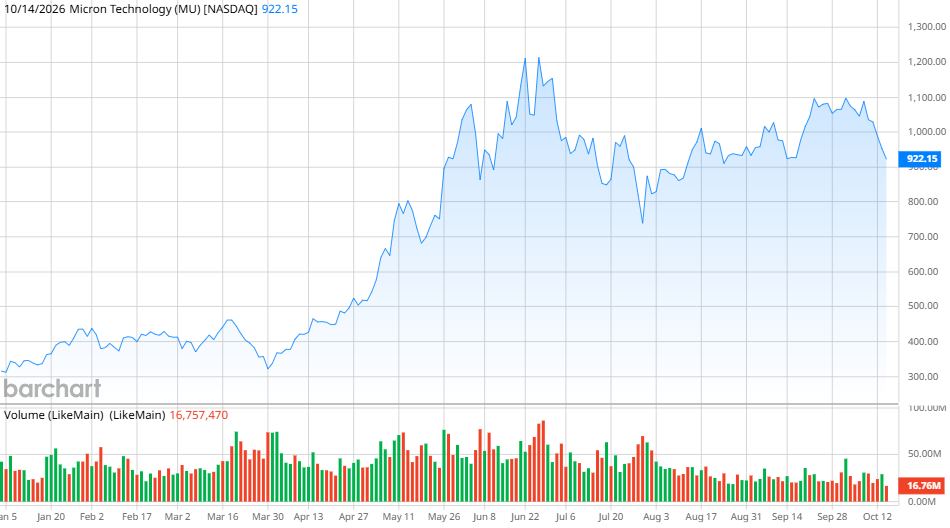
Why Micron's $35 Billion Buyback Matters
Share repurchases are great for investors. First, they reduce the number of available shares, which can increase earnings per share, since the company's profits are divided among fewer outstanding shares. A large authorization can signal that management believes the company will generate enough cash to fund its operations while returning money to shareholders.
Micron's authorization has no expiration date, and actual repurchases will depend on market conditions, the company's cash needs, and restrictions tied to its federal CHIPS Act funding agreements. But the fact that Micron’s board increased the authorization to this level sends a message about management's expectations for the business.
Micron Plays an Important Role in AI
Most discussions about artificial intelligence hardware begin with Nvidia (NVDA) and its graphics processing units (GPUs). But those powerful processors can't do their jobs without memory chips capable of supplying enormous amounts of data.
That's where Micron comes in. Micron, which is based in Boise, Idaho, makes both NAND and DRAM, or dynamic random-access memory. The difference is that DRAM temporarily stores information while computers process it, while NAND stores data for longer periods. Both are important for data centers, smartphones, computers, and a growing number of AI applications.
But the biggest opportunity may be high-bandwidth memory (HBM), a specialized form of DRAM designed to move information between memory and AI processors at extremely high speeds.
For instance, Micron's 36-gigabyte HBM4 product, designed for Nvidia's Vera Rubin platform, delivers more than 2.8 terabytes per second of bandwidth. Micron says that's more than twice the bandwidth of its previous-generation HBM3E product and also provides better power efficiency.
That's valuable for data center operators spending billions of dollars on AI equipment. Faster memory helps expensive processors spend less time waiting for information, while improved efficiency can help control electricity costs.
Micron's opportunity also extends beyond HBM. Its data center solid-state drives (SSDs) provide the storage capacity needed for increasingly demanding AI applications.
The top- and bottom-line results are astounding and help explain why MU stock is up more than 200% this year. Micron’s revenue for the fiscal fourth quarter (ending Sept. 3) was $54.23 billion in revenue, up from $11.32 billion a year ago. Net income was $37.7 billion, up from $3.2 billion a year ago, and diluted earnings came in at $32.87 versus $2.83 last year.
And the company isn't standing still. In June, Micron announced a strategic agreement with Anthropic to collaborate on memory and storage technology for future AI systems. That gives Micron a direct connection to the computing requirements of one of the companies developing advanced AI models. Micron also announced plans in July to increase its proposed U.S. manufacturing and technology investments to more than $250 billion through 2035.
Those projects won't produce additional chips overnight. But they demonstrate the scale of Micron's ambitions as demand for advanced memory continues to grow.
Is MU Stock Worth Buying?
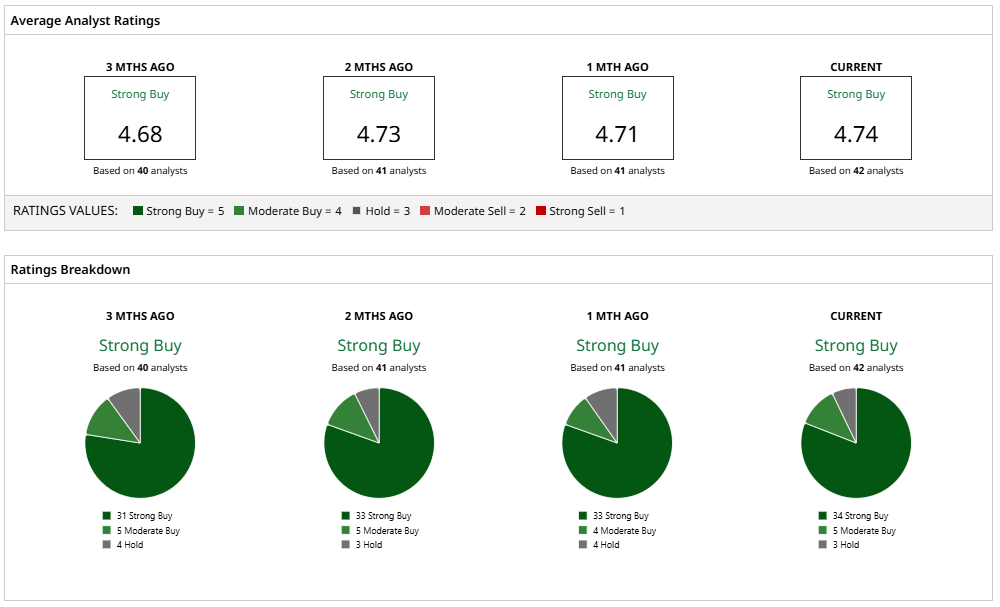
Micron is expecting strong growth to continue, posting first-quarter guidance of revenue between $60 billion and $63 billion, as well as gross margins of nearly 86%. Analysts remain bullish on MU stock, with 42 surveyed by Barchart issuing a consensus “Strong Buy” recommendation. The mean price target of $1,563.22 represents a potential upside of 69%.
Micron's new buyback authorization is encouraging, but the company's underlying business is what makes the announcement particularly interesting.
Memory manufacturing has historically been a cyclical business, and expanding production capacity carries considerable costs. Competition from Samsung Electronics (SMSN.L.IX) and SK Hynix (SKHY) isn't going away either.
Still, Micron has an attractive opportunity as AI systems require more memory, faster data transfers, and increasingly sophisticated storage technology. The $35.16 billion authorization gives Micron another way to reward shareholders if its business continues generating the cash needed to support those repurchases.
On the date of publication, Patrick Sanders had a position in: NVDA . All information and data in this article is solely for informational purposes. For more information please view the Barchart Disclosure Policy here.